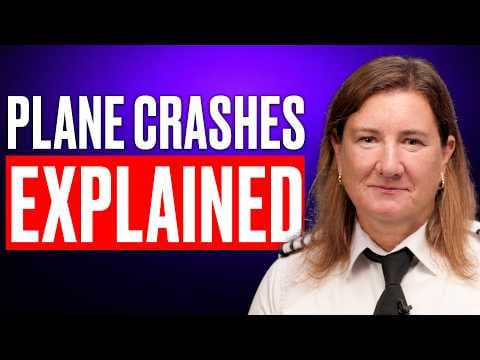
Airline pilot Emma Henderson answers a nervous flyer about crashes, turbulence, bird strikes, lightning, alcohol rules and simulator training.
What the video covers
Written in our own words. It only describes what the video shows and says.Why planes rarely crash
In this episode of Explainer for a Stranger from LADbible Stories, airline pilot Emma Henderson answers questions from a nervous flyer. She says she has more than 30 years of flying experience and starts by stressing that planes do not normally crash: an accident becomes big news precisely because it is rare. She names two broad causes, human error or human intervention and mechanical failure. On the first, she says the industry responded to a deliberate crash in 2015 with psychiatric assessments and flight deck measures so that nobody can be locked out of the cockpit. On the second, she compares flying with driving. Pilots do a full walk around before every flight, log oil levels on board and on the ground, and an engineer checks the aircraft every night. Later she adds that there are two pilots in the cockpit so that one catches the other's mistakes, and that pilots report their own small errors so trends are caught early.
Turbulence and how crews handle it
She explains turbulence as a change in lift over the wing. Causes include the wake of another aircraft, convective activity such as thunderstorms, wind over mountains and clear air turbulence linked to frontal activity. Crews get a weather brief at the start of the day, see heavy rain on the weather radar and hear reports from other aircraft via air traffic control. They can slow down to a turbulence speed, change altitude or ride it out, and in the worst case disconnect the autothrust and set a fixed thrust setting, which she says she has never had to do. Her advice to passengers is to keep the seatbelt fastened throughout the flight. She has 8,500 flying hours, mostly on the Airbus A320, and has never had an accident because of turbulence.
Takeoff, bird strikes, lightning and the rules
She calls takeoff the most demanding phase because the aircraft is heavy with fuel. The worst case trained in the simulator is an engine failure at decision speed, when the aircraft has to get airborne on one engine; pilots spend three days every six months in the simulator to reduce the startle effect. She describes a bird strike on takeoff from Corfu, after which the engine showed only a small mark on the nacelle, and a lightning strike as a new first officer approaching Amsterdam, when everything went dark for a few seconds before the systems came back. Phones have to be switched fully off during an autoland in fog, she says, because many phones searching for a signal could interfere with the radio signal the aircraft follows to the runway. Pilots may not drink within 10 hours of flying, are randomly tested for alcohol and drugs, and she puts the cost of becoming a pilot at a minimum of 120,000 pounds. Her only diversions were for medical emergencies, and she says around 100,000 flights take off and land safely around the world every day.