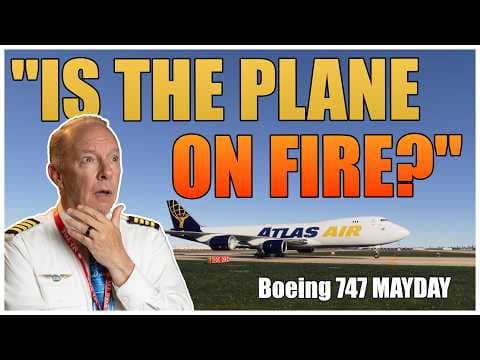
Atlas Air 747 cargo fire warning at Chicago O'Hare
Original title: "MAYDAY, MAYDAY!" Boeing 747 Reports Cargo Fire at O'Hare
Captain Steeeve · 18:49 · 10 Nov 2026 · Watch on YouTube

Captain Steeeve breaks down the ATC audio of an Atlas Air 747 that declared a mayday for an aft cargo fire indication on approach to Chicago O'Hare.

What the video covers

Written in our own words. It only describes what the video shows and says.

Cargo fire warning on the approach

Captain Steeeve plays and explains the ATC audio of Giant 8091, an Atlas Air Boeing 747 freighter arriving at Chicago O'Hare from Frankfurt on 1 October 2026 with five people on board. As the crew turns base to line up for the runway, they get an indication of a fire in the aft cargo compartment. He explains why the location matters: a fire above the main deck floor can be reached by a crew member with a fire extinguisher, while the lower cargo compartments under the floor cannot be reached in flight and have dedicated extinguishing bottles instead. The crew opens with mayday, mayday, mayday, states the problem and their intentions. According to Captain Steeeve, the mayday gets the fire trucks rolling and gives the aircraft priority, so the approach controller turns it straight in and clears it for the approach instead of sequencing it behind other traffic.

A short checklist and the landing

He describes the cargo fire checklist as only a few items long. On the aircraft he refers to, the crew lifts the guard and pushes the button that fires an extinguisher bottle into the affected compartment, filling it with foam. There are usually two bottles per compartment. Pushing the button starts a 30 second timer, and if the fire indication has not gone out after 30 seconds, the crew fires the second bottle. After that, the aircraft has to be on the ground because there are no more bottles for that compartment. He also notes that a freighter crew has no cabin crew or passengers to brief, so the priorities are to fly the aircraft and deal with the fire. When ATC asks again for the nature of the emergency, the crew confirms a cargo fire in the lower belly. After landing, the 747 turns off onto the parallel taxiway and stops on taxiway Echo short of Bravo, and the tower closes all runways so the rescue vehicles can drive straight to the aircraft.

FLIR inspection and a faulty sensor

The crew says it has no further indication, will send someone back to check the lower deck and asks the fire service for a visual and FLIR check of the back of the aircraft. Captain Steeeve explains that FLIR, forward looking infrared, detects heat signatures rather than a single temperature, works in the dark, sees through smoke and light haze and shows hot spots on a screen. Rescue 6510 takes command of the scene, the crew shuts down all four engines at the firefighters' request and the truck checks the rear of the aircraft. No hot spots are found and the crew checking inside sees no smoke and feels no heat on the floor. Captain Steeeve concludes it was most likely a faulty sensor, which still has to be handled as a real emergency, and he praises the crew, the controllers and the fire service for clear and deliberate radio communication.
Statements in the video

6:29There are usually two fire bottles for each cargo compartment, with a 30 second timer before the second one is fired.Captain Steeeve describes the cargo fire checklist.
10:25The crew asks the fire service for a visual check and a FLIR check of the back of the aircraft.Heard on the ground frequency after the 747 has stopped.
17:31There was nothing on fire, only a faulty sensor, but the crew still had to handle it as a real emergency.Captain Steeeve gives this as his conclusion after the FLIR check found no hot spots.

Moments from the video

0:00“This giant 747 has a cargo fire. That can be one of the scariest incidents on an airplane, especially if you're a cargo hauler. Let's listen in.”1:25“Okay, first thing out of his mouth, mayday, mayday, mayday. He says what the problem is. Next, he's going to come back with what his intentions are. Now, when you're this close to the airport and they're basically turning base leg, they're going to be…”6:29“Hit the button, and that is firing the extinguisher into that aft compartment. There's usually two fire bottles for each compartment. If the first one doesn't put it out, when you hit the button, it starts a 30-second timer. After 30 seconds, if the fire…”8:16“Giant 8091 Heavy, right when able, then turn left onto Echo, hold short Bravo. Left Echo, and we're going to hold on Echo. If you can, turn right at Tango Tango, then left onto Echo, once you get on Echo you can stop wherever you want. Right turn Tango…”10:25“So the 747 now is trying to determine whether they have a real fire. They're coming to a stop. The fire trucks are on their way out. He's going to make a request here in a minute, the aircraft. And Giant 8091, you guys up? 8091, O'Hare Ground, what can we…”10:55“A FLIR on the back. Okay, a FLIR on the back. What's a FLIR? A FLIR is a forward-looking infrared device. It's like a gun that the fire trucks have. And they can come out and it's different than just a temperature gun. So if you've got like, I don't know,…”17:31“So this is good news for them. There's nothing on fire in the back of their airplane. Just a bad sensor and that sensor goes off, but you still have to go through the checklist and you still have to handle it as though it were a real emergency. Most of the…”

Atlas Air 747 cargo fire warning at Chicago O'Hare

Original title: "MAYDAY, MAYDAY!" Boeing 747 Reports Cargo Fire at O'Hare
Captain Steeeve · 18:49 · 10 Nov 2026 · Watch on YouTube

Captain Steeeve breaks down the ATC audio of an Atlas Air 747 that declared a mayday for an aft cargo fire indication on approach to Chicago O'Hare.

IN THIS VIDEO
  1. 0:00Cargo fire indication on base leg
  2. 1:25Mayday and a direct approach
  3. 6:29Two fire bottles and a 30 second timer
  4. 8:16Stopping on the taxiway for the fire trucks
  5. 10:55What a FLIR camera shows
  6. 17:31A faulty sensor, handled as a real fire

What the video covers

Written in our own words. It only describes what the video shows and says.

Cargo fire warning on the approach

Captain Steeeve plays and explains the ATC audio of Giant 8091, an Atlas Air Boeing 747 freighter arriving at Chicago O'Hare from Frankfurt on 1 October 2026 with five people on board. As the crew turns base to line up for the runway, they get an indication of a fire in the aft cargo compartment. He explains why the location matters: a fire above the main deck floor can be reached by a crew member with a fire extinguisher, while the lower cargo compartments under the floor cannot be reached in flight and have dedicated extinguishing bottles instead. The crew opens with mayday, mayday, mayday, states the problem and their intentions. According to Captain Steeeve, the mayday gets the fire trucks rolling and gives the aircraft priority, so the approach controller turns it straight in and clears it for the approach instead of sequencing it behind other traffic.

A short checklist and the landing

He describes the cargo fire checklist as only a few items long. On the aircraft he refers to, the crew lifts the guard and pushes the button that fires an extinguisher bottle into the affected compartment, filling it with foam. There are usually two bottles per compartment. Pushing the button starts a 30 second timer, and if the fire indication has not gone out after 30 seconds, the crew fires the second bottle. After that, the aircraft has to be on the ground because there are no more bottles for that compartment. He also notes that a freighter crew has no cabin crew or passengers to brief, so the priorities are to fly the aircraft and deal with the fire. When ATC asks again for the nature of the emergency, the crew confirms a cargo fire in the lower belly. After landing, the 747 turns off onto the parallel taxiway and stops on taxiway Echo short of Bravo, and the tower closes all runways so the rescue vehicles can drive straight to the aircraft.

FLIR inspection and a faulty sensor

The crew says it has no further indication, will send someone back to check the lower deck and asks the fire service for a visual and FLIR check of the back of the aircraft. Captain Steeeve explains that FLIR, forward looking infrared, detects heat signatures rather than a single temperature, works in the dark, sees through smoke and light haze and shows hot spots on a screen. Rescue 6510 takes command of the scene, the crew shuts down all four engines at the firefighters' request and the truck checks the rear of the aircraft. No hot spots are found and the crew checking inside sees no smoke and feels no heat on the floor. Captain Steeeve concludes it was most likely a faulty sensor, which still has to be handled as a real emergency, and he praises the crew, the controllers and the fire service for clear and deliberate radio communication.
Statements in the video

6:29There are usually two fire bottles for each cargo compartment, with a 30 second timer before the second one is fired.Captain Steeeve describes the cargo fire checklist.
10:25The crew asks the fire service for a visual check and a FLIR check of the back of the aircraft.Heard on the ground frequency after the 747 has stopped.
17:31There was nothing on fire, only a faulty sensor, but the crew still had to handle it as a real emergency.Captain Steeeve gives this as his conclusion after the FLIR check found no hot spots.

Moments from the video

0:00“This giant 747 has a cargo fire. That can be one of the scariest incidents on an airplane, especially if you're a cargo hauler. Let's listen in.”1:25“Okay, first thing out of his mouth, mayday, mayday, mayday. He says what the problem is. Next, he's going to come back with what his intentions are. Now, when you're this close to the airport and they're basically turning base leg, they're going to be…”6:29“Hit the button, and that is firing the extinguisher into that aft compartment. There's usually two fire bottles for each compartment. If the first one doesn't put it out, when you hit the button, it starts a 30-second timer. After 30 seconds, if the fire…”8:16“Giant 8091 Heavy, right when able, then turn left onto Echo, hold short Bravo. Left Echo, and we're going to hold on Echo. If you can, turn right at Tango Tango, then left onto Echo, once you get on Echo you can stop wherever you want. Right turn Tango…”10:25“So the 747 now is trying to determine whether they have a real fire. They're coming to a stop. The fire trucks are on their way out. He's going to make a request here in a minute, the aircraft. And Giant 8091, you guys up? 8091, O'Hare Ground, what can we…”10:55“A FLIR on the back. Okay, a FLIR on the back. What's a FLIR? A FLIR is a forward-looking infrared device. It's like a gun that the fire trucks have. And they can come out and it's different than just a temperature gun. So if you've got like, I don't know,…”17:31“So this is good news for them. There's nothing on fire in the back of their airplane. Just a bad sensor and that sensor goes off, but you still have to go through the checklist and you still have to handle it as though it were a real emergency. Most of the…”
PREPARE FOR SELECTIONPreparing for an Airline Selection?
Academy · Alongside your ground school

Practise All 14 Subjects

ATPL theory (EASA) · a practice set per subject, then timed final exams
KNOWLEDGE BASEAsk the knowledge baseAnswers on training, selections and careers, with sourcesUP NEXT
0:31
Cessna 172 ends up inverted behind United jet at John WayneKTLA 5 · 0:31

More Like This

Atlas Air 747 cargo fire warning at Chicago O'Hare | PilotinQ