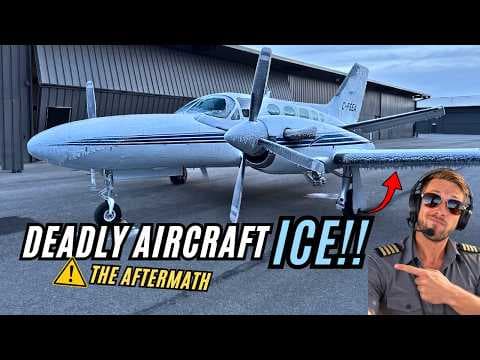
Evan Luft walks around a turboprop after an IFR approach through moderate icing. He shows where ice stayed on the aircraft after the de-icing boots had cycled.
What the video covers
Written in our own words. It only describes what the video shows and says.Evan Luft films this walkaround in the hangar right after landing. He says the approach took the aircraft down to IFR minimums and that the ice built up over the last 500 feet. He calls moderate icing a serious hazard for aircraft without proper de-icing boots and anti-icing equipment. The boots were cycled several times on the way down, so what he shows is the ice that was left afterwards. By his estimate the aircraft spent only a few minutes in those conditions.
Ice on the wingtip and leading edge
He starts at the wingtip, where he estimates about half an inch of ice on the light and on the leading edge. The ice has grown into small horns, which he finds remarkable given the airflow hitting that surface. On the booted part of the wing most of the ice is gone after about three cycles. A thin layer remains from the last clouds before landing because ice sticks better in some spots than in others.
Propeller, engine and windshield
Ice horns on the propeller spinner curve slightly with the rotation. The blades are heated in cycles. Luft warns that ice coming off them can strike the fuselage very loudly, which may surprise passengers. He had the inertial separators in use to keep ice from going directly into the compressor section of the engine. There is a little ice on the nose. He points out that ice on the windshield is a major problem when you need to see the runway, so this aircraft has a heating element inside the glass.
Tail, boots and approach speed
The pitot tubes and stall sensor are heated and stay clear. Luft says the walkaround is a good moment to confirm that the boots inflate properly because small holes or leaks can show up as ice left behind. Ice on a landing light can reduce its effectiveness at night. Much of the tail ice has already melted in the heated hangar, but he notes that a horn can form at the top of the tail where the boots do not reach. Ice that stays on the aircraft adds weight and above all drag. With a reference speed of 102 knots plus a small wind correction he aimed for about 105, then added 10 knots for the ice. That gave 112 to 115 knots over the threshold. He adds that he would not take ice like this into a short runway because of the extra speed he wants to carry.