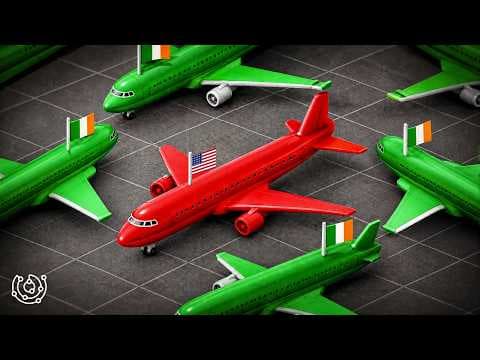
The video explains how Irish-based firms came to manage most leased commercial aircraft. It traces the rise from Shannon Airport to leasing companies.
What the video covers
Written in our own words. It only describes what the video shows and says.The video begins with a Boeing 787 flying towards Sydney that is owned by a company based in Ireland. It states that more than half of the world's commercial aircraft are rented rather than owned by the airlines flying them. It gives figures of roughly 14,700 leased aircraft, more than 9,500 managed by Irish-based firms, and around 69 per cent of leased aircraft value controlled by companies operating out of Ireland.
Shannon Airport and the jet age
The video traces the story to Shannon on Ireland's west coast. It explains that propeller aircraft in the 1930s and 1940s could not cross the Atlantic without refuelling, and Ireland was the last piece of Europe before about 2,000 miles of ocean. Through the 1950s, about half of all transatlantic aircraft refuelled there. The video says the jet engine changed that: by the late 1950s jets had ranges over 4,000 miles, and Shannon lost 80 per cent of its transatlantic refuelling traffic in 1955. It then describes Brendan O'Regan, the 1947 duty-free airport and the 1959 Shannon Free Zone, where companies paid no tax on export profits for 25 years.
GPA and the rise of aircraft leasing
The video introduces Tony Ryan, who joined Aer Lingus in 1955 and later worked in Cork, Chicago, New York and Dublin. It explains that Aer Lingus ordered two Boeing 747 aircraft in 1967 for delivery in 1971, but hijackings, the Troubles and the 1973 oil shock reduced demand. The video says Ryan persuaded Air Siam to rent one 747 in a wet lease with Aer Lingus pilots and mechanics, moved to Bangkok, and made a 3 million dollar profit in the first year. It says he proposed a company in January 1975 with Aer Lingus, Guinness Peat and himself, named Guinness Peat Aviation, or GPA. It describes six employees, one second-hand Boeing 737, an office in the Shannon Free Zone, and a 1977 shift to buying aircraft speculatively in bulk.
Irish advantages and competing pressures
The video says GPA's profit rose from 9 million dollars in 1983 to about 150 million dollars in 1989, and that GPA placed a 17 billion dollar order for 308 aircraft. It describes the collapse after GPA lost Shannon tax-free status in April 1990, the Gulf War, a failed 1992 share offering, and debts of roughly 6 billion dollars. It says GE Capital formed GE Capital Aviation Services in Shannon with 160 former GPA employees. It says former GPA people went on to lead AerCap, Avolon and SMBC Aviation Capital, and that Michael O'Leary began as Tony Ryan's personal assistant. It says AerCap bought GE Capital Aviation Services in 2021 in a deal worth over 30 billion dollars. It then lists Irish advantages: 12.5 per cent trading income tax, 25 per cent for asset owners, capital allowances over eight years, no withholding tax on lease rentals, Section 110, around 75 double taxation agreements, the Cape Town Convention, a 60-day repossession rule, five-day deregistration and the International Registry in Dublin. The video also names pressures from Singapore, Hong Kong, Chinese lessors, the global minimum tax, and the question of what Ireland gains from the sector.