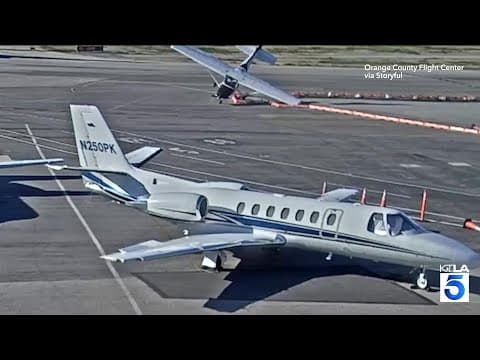
KTLA 5 shows flight school footage of a Cessna 172 slowly turning over behind a United Airlines jet at John Wayne Airport while the cause is investigated.
What the video covers
Written in our own words. It only describes what the video shows and says.Footage from the flight school
This short KTLA 5 news clip uses footage from the Orange County Flight Center, distributed via Storyful. It shows the moment a small aircraft slowly turns over at John Wayne Airport in Orange County, California. The overturn is visible in the upper part of the frame. KTLA describes the aircraft as a Cessna 172 and says it was taxiing behind a United Airlines plane when it was blown over on Saturday afternoon, 7 November 2026. The clip says the Cessna flipped on a runway. The airport has said the aircraft overturned on a general aviation ramp. It also said neither of the two people on board, an instructor and a student, was injured.
Jet blast or wind
KTLA frames the central question as whether jet blast from the larger aircraft caused the Cessna to end up on its roof. The report adds that federal officials had not yet confirmed the cause and that the investigation was ongoing. The FAA has said the Cessna was blown over while taxiing behind United Flight 2611, a Boeing 737 MAX 8 departing for Chicago. ADS-B data shows the Cessna almost directly in line behind the 737 as the jet started to move and turned onto the runway. The airport first pointed to high winds, but its weather station recorded a mean wind of 5 to 9 knots with gusts up to 15. The flight school has blamed jet blast and says construction work pushed the Cessna too close to the jet. Neither the airport nor the FAA has confirmed that account.
Jet blast behind a moving airliner
The clip does not explain how a light aircraft can be overturned behind an airliner. FAA guidance and Boeing planning data describe that hazard. The FAA Aeronautical Information Manual asks pilots to consider the effects of jet blast, prop wash and rotor wash during ground operations. The FAA also recommends that air carriers keep the rotating beacon on whenever an engine runs, because blast from large aircraft has overturned or damaged smaller aircraft taxiing behind them. That programme is voluntary, so a beacon alone is no proof that engines are running. Boeing publishes exhaust velocity contours for airport planning. For the 737 MAX 8 the 35 mph contour ends about 70 feet behind the aircraft at idle and about 75 feet at breakaway thrust on both engines, the power needed to start rolling. Breaking away on one engine pushes it to roughly 170 to 220 feet. At takeoff thrust it reaches about 1,100 feet. Boeing also notes that the contours behind a moving or turning aircraft differ from the static figures. Holding in trail directly behind a jet that is about to move or turn therefore carries the most exposure. Our news report on the overturn covers the ADS-B data, the wind readings and the responsibilities on the ground in more detail.