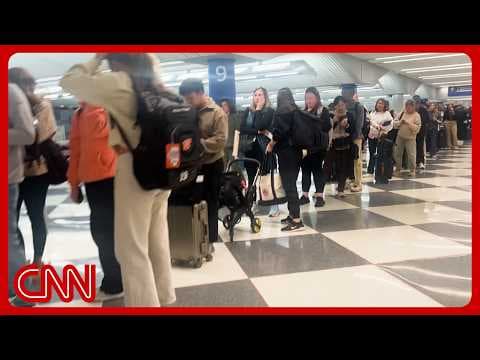
Coverage of a United States nationwide flight ground stop. Pete Muntean, Ian Petchenik, Nick Daniels and Richard Quest discuss the disruption.
What the video covers
Written in our own words. It only describes what the video shows and says.Nationwide ground stop and cancellations
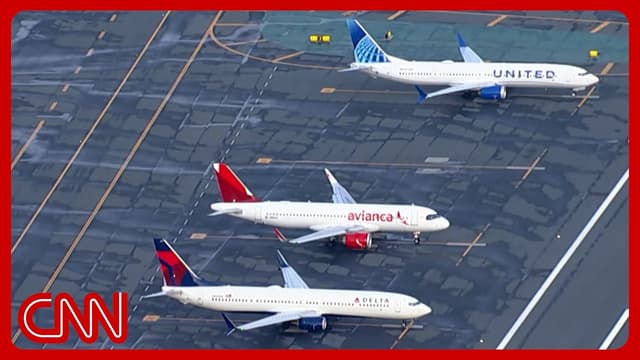
The video opens with a United States nationwide ground stop affecting every flight at every airport in the country. Airline sources say a problem with network routers began at Midway International Airport outside Chicago and spread nationwide, leading to a shutdown of the system. The anchor says more than 4,000 flights have already been cancelled. Pete Muntean reports that, according to airline analytics firm Cirium, the ground stop took hold around 4 p.m. Eastern Standard Time, with about 11,000 flights still scheduled to operate by U.S. airlines and about one and a half million passengers stranded. He says this will likely go down as the worst day for flight cancellations of the modern era, comparing it with the nationwide ground stops after 9-11 and on 11 January 2023, during the NOTAM system outage. He says Cirium counts about 800 flights diverted to other airports. Airlines tell him many airports are nearing ground saturation, with one airline source saying Austin may be emerging as the first airport to reach that condition. He says airports are running out of gates, tarmac space and taxiway space for aircraft parked on the ground for about five hours. He says the publicly facing FAA website has crashed, and that airlines say they may cancel all flights for the rest of the night to restart operations the next day.
Aircraft in the air and system shutdown
Ian Petchenik reports 377 aircraft in the air bound for U.S. airports, with a majority starting to move towards places that are still operating, such as Alaska and Hawaii. Pete Muntean says the understanding is that the problem started at Chicago Midway and then cascaded. Ian Petchenik says it is very early days in understanding exactly what happened, but the cascading failure affected the ability of air traffic control to operate the airspace in a manner they felt was safe enough, so they began to shut down. He says that affects aircraft that need somewhere to go, and raises the question of where to put those aircraft. He says the longer the problem lasts, the longer it will take to resolve the situation in full, because aircraft and crews are out of position and it will take longer for airlines to reset their systems once the FAA can reset its systems.
Controller operations and restart questions
Nick Daniels, president of the National Air Traffic Controllers Association, says controllers are doing extraordinary work and there is no playbook for this situation. He says controllers are trying to find out what frequency is operating properly and what radars they are worried about. He says when controllers have to worry about their tools and equipment being the fundamental issue, they spread aircraft out and start shutting the system down. He says frequencies are intermittent, and until there is stability in the system, overall capacity is reduced. He says CPDLC can send messages to aircraft, but only about 25 to 30 percent of the nation's aircraft are equipped with it. He gives examples from Minneapolis and Fort Worth, where controllers work in real time to find a nearby reliable frequency for aircraft. Richard Quest says people he has been texting with say they are not much closer to understanding what has gone wrong. He gives the example of a flight from Chicago to Haneda, saying it has to fly over half the country, while a flight from Los Angeles or San Francisco would already be on its way.