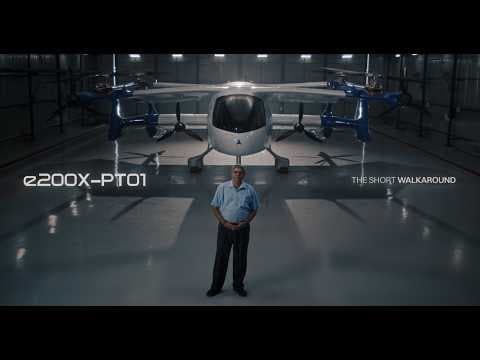
Prof. Satya Chakravarthy presents the e200X PT-01, the first full-scale prototype of The ePlane Company's compact electric air taxi, built in Chennai.
What the video covers
Written in our own words. It only describes what the video shows and says.A straight line instead of a traffic jam
Prof. Satya Chakravarthy opens the video with the idea behind The ePlane Company, the Chennai firm that grew out of the incubator of IIT Madras. Cities are designed around roads, he says, so congestion is treated as a fact of life, while growing cities expand outward and upward and mobility should follow. The trip from A to B should be a straight line rather than a traffic jam, and the company says it already has an answer. That answer is the e200X, an all electric, zero emission air taxi designed as one of the most compact eVTOL aircraft. What the camera shows is PT-01, the first full-scale prototype. According to the video, a later certification-compliant version will take off vertically like a helicopter and then cruise efficiently like an aeroplane. The footprint is described as half the size of a basketball court, small enough for rooftops, hospital access points and compact vertiports. The video description gives the numbers: 8 by 11 metres and a gross takeoff weight of 2.2 tonnes.
One airframe, three roles
The e200X is presented as a multimodal platform from the start. The same carbon fibre composite airframe can be built as an air ambulance, an air taxi or a cargo aircraft. The description lists the cabin layouts as one pilot and two passengers, a patient transport unit with a stretcher and a paramedic, or 200 kilograms of cargo. Batteries get the most attention: in electric aviation they are called the architecture rather than a component, because they define range, payload, economics and adoption. ePlane says it designed high energy density lithium ion systems for aviation demands and low frequency recharging. The powertrain is designed around reliability, to prevent thermal overheating and allow rapid turnaround charging, with layered redundancies, independent power paths and a fault tolerant architecture aimed at certification-grade standards.
Lift plus cruise and the road to here
The e200X uses a lift plus cruise layout: dedicated vertical rotors for takeoff and landing and separate forward propellers for cruise flight. The video quotes a speed of 160 kilometres per hour and a range of around 110 kilometres, which ePlane calls mid-mile urban air mobility. The company says it has already identified dozens of routes within and between cities where flying would save time and money compared with the road. Chakravarthy then tells how he was building one of the world's largest combustion research centres a few years ago and thought that if cars were going electric, aircraft would follow. He describes the path since then as iteration, invention, reinvention and learning, and closes from Chennai with the line that he will see viewers at the vertiport soon.