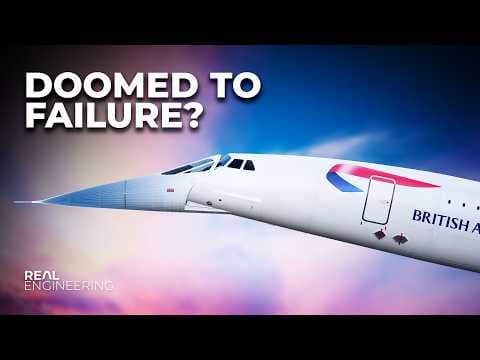
Real Engineering explains how Concorde's engines, wing and fuel system made Mach 2 possible, then follows the Air France 4590 investigation.
What the video covers
Written in our own words. It only describes what the video shows and says.Supersonic engines and intakes
Real Engineering opens with 1969 footage promising to cut London to New York from 7 hours 40 minutes to 3 hours 25 minutes. Narrator Brian McManus then turns to the Rolls-Royce Olympus 593, developed from the engine of the Avro Vulcan and raised from 49 kilonewtons of thrust to 169 kilonewtons. He explains that afterburners, called reheat by British engineers, inject fuel into the turbine exhaust to add thrust. Because Concorde operates across a wide speed range, it needed two controllable nozzles. The primary nozzle changes the jet exit area, while the secondary eyelid doors withstand large forces and can close on landing to act as reverse thrusters. Together they form a converging-diverging nozzle, which he links to the opposite behaviour of subsonic and supersonic airflow. The same principle applies at the square inlets, where ramps and doors slow the supersonic air before it reaches the compressors. At cruise this raises the pressure ratio from 14 to 1 to 80 to 1.
Airframe, heat and fuel management
The video moves to the ogival delta wing and the Droop Snoot. The compound wing joins its two sections with an ogee curve and uses vortex lift at low speeds, while the high angles of attack at those speeds make the Droop Snoot necessary. The nose can lower by 12.5 degrees, with positions for supersonic flight, heat shield visor, takeoff and taxi, and landing. An extendable tail landing gear protects the engines. The nose reached about 130 degrees Celsius at 60,000 feet, while ambient air was around minus 56 degrees Celsius. This heat caused the airframe to grow by 20 cm on each flight. A special aluminium alloy, Hiduminium RR58, was used, and expansion was accommodated by sliding panels, slack wiring and corrugated components. The fuel system had 13 tanks holding 119,000 litres. McManus explains that up to 20 tonnes of fuel was moved rearward approaching Mach 2 to shift the centre of gravity and match the rearward movement of the centre of pressure.
Air France 4590 investigation
The second half covers Air France 4590, which took off from runway 26R at Charles de Gaulle. McManus describes a loud bang two seconds after V1, loss of thrust in engines 2 and 1, and a crash into a hotel. Investigators organised the debris field, recovered the flight data recorder and cockpit voice recorder, and read surviving instruments. The runway showed a left tyre failure, a titanium strip with irregular drilled holes, and a piece of tank. The strip was traced to a Continental DC-10 that had left five minutes earlier, and maintenance documents showed the wear strip repair was not up to manufacturing standards. In a test with a wagon carrying a Concorde tyre and 25 tonnes of load, the strip cut the tyre the same way. McManus explains that a piece of rubber hit the wing underside, causing deformation and pressure waves that ruptured tank 5. The fuel leak was estimated at 60 kilograms per second. The video says a 2010 court ruling fined Continental 1 million euros. The court actually fined the airline 200,000 euros and awarded Air France about 1 million euros in damages. In November 2012 the Versailles appeals court overturned the criminal conviction, but it upheld Continental's civil liability and ordered the airline to pay Air France 1 million euros. The video then describes plans for Kevlar tank liners, reinforced ignition sources and new tyres. It closes on how high ticket prices and low demand made Concorde financially unviable, before Air France and British Airways ended their supersonic flying.