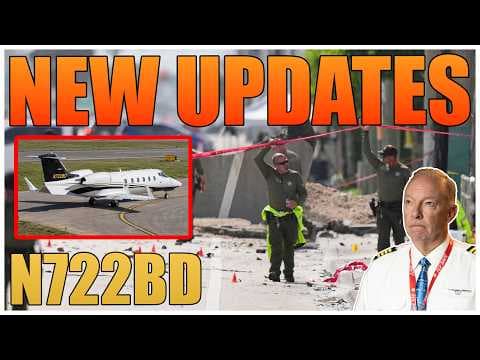
Captain Steeeve on the NTSB update about the Learjet 60 N722BD crash in Florida, its route through storms and severe turbulence six months earlier.
What the video covers
Written in our own words. It only describes what the video shows and says.Captain Steeeve returns to the Learjet 60 crash of 1 November near West Palm Beach, Florida, in which all nine people on board died. He goes through the update the NTSB published on Sunday 8 November and radio recordings from the flight and from an earlier event with the same aircraft. N722BD, built in 2004, flew under Part 135 charter rules, Steeeve says. It left Austin, Texas, at 09:37 on 1 November on its way to the Bahamas.
Storms on the way to Freeport
At flight level 410 across the Gulf the crew asked for direct Freeport, Steeeve says. He cites storm tops of 36,000 feet at 12:36 that had grown above 48,000 feet twenty minutes later, in an area of embedded thunderstorms he puts at about 100 miles. He says the FAA calls for at least 20 miles of separation from a thunderstorm and that storms like these grow too fast to outrun. In the recording the controller first allows deviations left or right, then clears the aircraft direct Freeport while warning that the turn looks pretty nasty, with areas of moderate to extreme precipitation. The crew accepts a descent to flight level 350, asks for further deviations and turns left to pass between two cells. When the flight is handed to the next controller, that controller cannot yet see it clearly on radar, Steeeve says.
The crew then reports moderate turbulence and icing they are managing, according to Steeeve. He calls icing and precipitation at that altitude extremely rare and explains how supercooled large droplets can move the centre of gravity and destroy lift. Near the end of the video he says it remains open whether icing played a part.
Severe turbulence in May
Steeeve also plays air traffic control audio from May, about six months before the crash, when the same aircraft went through turbulence near New Jersey. The crew first reported moderate turbulence and said they could not hold altitude. The controller replied that this was severe turbulence, after which the crew confirmed it. Steeeve says it lasted several minutes and that no injuries had been reported at that point. He stresses that it has not been confirmed that the same crew was flying. He also says it is not known whether the event was reported, written in the logbook or followed by an inspection. He expects the NTSB to check the logbooks.
The five points from the NTSB
According to Steeeve, the NTSB says the work outside the crater is largely complete while excavation of the crater continues. Recovered from the crater are portions of both wings, both engines, the flight deck, the vertical and horizontal stabilisers, flap and track assemblies and aileron sections. The wreckage goes to the NTSB laboratory in Washington, DC. The NTSB also asks the public to report anything that may be an aircraft part, with a photo if possible.
The left elevator was found in three pieces, 1.3 to 3.8 miles from the crash site. Steeeve concludes from that location that it came off during the steep dive because of the overspeed, not before it. The update says nothing about the right elevator, which he calls curious. He thinks it also came off and has not been found. The cockpit voice recorder is not on the list either. Steeeve says it is not known whether it worked. The NTSB has not determined a probable cause.