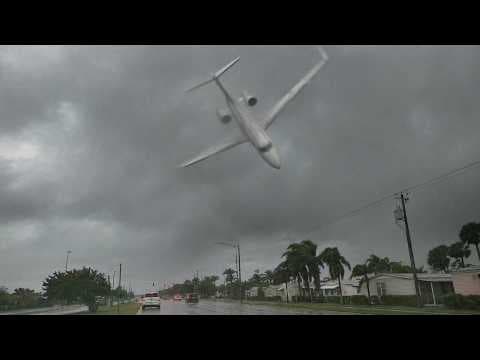
Fault Lines on the Learjet 60 crash in Florida: the radio calls, ice, overspeed, and what the NTSB will examine.
What the video covers
Written in our own words. It only describes what the video shows and says.On Sunday 1 November 2026, a Learjet 60 registered N722BD crashed at about 12:50 local time near Military Trail in Greenacres, Palm Beach County, Florida. It had left Austin-Bergstrom International Airport in Texas and was bound for North Eleuthera in the Bahamas. All nine people on board were killed. Fault Lines says their names have not been released and officials have not said how many were crew.
What has been confirmed
The jet came down on a road beside a mobile home community, leaving a burning crater and debris over a wide area. As of Sunday evening officials had not reported any deaths on the ground, and about 600 nearby residents needed shelter for the night. The NTSB is leading the investigation with support from the FAA, and the cause has not been determined. The video describes the Learjet 60 as a midsize business jet, a design from the early 1990s, with two rear-mounted Pratt & Whitney Canada PW305A turbofans of about 4,600 pounds of thrust each, certified to 51,000 feet, with a maximum operating speed at altitude of Mach 0.81.
The last minutes on the radio
Fault Lines takes this part from public air traffic control audio and flight tracking data, as reported by NBC News, CNN and others, and calls the details preliminary. The jet crossed the Florida peninsula at around 41,000 feet, then descended to 35,000 feet towards West Palm Beach. A flood watch was in effect, with showers and thunderstorms across southern Florida. The crew reported precipitation and light, clear ice that they described as manageable, reported moderate turbulence and asked to climb. They then declared a mayday, descending 10,000 feet per minute. According to CNN, they next reported an overspeed condition and a descent of 20,000 feet per minute. Tracking data shows the dive passing 30,000 feet per minute in a descending right turn, from cruise altitude to the ground in roughly one minute.
Ice, the coffin corner and the investigation
The second half explains the systems in general terms, and Fault Lines says this is not a finding about this flight. Supercooled droplets freeze on contact with a cold wing, and rough clear ice reduces lift, raises drag and can make the wing stall earlier. Many jets pipe engine bleed air along the wing leading edges and around the intakes, while pitot tubes and the windshield are heated electrically. According to CNN, the crew reported an outside temperature of minus 47 degrees Celsius. At such temperatures most moisture is ice crystals, which can block warm sensors, as happened to Air France Flight 447 in 2009. Whether anything similar happened here is not known. At 35,000 feet the air is about one third as dense as at sea level, so the slowest safe speed and the top speed move closer together, the gap pilots call the coffin corner. According to CNN, the crew reported turbulence that lifted the jet about 700 feet. Past the speed limit, Mach tuck can pitch the nose down, and a steep bank can tighten the descent into a spiral. Pilots are trained to reduce power, roll the wings level first, then ease out of the dive. The NTSB will review tracking data, recordings, weather, wreckage, any onboard recorders, maintenance history, pilot training and experience, and autopilot and anti-ice settings. The video says a preliminary report usually comes within about a month, and a final report with a probable cause typically takes one to two years.