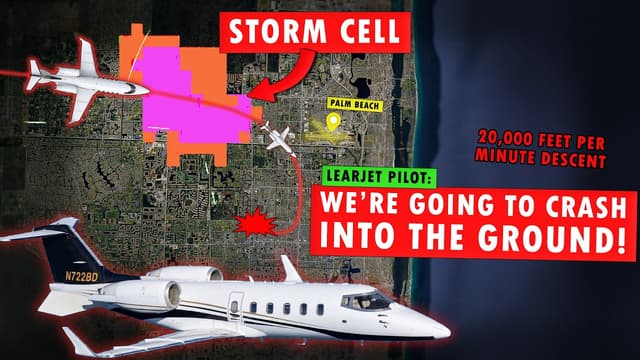
Captain Steeeve on the Learjet 60 crash in Palm Beach County: the radio calls, the thunderstorm and his view on severe icing.
What the video covers
Written in our own words. It only describes what the video shows and says.Captain Steeeve, an airline captain and former Naval aviator, looks at the crash of Learjet 60 N722BD on 1 November 2026 in Greenacres, Palm Beach County, Florida. The jet was flying from Austin, Texas, to the Bahamas. All nine people on board were killed. He opens with dash cam footage of the final seconds, which shows the aircraft at a bank angle of about 60 degrees. He plays only part of the radio exchange with air traffic control. Out of respect for the families he leaves out the last transmissions and describes them instead.
The radio calls at flight level 350
In the recording the co-pilot checks in with a new controller at flight level 350, reports moderate turbulence with altitude swings of plus or minus 700 feet and gives an outside air temperature of minus 47 degrees Celsius. She says the crew is managing the ice, asks for a better ride and then reports that they are picking up precipitation and need to climb to flight level 370. The controller clears the climb. Shortly afterwards she declares a mayday and reports descent rates of 10,000, then 20,000 and 22,000 feet per minute in a 60 degree bank.
Captain Steeeve points out that the radar picture in the video shows the jet heading into the yellow and red core of a thunderstorm, with tops reported above 40,000 feet. In his view, an aircraft that only holds altitude within 700 feet is in severe rather than moderate turbulence. Precipitation at 35,000 feet on top of known ice should have set alarm bells ringing, he says. Minus 47 degrees is normal at that level, he says, which makes rain or icing there very rare.
Weather, pilots and plane
He expects the NTSB to look at three factors together. The weather comes first: every instrument rated pilot learns to stay 20 miles or more away from a thunderstorm and never to try to fly over it or outrun it. Then the pilots, from currency, fatigue and medical issues to the question of why they flew into the storm. Finally the aircraft, including maintenance, the weather radar, the engines and whether it came apart in flight. According to Captain Steeeve this airframe had a cockpit voice recorder but no flight data recorder, which may limit what investigators can reconstruct.
Icing and the loss of lift
He explains the four FAA icing categories: trace, light, moderate and severe. With trace icing you see the first flecks on the windshield wiper, light icing needs occasional use of the ice protection, moderate icing builds constantly and is a reason to leave the area. With severe icing the build-up outpaces the de-icing and anti-icing systems. He also explains the difference between anti-icing, which keeps ice from forming. De-icing on the other hand removes ice once a layer has built up.
Captain Steeeve believes this crew met severe icing with supercooled large droplets. Those droplets do not freeze on the leading edge but run back along the wing and form a ridge that disrupts the airflow, so the wing loses lift. He thinks one wing, probably the right one, stalled first, after which the jet rolled onto its side and entered a descent it could not recover from. Tracking data showed a descent of about 32,000 feet per minute before impact. At its briefing on 2 November the NTSB said there are signs the jet began to break up before it hit the ground. The cause has not been determined.