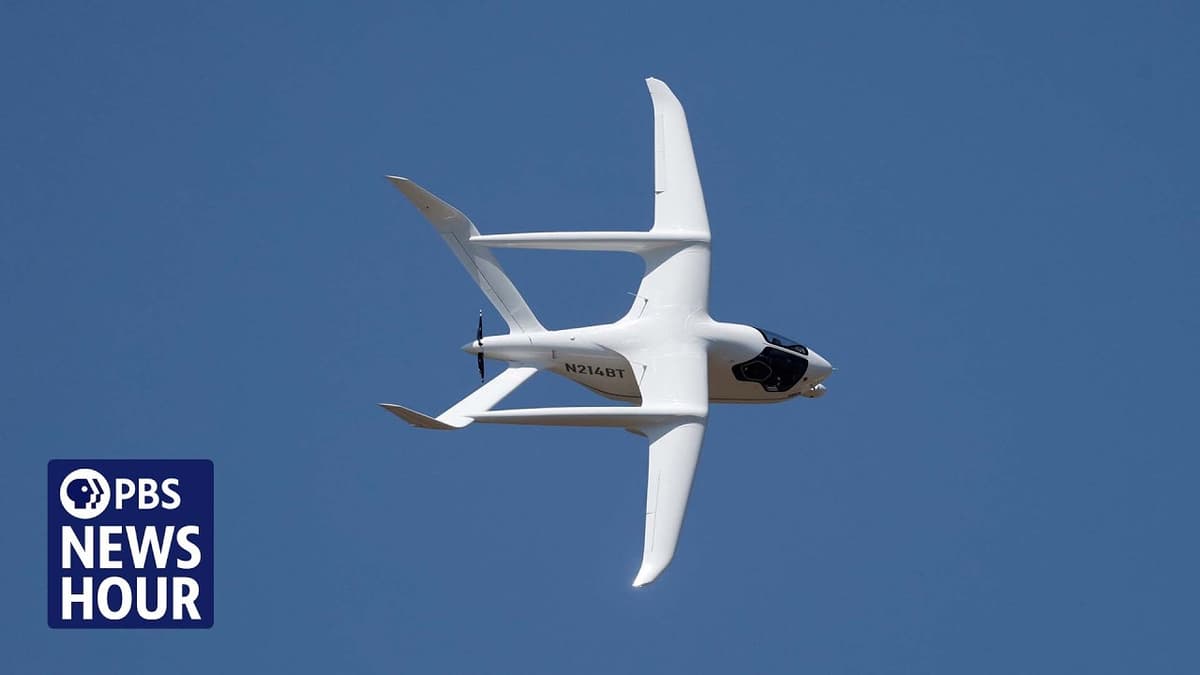
Miles O'Brien reports on electric aviation. He flies a Beta Technologies aircraft and covers certification, batteries and business plans.
What the video covers
Written in our own words. It only describes what the video shows and says.First flight and regulation
Miles O'Brien reports on electric aviation, or e-aviation, and becomes the first journalist to pilot one of the aircraft. The pilot in command is Kyle Clark, founder and CEO of Beta Technologies. The flight takes place over Vermont's Green Mountains. Clark founded the company nine years earlier in Burlington, his hometown. The company designs and builds planes, batteries and motors through an FAA certification process. Clark says regulation takes up most of his time. He describes the work as interpreting rules written for turbine aircraft and applying them to electric aircraft. The Trump administration has embraced expansion of electric aviation, while federal support for electric cars has been pulled back. In May of 2026, Transportation Secretary Sean Duffy flew in the aircraft and in an eVTOL version. In June of 2025, the White House launched a programme to accelerate eVTOL operations. The FAA has carved out airspace for eight projects spanning 26 states. Beta is among at least eight companies that will test fly uncertified electric and hybrid aircraft in demonstration missions under a three-year pilot programme. Archer Aviation is the appointed air taxi provider for the 2028 Olympic and Paralympic Games.
Battery limits and rules
Kyle Clark gives a factory tour focused on batteries, the bottleneck to practical electric flight. The aircraft has 13,000 lithium-ion cells bundled into 55 modules, with five times the energy of a Tesla Model 3. Clark says the batteries exceed automotive and FAA safety standards. He mentions carbon, titanium and aluminium, and twice the number of battery management systems. Engineers run batteries through accelerated life cycles, drop them, overheat them and push them to failure to seek a design that avoids a catastrophic worst case. COO Sean Donovan says electric vehicles have pushed battery technology far and enabled electric aviation. Venkat Vishwanathan, a professor of aerospace engineering at the University of Michigan, says eVTOL batteries must deliver very high power at the beginning and end of discharge. He says delivering both energy and power has historically been very difficult for a battery. The video states that FAA rules require enough range to reach the destination, divert to an alternate and fly another 45 minutes.
Business plans and landing
The video reports that today's batteries can deliver about five passengers and about 150 nautical miles. The video says this range may suit some use cases, while urban air taxi use remains challenging. Kyle Clark says Beta built its business plan around current battery limits and expected progress. The company first focuses on the fixed-wing aircraft for cargo missions and later passengers, while installing charging stations at airports nationwide. Beta's November 2025 IPO raised about a billion dollars and valued the company at 7.4 billion dollars, but shares have fallen roughly 40 percent. Clark describes a two-decade vision of building bigger electric airplanes for 70 to 150 passengers. The fixed-wing aircraft has one motor and fly-by-wire controls. The eVTOL version has four additional motors for vertical flight and no tilting propellers. During the return, Miles O'Brien takes the controls, the landing is described as not his finest performance, and the aircraft taxis to a charging station and plugs in.