UK: British Airways A321neo From Amsterdam Strikes Tail at Heathrow

A British Airways Airbus A321neo struck its tail on the runway while landing at London Heathrow on 12 November and went around. Flight BA431 from Amsterdam landed safely about 15 minutes later. The AAIB is investigating.

PQ
By the PilotinQ editorial team · based on 14 sources
Published 13 Nov 2026, 18:46 UTC6 min read
A British Airways Airbus A321neo registered G-TNEB just before touchdown on a runway at Heathrow, with office buildings in the background
The Airbus A321neo G-TNEB, the aircraft involved, landing at Heathrow in November 2025 (archive image). Photo: Matt Taylor via Wikimedia Commons · CC BY-SA 4.0
IN SHORT
  • A British Airways A321neo from Amsterdam struck its tail on the runway during a landing attempt at Heathrow on 12 November and went around.12
  • G-TNEB, operating as BA431, landed without further problems about fourteen minutes later. Passengers disembarked normally.25
  • British Airways says it is assisting the AAIB with its investigation. The aircraft has been taken out of service for inspection.34
  • The A321 is the longest member of the A320 family. Its tail touches the ground at a pitch attitude of 9.7 to 11.2 degrees.8

A British Airways Airbus A321neo struck its tail on the runway during a landing attempt at London Heathrow on Thursday 12 November. The aircraft was operating flight BA431 from Amsterdam. The crew went around and landed without further problems about 15 minutes later12. British Airways says it is assisting the UK Air Accidents Investigation Branch (AAIB) with its investigation34.

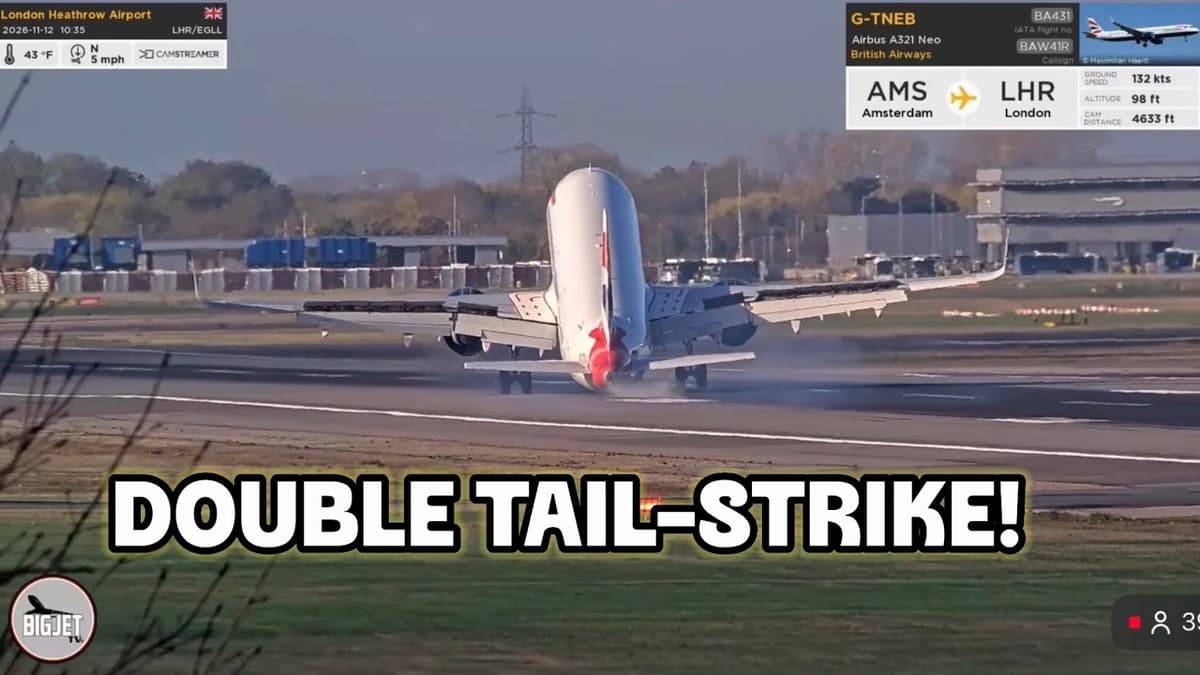
The aircraft is the A321neo registered G-TNEB25. BIG JET TV, which films Heathrow with a permanent camera, describes a double tail strike1. According to Aerospace Global News, the footage appears to show the aircraft bouncing and the underside of its tail contacting the runway twice before it climbs away4. The Daily Express also reported that the aircraft bounced on the runway before the landing was abandoned3.

How the flight unfolded

Open ADS-B data from adsb.lol shows G-TNEB departing Amsterdam Schiphol under the callsign BAW41R at 09:45 UTC, which is also London time in November2. At about 10:35 the aircraft descended to runway level over runway 27L, the southern runway at Heathrow. Shortly afterwards the data shows it climbing again, with the speed rising from around 130 to more than 170 knots2. The ADS-B record has a gap of about twelve seconds at exactly that moment, so the number and severity of runway contacts cannot be read from this data2.

After the go-around G-TNEB climbed to about 2,200 feet, turned south and flew back to the final approach for runway 27L. At 10:49 it was back on the runway, about fourteen minutes after the first attempt2. Passengers disembarked normally54. Neither the British Airways statement nor reports on the occurrence mention any injuries354.
British Airways and the AAIB

In a statement published by the Daily Express and Paddle Your Own Kanoo, among others, a British Airways spokesperson said that the aircraft landed safely and that the airline is assisting the AAIB with its investigation. The spokesperson added that the airline is legally unable to comment further at this stage35. As of 13 November the AAIB had not published a notice or bulletin about the occurrence on its website6.

G-TNEB has been taken out of service for inspection. According to the Daily Express, a provisional return to service is planned for 14 November, depending on the extent of any damage3. The damage has not been disclosed4. In the ADS-B data the aircraft made no further flights on 12 November. At the last reports that day, around 18:00 UTC, it was still at Heathrow2.

The weather at Heathrow

The Heathrow weather report for 10:20 UTC gave a wind from 020 degrees at 8 knots, varying between 350 and 060 degrees, visibility of 10 kilometres or more, broken cloud at 4,000 feet and a temperature of 6 degrees Celsius. At 10:50 UTC the wind was from the north at 11 knots with no significant cloud7. For a landing on runway 27, which points west, that put the wind almost directly from the right7. Whether the weather played a role has not been established.

What a tail strike is

In a tail strike, the rear fuselage touches the ground during takeoff or landing. An Airbus flight operations briefing note, quoted by the Irish investigation unit AAIU, says that 'tailstrikes occur more often with long aircraft, because tailstrike occurrence is directly related to pitch attitude versus aircraft geometry, and the status of main landing gear extension.' The same note warns that tail strikes can cause significant structural damage and lead to considerable maintenance action8.

The pitch margin depends on the length of the aircraft. On the A321 the tail touches the ground at a pitch attitude of 9.7 degrees with the main landing gear shock absorbers fully compressed, and at 11.2 degrees with them fully extended. A bank angle can reduce that margin further8.

Why the A321 in particular

The A321 is the longest member of the A320 family. The Airbus Flight Crew Training Manual (FCTM) says tail strikes are not a concern for the short A318, but that the subject becomes more important as fuselage length increases: 'Therefore, it is particularly important for A321 operators'8. Airbus statistics cited by the AAIU show that tail strikes during landing or a go-around near the ground occur more often per million flight cycles on the A321 than on the A320, and more often on the A321neo than on the A321ceo. According to the AAIU, Airbus is carrying out a global analysis of tail strikes across the A321neo fleet8.

Tail strike protection on the A321neo

On the A320 and A321, a pitch limit indicator appears on the primary flight display during the approach below 400 feet above the ground. It shows how much further the nose can rise before the tail touches. When the pitch is predicted to reach that limit, a 'PITCH PITCH' aural warning sounds. Once the crew selects TOGA thrust for a go-around, the indicator and the warning are no longer shown8. The shorter A318 and A319 do not have this indication, because their shorter fuselage carries less risk9.

The A321neo also has a tail strike pitch rate limitation. It adds a nose-down command that slows the pitch rate when the aircraft approaches the critical pitch angle at a high rate. The function is only authorised when the ground spoilers are commanded to extend. One second after TOGA is selected, full elevator authority is restored for the go-around8.

Going around close to the ground

Between January 2022 and September 2024, Airbus received 49 tail strike reports: 5 during takeoff, 23 during landing and 21 during a go-around near the ground10. Close to the runway the aircraft is low and relatively slow, while the engines need a few seconds to spool up. Airbus advises crews to monitor pitch closely in this phase, to avoid large nose-up sidestick inputs and to retract flaps and landing gear only once the aircraft is established in the climb. If a go-around is started during a bounce, the pilot flying should maintain the pitch and accept a possible second touchdown10. In the case of a high bounce, Airbus recommends maintaining the pitch attitude and going around11.

This background describes how tail strikes happen in general. What happened on board BA431 is a matter for the investigation.
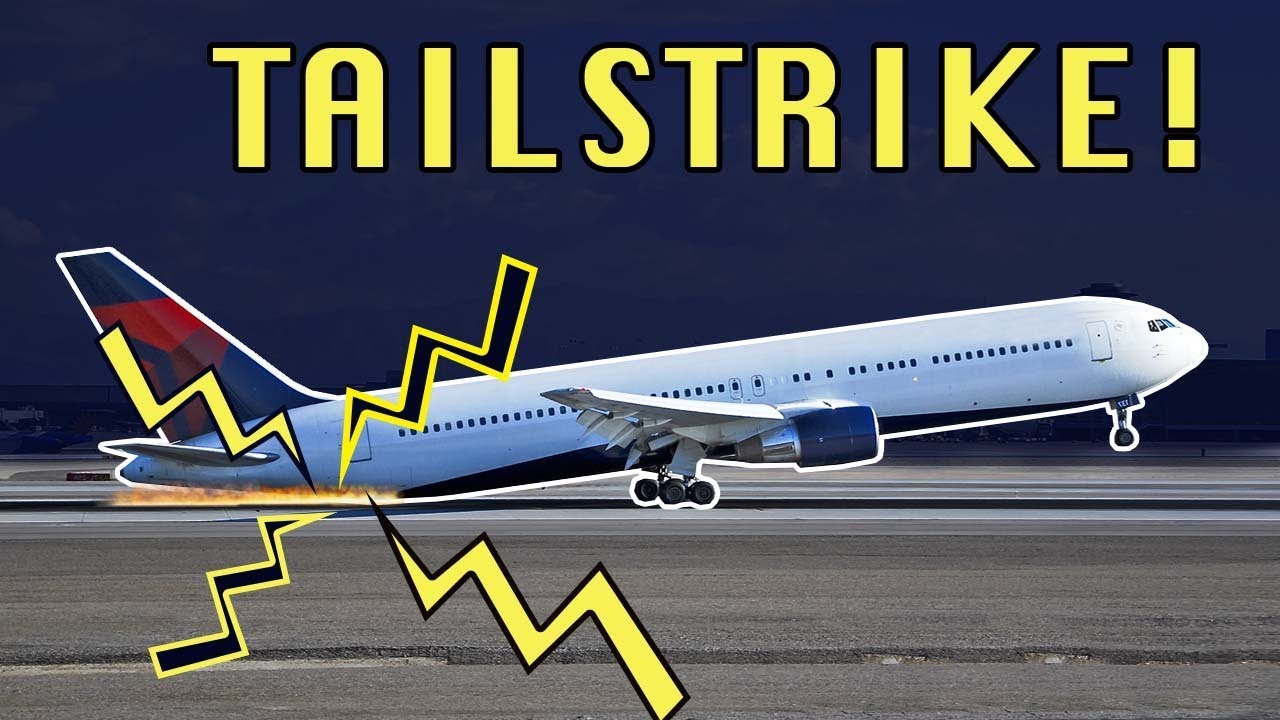
Video still: Mentour Pilot explains what a tail strike is and how pilots prevent one
Watch the video: Mentour Pilot explains what a tail strike is and how pilots prevent one. Footage: Mentour Pilot via YouTube.

Earlier similar occurrences

On 18 October 2024 an A321neo registered TC-LTL struck its tail during a go-around at Dublin Airport, after the main landing gear had already touched the runway. The damage to the lower tail section was about 3.4 metres long, with cracks in the supporting structure. After extensive temporary repairs the aircraft was flown on a non-revenue, unpressurised flight to a repair facility. In its final report of May 2026 the AAIU named over-rotation during the go-around as the probable cause8. On 1 July 2025 a second go-around tail strike occurred at Dublin involving the same aircraft type and operator, which the AAIU is investigating separately8.

Heathrow has seen it before as well. On 12 October 2025 an Airbus A300-600F freighter, D-AEAG, struck its tail on touchdown on runway 09L. The commander then initiated a go-around and the aircraft landed on runway 09R on a second approach. The damage was beyond economical repair. The AAIB published its bulletin on that accident on 12 November 2026, the same day as the BA431 tail strike12.
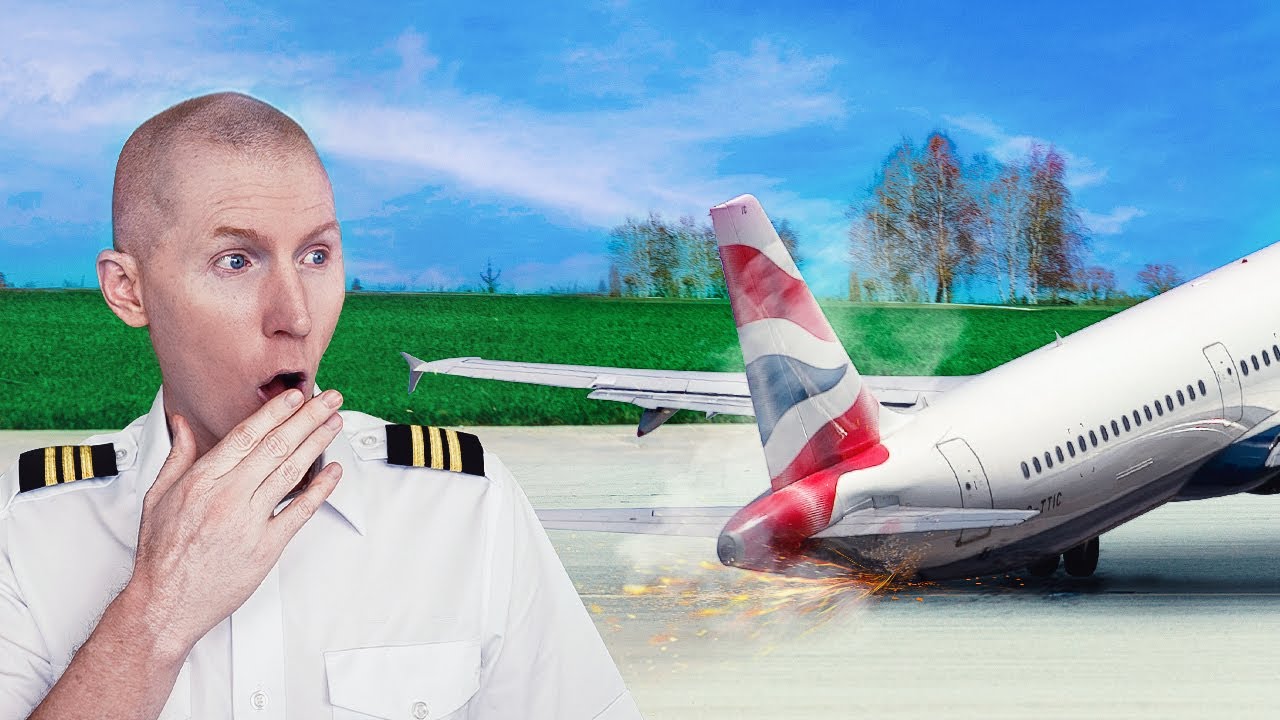
Video still: 74 Gear discusses an earlier British Airways tail strike on landing and how tail strikes happen
Watch the video: 74 Gear discusses an earlier British Airways tail strike on landing and how tail strikes happen. Footage: 74 Gear via YouTube.

What is not yet known

The AAIB has not published any findings. British Airways has not commented on the damage to G-TNEB or on the cause34.

Timeline

  1. 18 Oct 2024
    An A321neo, TC-LTL, strikes its tail during a go-around at Dublin Airport.8
  2. 12 Oct 2025
    An A300-600F freighter, D-AEAG, strikes its tail on landing at Heathrow and goes around.12
  3. 12 Nov 2026
    The AAIB publishes its bulletin on D-AEAG. The same day, BA431 strikes its tail at Heathrow and goes around.12
About:SafetyBritish AirwaysLondon Heathrow Airport
KEEP READINGAIRLINEBritish AirwaysNEWSSafety newsAsk your own pilot question

Sources

  1. 1BIG JET TV (YouTube) · DOUBLE Tail Strike & Go-Around At Heathrow Airport !12 Nov 2026
  2. 2adsb.lol · Open ADS-B data for Airbus A321neo G-TNEB (Mode S 407FCA), 12 November 202612 Nov 2026
  3. 3Daily Express via AOL · Moment British Airways plane 'bounces down' Heathrow runway before abandoning landing12 Nov 2026
  4. 4Aerospace Global News · BA Heathrow tail strike: What happens to an Airbus A321neo?13 Nov 2026
  5. 5Paddle Your Own Kanoo · Accident Investigators Called In After British Airways Airbus A321 Suffers Double Tailstrike While Trying to Land at Heathrow12 Nov 2026
  6. 6GOV.UK · Air Accidents Investigation Branch reports13 Nov 2026
  7. 7Aviation Weather Center (NOAA) · METAR EGLL 121020Z and 121050Z, London Heathrow12 Nov 2026
  8. 8Air Accident Investigation Unit Ireland · Report 2026-004: Airbus A321-271NX (neo), TC-LTL, Dublin Airport, 18 October 202419 May 2026
  9. 9Airbus Safety First · A Focus on the Takeoff Rotation1 Jan 2021
  10. 10Airbus Safety First · Preventing Tailstrike During Go-around Near the Ground1 Oct 2024
  11. 11Airbus Safety First · A Focus on the Landing Flare1 Sep 2020
  12. 12Air Accidents Investigation Branch · AAIB investigation to Airbus A300-600F, D-AEAG12 Nov 2026
  13. 13Mentour Pilot (YouTube) · TAILSTRIKE! Can an aircraft hit the tail?16 Mar 2018
  14. 1474 Gear (YouTube) · British Airways Tail Strike on Landing7 Aug 2022
CHANGES13 Nov 2026, 18:46 UTC · PublishedSpotted an error? Tell us, corrections are noted under the article.Every fact is checked against the sources listed above. How we work

UK: British Airways A321neo From Amsterdam Strikes Tail at Heathrow

A British Airways Airbus A321neo struck its tail on the runway while landing at London Heathrow on 12 November and went around. Flight BA431 from Amsterdam landed safely about 15 minutes later. The AAIB is investigating.

PQ
By the PilotinQ editorial team · based on 14 sources
Published 13 Nov 2026, 18:46 UTC6 min read
A British Airways Airbus A321neo registered G-TNEB just before touchdown on a runway at Heathrow, with office buildings in the background
The Airbus A321neo G-TNEB, the aircraft involved, landing at Heathrow in November 2025 (archive image). Photo: Matt Taylor via Wikimedia Commons · CC BY-SA 4.0
IN SHORT
  • A British Airways A321neo from Amsterdam struck its tail on the runway during a landing attempt at Heathrow on 12 November and went around.12
  • G-TNEB, operating as BA431, landed without further problems about fourteen minutes later. Passengers disembarked normally.25
  • British Airways says it is assisting the AAIB with its investigation. The aircraft has been taken out of service for inspection.34
  • The A321 is the longest member of the A320 family. Its tail touches the ground at a pitch attitude of 9.7 to 11.2 degrees.8

A British Airways Airbus A321neo struck its tail on the runway during a landing attempt at London Heathrow on Thursday 12 November. The aircraft was operating flight BA431 from Amsterdam. The crew went around and landed without further problems about 15 minutes later12. British Airways says it is assisting the UK Air Accidents Investigation Branch (AAIB) with its investigation34.

The aircraft is the A321neo registered G-TNEB25. BIG JET TV, which films Heathrow with a permanent camera, describes a double tail strike1. According to Aerospace Global News, the footage appears to show the aircraft bouncing and the underside of its tail contacting the runway twice before it climbs away4. The Daily Express also reported that the aircraft bounced on the runway before the landing was abandoned3.

Academy · Alongside your ground school

Practise All 14 Subjects

ATPL theory (EASA) · a practice set per subject, then timed final exams

How the flight unfolded

Open ADS-B data from adsb.lol shows G-TNEB departing Amsterdam Schiphol under the callsign BAW41R at 09:45 UTC, which is also London time in November2. At about 10:35 the aircraft descended to runway level over runway 27L, the southern runway at Heathrow. Shortly afterwards the data shows it climbing again, with the speed rising from around 130 to more than 170 knots2. The ADS-B record has a gap of about twelve seconds at exactly that moment, so the number and severity of runway contacts cannot be read from this data2.

After the go-around G-TNEB climbed to about 2,200 feet, turned south and flew back to the final approach for runway 27L. At 10:49 it was back on the runway, about fourteen minutes after the first attempt2. Passengers disembarked normally54. Neither the British Airways statement nor reports on the occurrence mention any injuries354.

British Airways and the AAIB

In a statement published by the Daily Express and Paddle Your Own Kanoo, among others, a British Airways spokesperson said that the aircraft landed safely and that the airline is assisting the AAIB with its investigation. The spokesperson added that the airline is legally unable to comment further at this stage35. As of 13 November the AAIB had not published a notice or bulletin about the occurrence on its website6.

G-TNEB has been taken out of service for inspection. According to the Daily Express, a provisional return to service is planned for 14 November, depending on the extent of any damage3. The damage has not been disclosed4. In the ADS-B data the aircraft made no further flights on 12 November. At the last reports that day, around 18:00 UTC, it was still at Heathrow2.

The weather at Heathrow

The Heathrow weather report for 10:20 UTC gave a wind from 020 degrees at 8 knots, varying between 350 and 060 degrees, visibility of 10 kilometres or more, broken cloud at 4,000 feet and a temperature of 6 degrees Celsius. At 10:50 UTC the wind was from the north at 11 knots with no significant cloud7. For a landing on runway 27, which points west, that put the wind almost directly from the right7. Whether the weather played a role has not been established.

What a tail strike is

In a tail strike, the rear fuselage touches the ground during takeoff or landing. An Airbus flight operations briefing note, quoted by the Irish investigation unit AAIU, says that 'tailstrikes occur more often with long aircraft, because tailstrike occurrence is directly related to pitch attitude versus aircraft geometry, and the status of main landing gear extension.' The same note warns that tail strikes can cause significant structural damage and lead to considerable maintenance action8.

The pitch margin depends on the length of the aircraft. On the A321 the tail touches the ground at a pitch attitude of 9.7 degrees with the main landing gear shock absorbers fully compressed, and at 11.2 degrees with them fully extended. A bank angle can reduce that margin further8.

Why the A321 in particular

The A321 is the longest member of the A320 family. The Airbus Flight Crew Training Manual (FCTM) says tail strikes are not a concern for the short A318, but that the subject becomes more important as fuselage length increases: 'Therefore, it is particularly important for A321 operators'8. Airbus statistics cited by the AAIU show that tail strikes during landing or a go-around near the ground occur more often per million flight cycles on the A321 than on the A320, and more often on the A321neo than on the A321ceo. According to the AAIU, Airbus is carrying out a global analysis of tail strikes across the A321neo fleet8.

Tail strike protection on the A321neo

On the A320 and A321, a pitch limit indicator appears on the primary flight display during the approach below 400 feet above the ground. It shows how much further the nose can rise before the tail touches. When the pitch is predicted to reach that limit, a 'PITCH PITCH' aural warning sounds. Once the crew selects TOGA thrust for a go-around, the indicator and the warning are no longer shown8. The shorter A318 and A319 do not have this indication, because their shorter fuselage carries less risk9.

The A321neo also has a tail strike pitch rate limitation. It adds a nose-down command that slows the pitch rate when the aircraft approaches the critical pitch angle at a high rate. The function is only authorised when the ground spoilers are commanded to extend. One second after TOGA is selected, full elevator authority is restored for the go-around8.

Going around close to the ground

Between January 2022 and September 2024, Airbus received 49 tail strike reports: 5 during takeoff, 23 during landing and 21 during a go-around near the ground10. Close to the runway the aircraft is low and relatively slow, while the engines need a few seconds to spool up. Airbus advises crews to monitor pitch closely in this phase, to avoid large nose-up sidestick inputs and to retract flaps and landing gear only once the aircraft is established in the climb. If a go-around is started during a bounce, the pilot flying should maintain the pitch and accept a possible second touchdown10. In the case of a high bounce, Airbus recommends maintaining the pitch attitude and going around11.

This background describes how tail strikes happen in general. What happened on board BA431 is a matter for the investigation.

Video still: Mentour Pilot explains what a tail strike is and how pilots prevent one
Watch the video: Mentour Pilot explains what a tail strike is and how pilots prevent one. Footage: Mentour Pilot via YouTube.

Earlier similar occurrences

On 18 October 2024 an A321neo registered TC-LTL struck its tail during a go-around at Dublin Airport, after the main landing gear had already touched the runway. The damage to the lower tail section was about 3.4 metres long, with cracks in the supporting structure. After extensive temporary repairs the aircraft was flown on a non-revenue, unpressurised flight to a repair facility. In its final report of May 2026 the AAIU named over-rotation during the go-around as the probable cause8. On 1 July 2025 a second go-around tail strike occurred at Dublin involving the same aircraft type and operator, which the AAIU is investigating separately8.

Heathrow has seen it before as well. On 12 October 2025 an Airbus A300-600F freighter, D-AEAG, struck its tail on touchdown on runway 09L. The commander then initiated a go-around and the aircraft landed on runway 09R on a second approach. The damage was beyond economical repair. The AAIB published its bulletin on that accident on 12 November 2026, the same day as the BA431 tail strike12.

Video still: 74 Gear discusses an earlier British Airways tail strike on landing and how tail strikes happen
Watch the video: 74 Gear discusses an earlier British Airways tail strike on landing and how tail strikes happen. Footage: 74 Gear via YouTube.

What is not yet known

The AAIB has not published any findings. British Airways has not commented on the damage to G-TNEB or on the cause34.

Timeline

  1. 18 Oct 2024
    An A321neo, TC-LTL, strikes its tail during a go-around at Dublin Airport.8
  2. 12 Oct 2025
    An A300-600F freighter, D-AEAG, strikes its tail on landing at Heathrow and goes around.12
  3. 12 Nov 2026
    The AAIB publishes its bulletin on D-AEAG. The same day, BA431 strikes its tail at Heathrow and goes around.12
About:SafetyBritish AirwaysLondon Heathrow Airport
KEEP READINGAIRLINEBritish AirwaysNEWSSafety newsAsk your own pilot question

Prepare for selection

Sources

  1. 1BIG JET TV (YouTube) · DOUBLE Tail Strike & Go-Around At Heathrow Airport !12 Nov 2026
  2. 2adsb.lol · Open ADS-B data for Airbus A321neo G-TNEB (Mode S 407FCA), 12 November 202612 Nov 2026
  3. 3Daily Express via AOL · Moment British Airways plane 'bounces down' Heathrow runway before abandoning landing12 Nov 2026
  4. 4Aerospace Global News · BA Heathrow tail strike: What happens to an Airbus A321neo?13 Nov 2026
  5. 5Paddle Your Own Kanoo · Accident Investigators Called In After British Airways Airbus A321 Suffers Double Tailstrike While Trying to Land at Heathrow12 Nov 2026
  6. 6GOV.UK · Air Accidents Investigation Branch reports13 Nov 2026
  7. 7Aviation Weather Center (NOAA) · METAR EGLL 121020Z and 121050Z, London Heathrow12 Nov 2026
  8. 8Air Accident Investigation Unit Ireland · Report 2026-004: Airbus A321-271NX (neo), TC-LTL, Dublin Airport, 18 October 202419 May 2026
  9. 9Airbus Safety First · A Focus on the Takeoff Rotation1 Jan 2021
  10. 10Airbus Safety First · Preventing Tailstrike During Go-around Near the Ground1 Oct 2024
  11. 11Airbus Safety First · A Focus on the Landing Flare1 Sep 2020
  12. 12Air Accidents Investigation Branch · AAIB investigation to Airbus A300-600F, D-AEAG12 Nov 2026
  13. 13Mentour Pilot (YouTube) · TAILSTRIKE! Can an aircraft hit the tail?16 Mar 2018
  14. 1474 Gear (YouTube) · British Airways Tail Strike on Landing7 Aug 2022
CHANGES13 Nov 2026, 18:46 UTC · PublishedSpotted an error? Tell us, corrections are noted under the article.Every fact is checked against the sources listed above. How we work
Keep reading

More on Safety