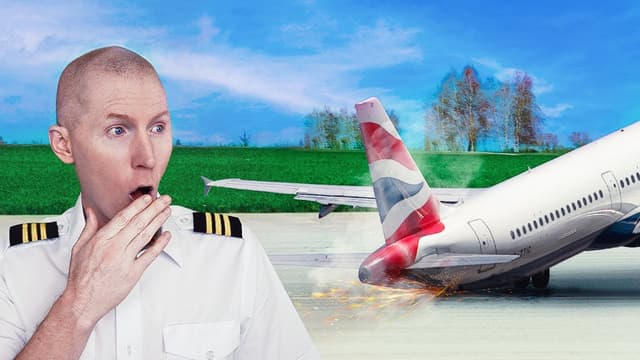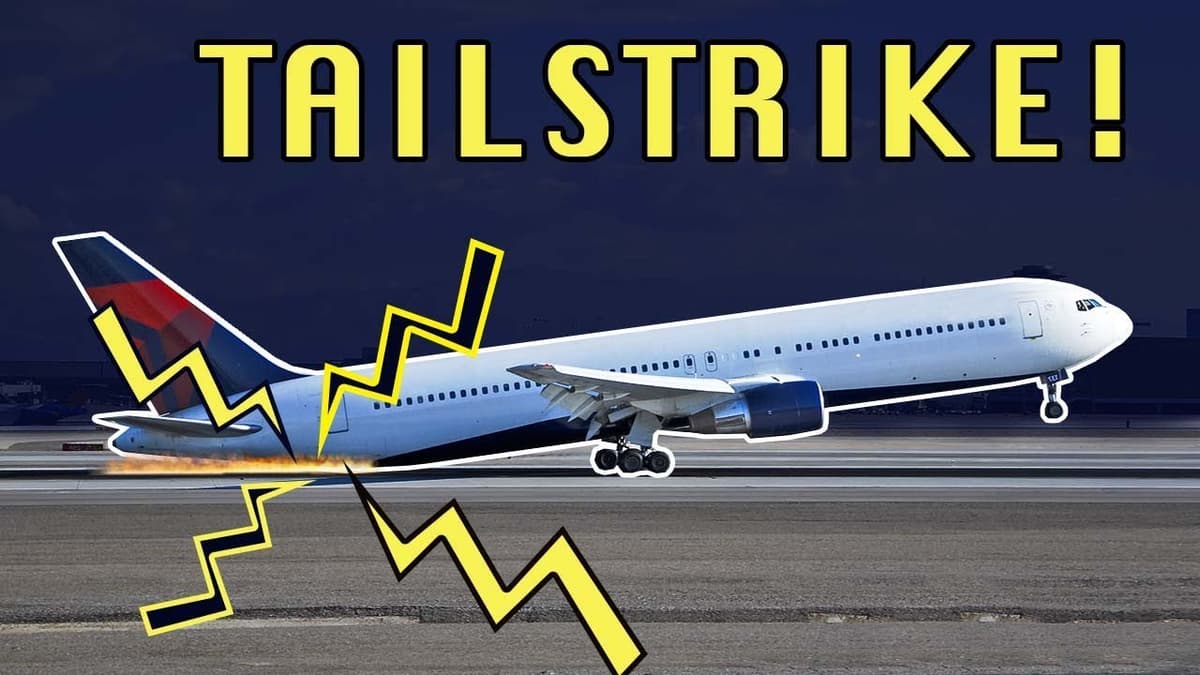
Mentour Pilot explains tail strikes on the 737-800. The video covers design, takeoff risks, handling and landing cases.
What the video covers
Written in our own words. It only describes what the video shows and says.The 737 was built close to the ground to make handling easier for ground crew. The early 737-100 and 737-200 were short, but Boeing stretched later versions to carry more passengers. Because the aircraft was already low, stretching it brings the tail closer to the runway during rotation. Mentour Pilot says the 737-800 and 737-900 are the longest versions and are very susceptible to tail strikes.
Design of the 737-800 and the tail skid
A small shoe is fitted at the rear of the aircraft where the tail could contact the runway. Mentour Pilot describes it as crushable honeycomb material with a gradient and red and green colouring. If the tail skid is pushed in during a tail strike, engineering can estimate how severe the strike was from how far it has been pushed in.
Risk factors and handling on takeoff
Mentour Pilot identifies an incorrect load sheet as the biggest single risk factor for a tail strike during takeoff. Passengers sitting in the wrong places or an incorrect weight given to the flight crew can affect balance and takeoff speeds. If the aircraft is rotated before it is ready to fly, it may continue to pitch up without becoming airborne and the tail may strike the runway. Mentour Pilot says rotation should be about two and a half to three degrees per second. Trimming during rotation and crosswind techniques can also reduce tail clearance.
If pilots feel a bump during rotation, Mentour Pilot says they may level off, complete the quick reference handbook checklist and return. If they do not notice it, cabin crew seated in the rear may hear unusual noises and report them. Mentour Pilot explains that the checklist calls for depressurisation because damage to the aft bulkhead could be aggravated by pressurisation. The checklist directs the crew to land at the nearest suitable airport. Mentour Pilot notes that if the aircraft is already above 10,000 feet, the crew may descend to 10,000 feet before depressurising.
Tail strikes on landing and tail clearance
Mentour Pilot says tail strikes on landing are much more rare but potentially more damaging. An unstabilised approach, a high descent rate, closed thrust levels during the approach or a steep flare can lead to one. The tail may hit before the landing gear, causing the tail to absorb the energy and leading to expensive repairs. A bounced landing can also cause a tail strike if the thrust levels are closed and speed runs off. Mentour Pilot says the crew may add thrust, or perform a go around with takeoff go around power, flaps 15 and a rotation of two and a half to three degrees per second.
Mentour Pilot states that a normal takeoff with flaps 1 at the correct speed gives about 31 centimetres of tail clearance at the closest point. With flaps 5 there is about 51 centimetres, which is why flaps 5 are generally used in strong crosswind.