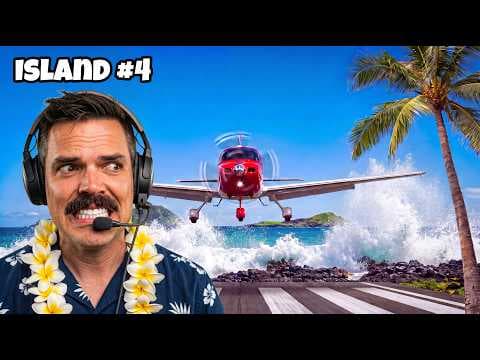
Blake rents a Cirrus SR20 in Honolulu and flies with a local instructor to land on all six Hawaiian islands that have an airport, in a single day.
What the video covers
Written in our own words. It only describes what the video shows and says.Six islands, six landings
Hawaii has eight main islands, and two of them have no airport. That leaves six, and in this video Blake of We Flew There sets out to land on all of them in one day. His own plane is in Utah, so he rents a Cirrus SR20 in Honolulu, the lighter version of his own aircraft, and flies with Spencer, a local instructor who works the radios so Blake can focus on flying. Kauai has been under rain clouds all morning, so they head east first and hope it clears later, and with a hurricane due later in the week this day is their only chance. Hawaii also becomes the 12th state Blake has landed in on the channel, on his way to all 50.
Lanai, Upolu and Hana
The flight is under visual flight rules, so they cannot fly through clouds and spend the day dodging around them. The first leg is a 72 mile hop past Waikiki to Lanai, an island with a single town of about 3,000 people, where they duck under the clouds for runway 3 and float a long way before touching down. On the Big Island they skip Kona and Hilo for Upolu, a small field at the northern tip with 3,800 feet of runway and no tower. On the way they pass Molokini, the crescent shaped islet known for snorkeling, and the slopes of Haleakala, and the gusty landing at Upolu makes Blake fight for it. Next is Hana on the lush, windward east side of Maui. Distracted by the rising terrain of Haleakala, Blake flies his turn high and close in, which means a steep descent and a float about halfway down the runway. After three islands they stop at Kahului, the only airport so far that sells fuel, and take a crew car to a shrimp truck while the plane is refuelled.
Molokai, Kauai and the bill
On Molokai they fly along the north face sea cliffs, the tallest in the world at over 3,000 feet, formed when about a third of the island collapsed into the ocean. The cliffs are so high that the terrain warning goes off. Their landing spot, Kalaupapa, is the one flat piece of land at the foot of those cliffs: a National Historical Park that served as a mandatory leprosy settlement for a hundred years, reachable only on foot, by sea or by air. The 2,700 foot runway is a quarter of what Honolulu offers and comes with about 30 knots of gusty wind on the nose, which Spencer calls the most intimidating runway on the island. The longest leg follows, 160 miles to Kauai, routed south by air traffic control to stay clear of the jets landing at Honolulu and flown entirely over open water. Kauai is clear enough for a touch and go in a crosswind just before the rain arrives, and a 100 mile flight back to Honolulu completes all six islands. Blake closes with the cost: 615 dollars an hour for the brand new plane, fuel and the instructor, billed on Hobbs time. With 4.5 hours of flying, the day came to 2,920.36 dollars including tax.