VideosTRAINING
London City Airport: steep approach and landing
Original title: Landing at the Most Challenging Airport in Europe: London City Airport
TravelTV · 4:08 · 23 Oct 2026 · Watch on YouTube

The presenter describes an approach and landing at London City Airport. The account covers the steep glide path, cockpit actions, touchdown and weather.

What the video covers

Written in our own words. It only describes what the video shows and says.

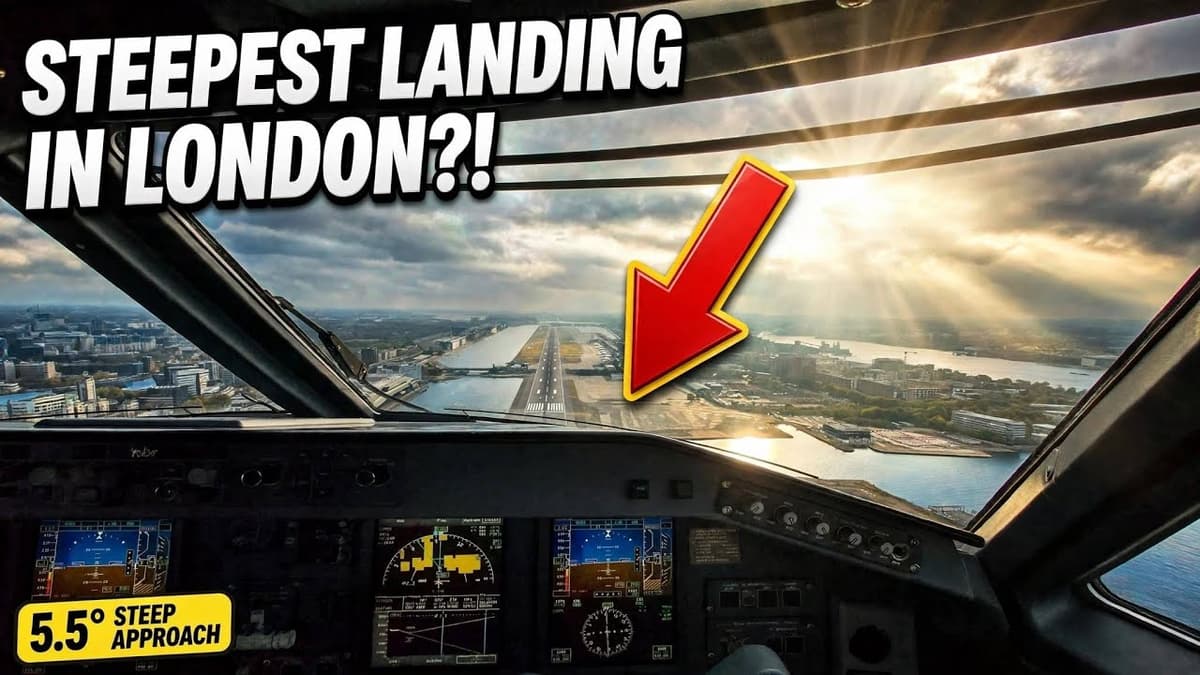
The presenter describes an approach to London City Airport from the west, with the aircraft heading for runway 09. The River Thames is mentioned below, and Canary Wharf is named as part of the financial district ahead. The presenter says that most airports use a standard approach angle of around 3 degrees, while this arrival uses a 5.5 degree glide path. According to the presenter, the procedure keeps the aircraft high for as long as possible to clear the city's obstacles, then descends more steeply than normal to reach a short landing area. The presenter says the real part of the approach begins after passing the river, the docks and Canary Wharf.

Cockpit configuration and descent rate

The presenter describes the cockpit configuration for the steep approach. Before intercepting the glide path, the flaps are set for the steep approach, the landing gear is lowered and a slightly higher approach speed is targeted for better control. The presenter says the required rate of descent is almost doubled compared with a standard 3 degree glide. Instead of around 700 feet per minute, the presenter gives roughly 1,200 to 1,300 feet per minute, depending on wind and ground speed. The presenter also says that the autopilot, if used, must be certified for 5.5 degree approaches, and that many crews still prefer to fly the final segment manually. The presenter describes scanning the instruments, the localizer, the glide slope and the outside view, so the city, buildings and river remain in the expected position relative to the nose.

Idle descent, short runway and flare

The presenter says the aircraft is established on the glide path and that the engine tone changes, with the engines at idle or close to idle. The Thames is described as right beneath the aircraft, the boats as almost still, and the runway strip as growing larger in the windscreen. The presenter states that the runway is short, just over 1,500 metres, and that the aim is to touch down almost halfway along it, then brake hard and use reverse thrust to stop in time. The presenter explains that the flare differs from a normal landing because pulling up too early risks flattening out and landing long, while pulling too late makes the impact firm. The timing is described as precise, with a firm but controlled flare to soften the last part of the descent and place the aircraft on the intended spot.

Touchdown, terminal and weather

The presenter says the wheels touch the ground, the reversers and brakes are heard, and the aircraft goes from approach speed to taxi speed within seconds. The outside view is described as a compact terminal with buildings all around and a sensation of having landed in the heart of the city. The presenter mentions typical London weather, with a layer of cloud, diffused light and the Thames shining below. The presenter then says that landing at London City requires specific training, discipline and strong confidence in the aircraft and in the pilot's own skills.

Statements in the video

0:16The presenter says that unlike most airports, where the standard approach angle is around 3 degrees, the aircraft is set up for a 5.5 degree glide path.The presenter says this while describing the approach from the west toward runway 09.
1:11The presenter says the required rate of descent is almost doubled from a standard 3 degree glide, with roughly 1,200 to 1,300 feet per minute instead of around 700 feet per minute, depending on wind and ground speed.The presenter says this while describing the cockpit configuration before intercepting the glide path.
2:04The presenter says the runway is short, just over 1,500 metres, and the aim is to touch down almost halfway along it, then brake hard and use reverse thrust to stop in time.The presenter says this while the aircraft is on the glide path and descending toward the runway.

Moments from the video

0:01“Welcome on board. Today, we're landing at London City, one of the most unique airports in Europe. We're approaching from the west, heading for runway 09. Below us flows the River Thames, and just ahead lies the heart of London's financial district,”0:33“the steepest in Europe for a scheduled jet airport. This procedure exists for a reason. We need to stay high for as long as possible to clear the city's obstacles, then descend much more steeply than normal to touch down in a very short space. Look ahead. The…”1:11“Before intercepting the glide path, we set the flaps for the steep approach, lower the landing gear, and target a slightly higher approach speed for better control. The required rate of descent is almost doubled out of a standard 3 degree glide. Instead of…”2:04“You can hear the change in engine tone. We're at idle, or close to it, and the aircraft is descending decisively. The Thames is right beneath us. The boats look almost still, and the strip of asphalt at London City grows larger in windscreen. The runway is…”

More videos

All
15:57
TRAININGFlying a Cessna 182 into the Maasai Mara in KenyaFly Me to the Fun™
Sign in
TRAINING

London City Airport: steep approach and landing

Original title: Landing at the Most Challenging Airport in Europe: London City Airport
TravelTV · 4:08 · 23 Oct 2026 · Watch on YouTube

The presenter describes an approach and landing at London City Airport. The account covers the steep glide path, cockpit actions, touchdown and weather.

IN THIS VIDEO
  1. 0:00Approach from the west
  2. 0:51Steep approach begins
  3. 1:11Configuration and descent rate
  4. 2:04Idle descent and short runway
  5. 3:07Touchdown, braking and terminal
  6. 3:27Weather and pilot procedures

What the video covers

Written in our own words. It only describes what the video shows and says.

The presenter describes an approach to London City Airport from the west, with the aircraft heading for runway 09. The River Thames is mentioned below, and Canary Wharf is named as part of the financial district ahead. The presenter says that most airports use a standard approach angle of around 3 degrees, while this arrival uses a 5.5 degree glide path. According to the presenter, the procedure keeps the aircraft high for as long as possible to clear the city's obstacles, then descends more steeply than normal to reach a short landing area. The presenter says the real part of the approach begins after passing the river, the docks and Canary Wharf.

Cockpit configuration and descent rate

The presenter describes the cockpit configuration for the steep approach. Before intercepting the glide path, the flaps are set for the steep approach, the landing gear is lowered and a slightly higher approach speed is targeted for better control. The presenter says the required rate of descent is almost doubled compared with a standard 3 degree glide. Instead of around 700 feet per minute, the presenter gives roughly 1,200 to 1,300 feet per minute, depending on wind and ground speed. The presenter also says that the autopilot, if used, must be certified for 5.5 degree approaches, and that many crews still prefer to fly the final segment manually. The presenter describes scanning the instruments, the localizer, the glide slope and the outside view, so the city, buildings and river remain in the expected position relative to the nose.

Idle descent, short runway and flare

The presenter says the aircraft is established on the glide path and that the engine tone changes, with the engines at idle or close to idle. The Thames is described as right beneath the aircraft, the boats as almost still, and the runway strip as growing larger in the windscreen. The presenter states that the runway is short, just over 1,500 metres, and that the aim is to touch down almost halfway along it, then brake hard and use reverse thrust to stop in time. The presenter explains that the flare differs from a normal landing because pulling up too early risks flattening out and landing long, while pulling too late makes the impact firm. The timing is described as precise, with a firm but controlled flare to soften the last part of the descent and place the aircraft on the intended spot.

Touchdown, terminal and weather

The presenter says the wheels touch the ground, the reversers and brakes are heard, and the aircraft goes from approach speed to taxi speed within seconds. The outside view is described as a compact terminal with buildings all around and a sensation of having landed in the heart of the city. The presenter mentions typical London weather, with a layer of cloud, diffused light and the Thames shining below. The presenter then says that landing at London City requires specific training, discipline and strong confidence in the aircraft and in the pilot's own skills.
Statements in the video

0:16The presenter says that unlike most airports, where the standard approach angle is around 3 degrees, the aircraft is set up for a 5.5 degree glide path.The presenter says this while describing the approach from the west toward runway 09.
1:11The presenter says the required rate of descent is almost doubled from a standard 3 degree glide, with roughly 1,200 to 1,300 feet per minute instead of around 700 feet per minute, depending on wind and ground speed.The presenter says this while describing the cockpit configuration before intercepting the glide path.
2:04The presenter says the runway is short, just over 1,500 metres, and the aim is to touch down almost halfway along it, then brake hard and use reverse thrust to stop in time.The presenter says this while the aircraft is on the glide path and descending toward the runway.

Moments from the video

0:01“Welcome on board. Today, we're landing at London City, one of the most unique airports in Europe. We're approaching from the west, heading for runway 09. Below us flows the River Thames, and just ahead lies the heart of London's financial district,”0:33“the steepest in Europe for a scheduled jet airport. This procedure exists for a reason. We need to stay high for as long as possible to clear the city's obstacles, then descend much more steeply than normal to touch down in a very short space. Look ahead. The…”1:11“Before intercepting the glide path, we set the flaps for the steep approach, lower the landing gear, and target a slightly higher approach speed for better control. The required rate of descent is almost doubled out of a standard 3 degree glide. Instead of…”2:04“You can hear the change in engine tone. We're at idle, or close to it, and the aircraft is descending decisively. The Thames is right beneath us. The boats look almost still, and the strip of asphalt at London City grows larger in windscreen. The runway is…”
READ MORE ON PILOTINQ
What is Getting to Grips with Aircraft Performance?
Practise for your exams and airline selectionStart for free

More videos