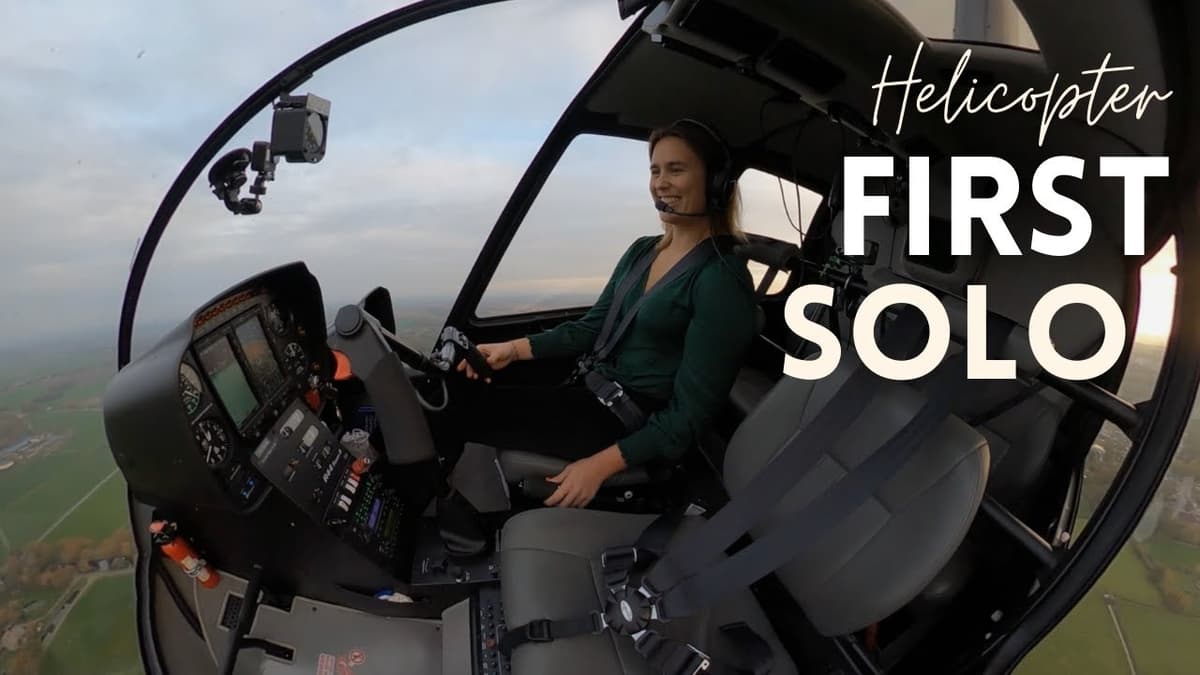
A presenter completes a first solo helicopter flight after an instructor's briefing. The video covers pre-flight checks, radio calls and a debriefing.
What the video covers
Written in our own words. It only describes what the video shows and says.Pre-flight briefing and takeoff
The video begins with the presenter and an instructor discussing a recently completed circuit. The instructor notes that the circuit was executed perfectly and resembled a textbook example. The presenter agrees that the speed reduction on the base leg provided more time to establish a walking pace feeling. The instructor then prepares the presenter for a solo flight, advising that without a passenger, the helicopter will be significantly lighter, causing the nose to pitch up more easily. The presenter is instructed to look far ahead, maintain a slightly higher hover to provide clearance for the tail, and repeat the procedures from the previous circuit. After taking the controls, the presenter performs pre-takeoff checks, confirming that the warning lights are out, the revolutions per minute are correct, the temperatures and pressures are in the green zone, and there is sufficient fuel. The presenter notes the increased sensitivity of the rudder pedals due to the lighter weight. After lining up on the runway, the presenter initiates the takeoff, accelerating through forty knots and then sixty knots while continuing the climb.
Solo flight and radio communications
Once airborne, the presenter expresses amazement at flying alone. The presenter notices the airspeed approaching seventy knots and adjusts the pitch to slow down. The presenter then contacts Rogeveen Radio, identifying as Papa Gold Victor. The presenter requests clearance for a visual flight rules flight to Teuge with two persons on board, stating the captain is Bessemer. The radio operator informs the presenter that runway zero nine left hand is in use. Another aircraft, Papa Gold Bravo, reports beginning a left hand downwind for runway zero nine and is instructed to report on final approach. The presenter reports flying at an altitude of seven hundred and forty feet and a speed of eighty knots, confirming there is no visual traffic. The presenter repeats the instrument checks, ensuring lights are off, revolutions per minute are good, temperatures and pressures are normal, and fuel is adequate.
Landing and post-flight debriefing
As the flight progresses, the presenter prepares for landing, noting that the helicopter will be heavier on the tail than on the nose. The presenter initiates a base turn, lowers the collective to descend, and reduces the speed to sixty knots while turning on the landing lights. The presenter focuses on maintaining the correct nose attitude and pedal inputs, aiming for a walking pace while being cautious of the tail clearance. After completing the circuit, the presenter turns onto the final approach and brings the helicopter into a hover before landing. During the debriefing, the presenter tells the instructor that the experience was incredible. The presenter reflects on the flight, noting that the pedals required more attention initially and that the helicopter had abundant power. The presenter mentions experiencing translational lift during takeoff, causing a rapid acceleration past sixty knots, and suggests that less manifold pressure could have been used. The presenter observes that the first circuit approach was slightly shallow and fast, but subsequent attempts improved. The instructor agrees, stating that the hover was steady and that this is the natural process of learning to fly solo.