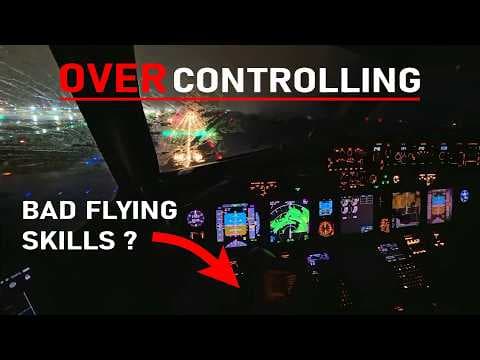
Boeing 737 captain Command T explains why so many pilots over-control and how to find the balanced position of the flight controls.
What the video covers
Written in our own words. It only describes what the video shows and says.Command T is a Boeing 737 captain with about 8,500 hours on jets, general aviation and aerobatic aircraft. In this video he looks at over-controlling: a habit he sees in students, test pilots and very experienced airline captains alike. He promises a practical rule of thumb that he wishes every flight instructor had passed on to students on day one. Nobody told him, he says. It took him years to work it out himself.
Not just a beginner's problem
As a first officer he flew with captains who had far more experience than he has today. The moment they disconnected the autopilot, a smooth flight turned into constant left, right, up and down inputs. The passengers in the back felt every one of them. More hours help a pilot get used to an aircraft, he says, but they do not fix the habit on their own. The first sign is the frequency of the inputs: many pilots could simply hold the yoke steady for a moment and watch what the aircraft does.
The myth of the centred stick
The second sign, according to Command T, shows up in every pilot who over-controls, whether they fly a gyrocopter, an F-15 or an airliner. They treat the neutral, centred position of the yoke or stick as home base. The aircraft drifts, the pilot answers with a quick, jerky input and then brings the controls straight back to the middle. The aircraft drifts again and the cycle repeats.
The point where all forces are in balance is almost never the middle, he explains. It might be a little forward pressure or a touch of right aileron. It also keeps moving as the wind shifts. Feeling the aircraft means searching for that balanced position all the time. When the aircraft drifts gently, you feed in a gentle opposite input and hold it until you find the new point of equilibrium. In smooth air you can briefly freeze the controls there until the next correction is needed.
His second rule is to match the cadence of your inputs to what the aircraft is doing. In a storm a gust can lift a wing by 20 degrees in an instant. Then the input has to be just as quick. Even then the controls do not need to snap back to the centre. This, he believes, is what pilots mean when they say an aircraft feels like an extension of their body.
Anticipate instead of react
Finally he warns against being too reactive. Some airline pilots wait for the flight director to tell them what to do, while the seat of the pants on a gusty approach tells you far more than any instrument. With experience you feel the aircraft sink and add pitch and thrust before the flight director asks for it. The reward is a smoother ride for passengers and better precision, which he calls the whole point of flying. His advice applies to simulator pilots, aspiring airline pilots and fighter pilots alike.