Missionary Bush Pilot documents a flight from Yifki to his home base in Goroka, discussing cultural interactions and the details of the flight.
What the video covers
Written in our own words. It only describes what the video shows and says.Pre-flight at Yifki
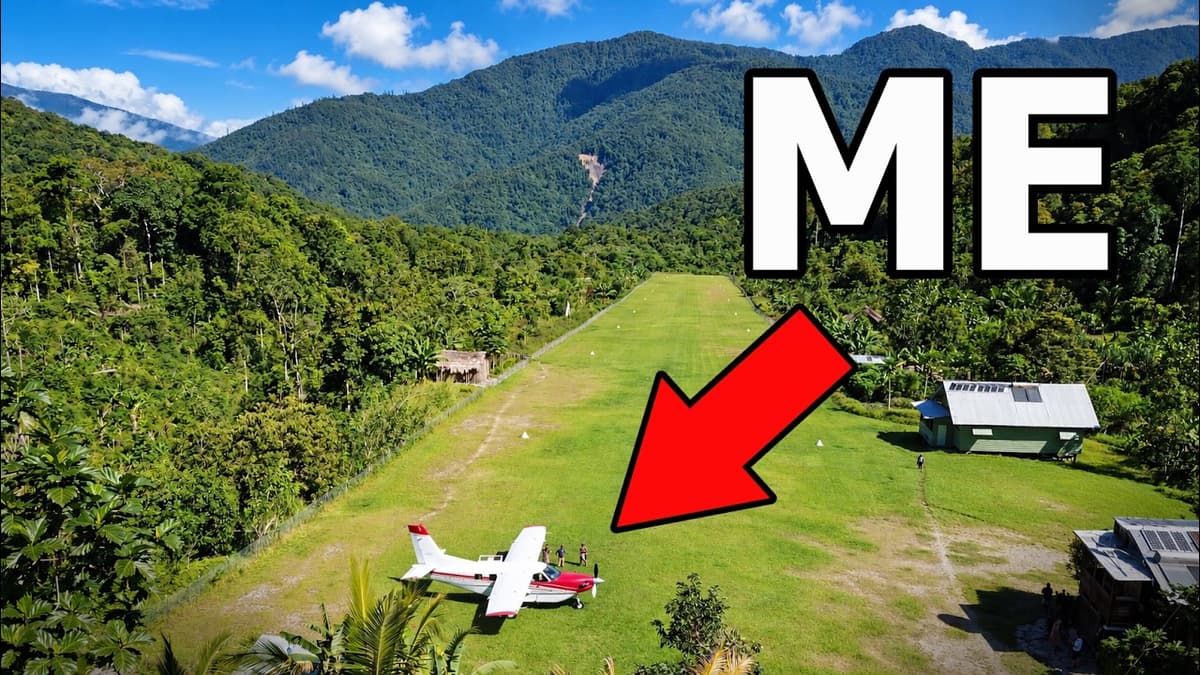
The video starts at the Yifki airstrip, where Missionary Bush Pilot has delivered fuel and a water tank. A situation develops concerning a sick person who needs to be flown out, with a delay over payment. This leads to a discussion about the challenges of the job, which extend beyond flying. Missionary Bush Pilot explains that working with a different culture is a key part of the role. He describes these interactions as just different, not better or worse, but sometimes awkward. While the issue is resolved, he gives a tour of the airstrip, noting the runway has a consistent six percent slope, making it a good training location. He also points out a typical local house, built without windows, as the settlement is at an elevation of around 3,000 feet.
Departure and Cruise
The community pays for the flight, and the sick passenger is boarded for the one hour and ten minute flight. After pre-departure checks, the pilot begins the takeoff on the sloped, grassy runway. The aircraft lifts off, and he makes a left turn to climb out of the valley, cleaning up the aircraft for the climb. The initial flight path involves navigating around mountains to gain altitude towards the planned cruise level of 11,000 feet. During the climb, he elaborates on the cultural aspects of his work, stating that learning to communicate across cultures is one of the most difficult parts of flying in PNG. This applies to the local population and colleagues from different nationalities. Upon reaching 11,000 feet, he demonstrates his technique for transitioning to cruise flight by letting the aircraft accelerate before reducing power.
Arrival into Goroka
Approaching a mountain pass near Mount Hagen, Missionary Bush Pilot prepares to enter Hagen airspace. He contacts Hagen Tower and receives traffic information about other aircraft in the area. He explains how clouds typically build over mountains, allowing a pilot to form a mental picture of the terrain without a terrain map. After being handed over from Moresby, he communicates with the tower and other pilots to maintain separation. The descent into Goroka is started early to create space from another aircraft. He performs the landing checklist, highlighting its value for a single pilot in keeping attention outside. He positions the aircraft for a left base to runway 35R at Goroka and is cleared to land. To be considerate of traffic behind, he maintains a slightly higher speed on final approach, which causes a longer float before a smooth touchdown.