VideosTRAINING
DA40 first flight: from simulator to real aircraft
Original title: He Trained Only in a Simulator. Then We Gave Him a Real Airplane | Flying New Guy
Pilot Institute Airplanes · 28:22 · 8 Aug 2026 · Watch on YouTube

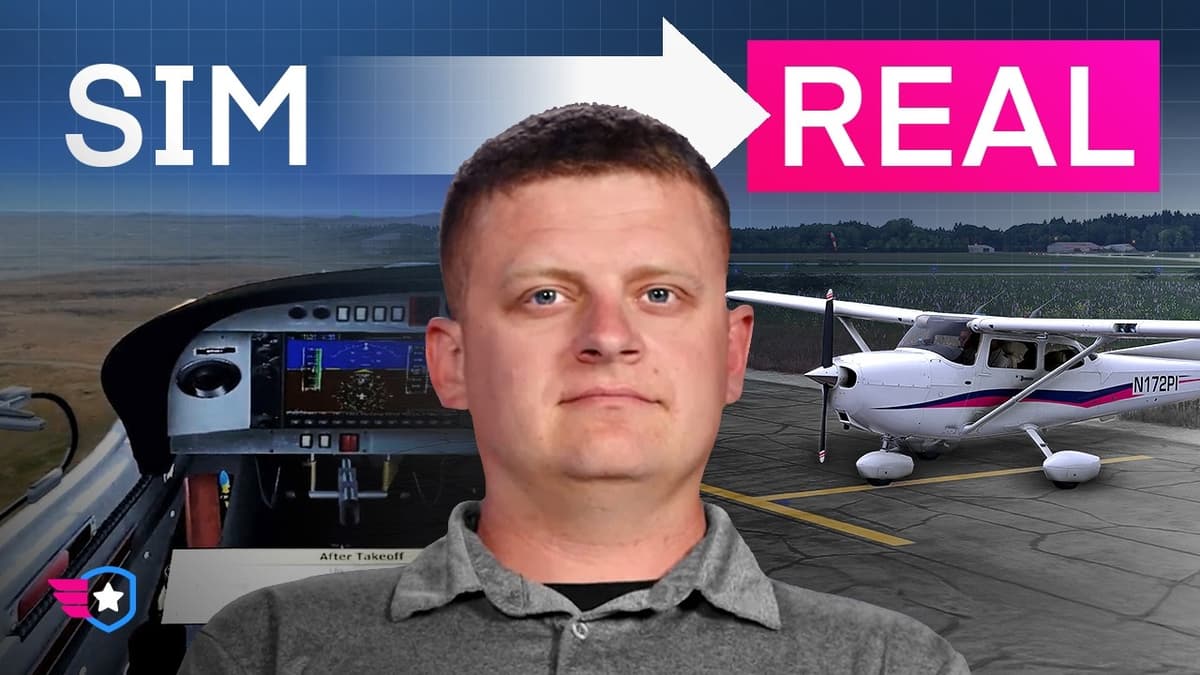
Instructor Tom and student Jason discuss Jason's first real flight in a DA40. The presenter joins them to compare the aircraft to the simulator.

What the video covers

Written in our own words. It only describes what the video shows and says.

Pre-flight preparation and taxiing

The video begins with the presenter introducing Jason, a student pilot transitioning from a True Course Simulations simulator to his first actual flight. Instructor Tom outlines the primary goals for the lesson, which include having fun, keeping the aircraft safe, and avoiding annoying ATC. Before heading out, Tom and Jason conduct a pre-flight briefing, a step the presenter notes is crucial for saving time and setting expectations. Once in the DA40 aircraft, Jason experiences taxiing for the first time. The presenter explains that the DA40 lacks a directional nose gear, meaning Jason must rely on differential braking rather than just rudder pedals to turn. Jason finds this challenging compared to the simulator, noting the necessity of anticipating turns and maintaining the centre line while communicating with Prescott Ground control.

Takeoff and basic flight manoeuvres

After navigating the taxiway, Tom guides Jason through the engine run-up checks. Tom instructs Jason to test the constant speed propeller three times to familiarise himself with the associated drops in oil pressure, RPM, and manifold pressure. Following the checks, Jason performs his first takeoff. He observes that the real aircraft accelerates much faster than the simulator and requires significantly less back pressure on the control stick to lift off at the rotation speed of 59 knots. Once airborne, they depart to the northwest to practice straight and level flight, climbs, descents, and turns to visual references. Jason remarks that the real aircraft is much more sensitive to environmental changes and control inputs than the simulator. Tom teaches Jason to use the gap between the horizon and the top of the instrument panel as a visual reference for pitch, emphasising the importance of keeping his attention primarily outside the cockpit.

Traffic pattern and landing demonstrations

Upon returning to the airport, Tom takes control to demonstrate how to enter the traffic pattern and perform a landing. During the first approach, they encounter unusual air currents off the approach end of runway 21 right, resulting in an unstable approach. Tom uses this opportunity to demonstrate a go-around, explaining to Jason that forcing a landing from an unstable altitude builds bad habits. They re-enter the rectangular traffic pattern, climbing to 700 feet before turning crosswind. On the subsequent approach, Tom shows Jason how to use the rudder to align with the runway and the ailerons to control drift. They complete a successful landing despite a minor wind gust, and the lesson concludes with Jason learning how to properly ground and refuel the aircraft. Tom praises Jason for his performance, estimating his skills align with those of a student who has already completed several hours of flight training, and outlines plans to cover slow flight and ground reference manoeuvres in their next session.

Statements in the video

4:16The DA40 aircraft does not have a directional nose gear, requiring the pilot to use differential braking to steer.The presenter explains this to the audience while discussing why Jason found taxiing difficult compared to the simulator.
22:27The instructor executed a go-around because the approach was unstable and the aircraft was too high.Instructor Tom tells Jason this during the flight to demonstrate why he chose not to force a landing from an unsafe altitude.

Moments from the video

0:00“Have fun, not wreck the airplane, and not annoy ATC. Straight and level flights, turn, climbs, descents, then come back in and conduct all of the different landings. We're going to see how Jason can take what he's learned from the simulator and turn it into…”3:57“Cool. And then we have our center line right here. That should track right down the middle of the airplane. So our inside leg should be sitting right on top of that yellow line. Okay. Always looking around, making sure our resident coyote doesn't come running…”8:02“It can be 10, 15 minutes discussing what's coming into the flight. And then before you go into your flight, you should know the day before what to expect. So Jason, I've seen him study in the office before his flight because he knows what's coming up. So you…”12:19“Give it a five count and watch the drop. And then after you're done with that, go back to both. One, two, three, four, five. Yep, so back to both. So that was a 70 RPM drop. Now go to the right. So two clicks. One, two, three, four, five.”16:14“it's much more sensitive to, to changes. Yeah. You have environmental things and of course it's summer right now, so it's going to be a little bumpier and a little harder for sure. Yep. All right. This is pretty good. Five knots high, 60 feet high. I'm good…”19:51“Because as you'll see in your upcoming flights, like when we're going to the practice area, when we're coming back, we're going that straight level flight. So you get the extra practice without having to like spend a whole lesson on it. I gotcha. All these…”23:58“All right, so here's a preview of what you're going to have to do when we do pattern work. So about the fourth stripe is going to be our landing point. So being our landing point, what we're going to do is we're going to reduce our power to about the bottom…”27:44“Overall, I thought it was a very successful flight. A good, a good starting, starting block. So what's next? So I think the next flight we're going to move on, we're going to be doing a slow flight and then ground reference maneuvers. Not sure that we'll be…”

More videos

All
Sign in
TRAINING

DA40 first flight: from simulator to real aircraft

Original title: He Trained Only in a Simulator. Then We Gave Him a Real Airplane | Flying New Guy
Pilot Institute Airplanes · 28:22 · 8 Aug 2026 · Watch on YouTube

Instructor Tom and student Jason discuss Jason's first real flight in a DA40. The presenter joins them to compare the aircraft to the simulator.

IN THIS VIDEO
  1. 0:00Pre-flight briefing and taxiing
  2. 8:50Engine run-up and first takeoff
  3. 16:14Straight and level flight manoeuvres
  4. 20:43Traffic pattern and go-around
  5. 27:44Post-flight debriefing and next steps

What the video covers

Written in our own words. It only describes what the video shows and says.

Pre-flight preparation and taxiing

The video begins with the presenter introducing Jason, a student pilot transitioning from a True Course Simulations simulator to his first actual flight. Instructor Tom outlines the primary goals for the lesson, which include having fun, keeping the aircraft safe, and avoiding annoying ATC. Before heading out, Tom and Jason conduct a pre-flight briefing, a step the presenter notes is crucial for saving time and setting expectations. Once in the DA40 aircraft, Jason experiences taxiing for the first time. The presenter explains that the DA40 lacks a directional nose gear, meaning Jason must rely on differential braking rather than just rudder pedals to turn. Jason finds this challenging compared to the simulator, noting the necessity of anticipating turns and maintaining the centre line while communicating with Prescott Ground control.

Takeoff and basic flight manoeuvres

After navigating the taxiway, Tom guides Jason through the engine run-up checks. Tom instructs Jason to test the constant speed propeller three times to familiarise himself with the associated drops in oil pressure, RPM, and manifold pressure. Following the checks, Jason performs his first takeoff. He observes that the real aircraft accelerates much faster than the simulator and requires significantly less back pressure on the control stick to lift off at the rotation speed of 59 knots. Once airborne, they depart to the northwest to practice straight and level flight, climbs, descents, and turns to visual references. Jason remarks that the real aircraft is much more sensitive to environmental changes and control inputs than the simulator. Tom teaches Jason to use the gap between the horizon and the top of the instrument panel as a visual reference for pitch, emphasising the importance of keeping his attention primarily outside the cockpit.

Traffic pattern and landing demonstrations

Upon returning to the airport, Tom takes control to demonstrate how to enter the traffic pattern and perform a landing. During the first approach, they encounter unusual air currents off the approach end of runway 21 right, resulting in an unstable approach. Tom uses this opportunity to demonstrate a go-around, explaining to Jason that forcing a landing from an unstable altitude builds bad habits. They re-enter the rectangular traffic pattern, climbing to 700 feet before turning crosswind. On the subsequent approach, Tom shows Jason how to use the rudder to align with the runway and the ailerons to control drift. They complete a successful landing despite a minor wind gust, and the lesson concludes with Jason learning how to properly ground and refuel the aircraft. Tom praises Jason for his performance, estimating his skills align with those of a student who has already completed several hours of flight training, and outlines plans to cover slow flight and ground reference manoeuvres in their next session.
Statements in the video

4:16The DA40 aircraft does not have a directional nose gear, requiring the pilot to use differential braking to steer.The presenter explains this to the audience while discussing why Jason found taxiing difficult compared to the simulator.
22:27The instructor executed a go-around because the approach was unstable and the aircraft was too high.Instructor Tom tells Jason this during the flight to demonstrate why he chose not to force a landing from an unsafe altitude.

Moments from the video

0:00“Have fun, not wreck the airplane, and not annoy ATC. Straight and level flights, turn, climbs, descents, then come back in and conduct all of the different landings. We're going to see how Jason can take what he's learned from the simulator and turn it into…”3:57“Cool. And then we have our center line right here. That should track right down the middle of the airplane. So our inside leg should be sitting right on top of that yellow line. Okay. Always looking around, making sure our resident coyote doesn't come running…”8:02“It can be 10, 15 minutes discussing what's coming into the flight. And then before you go into your flight, you should know the day before what to expect. So Jason, I've seen him study in the office before his flight because he knows what's coming up. So you…”12:19“Give it a five count and watch the drop. And then after you're done with that, go back to both. One, two, three, four, five. Yep, so back to both. So that was a 70 RPM drop. Now go to the right. So two clicks. One, two, three, four, five.”16:14“it's much more sensitive to, to changes. Yeah. You have environmental things and of course it's summer right now, so it's going to be a little bumpier and a little harder for sure. Yep. All right. This is pretty good. Five knots high, 60 feet high. I'm good…”19:51“Because as you'll see in your upcoming flights, like when we're going to the practice area, when we're coming back, we're going that straight level flight. So you get the extra practice without having to like spend a whole lesson on it. I gotcha. All these…”23:58“All right, so here's a preview of what you're going to have to do when we do pattern work. So about the fourth stripe is going to be our landing point. So being our landing point, what we're going to do is we're going to reduce our power to about the bottom…”27:44“Overall, I thought it was a very successful flight. A good, a good starting, starting block. So what's next? So I think the next flight we're going to move on, we're going to be doing a slow flight and then ground reference maneuvers. Not sure that we'll be…”
Practise for your exams and airline selectionStart for free

More videos