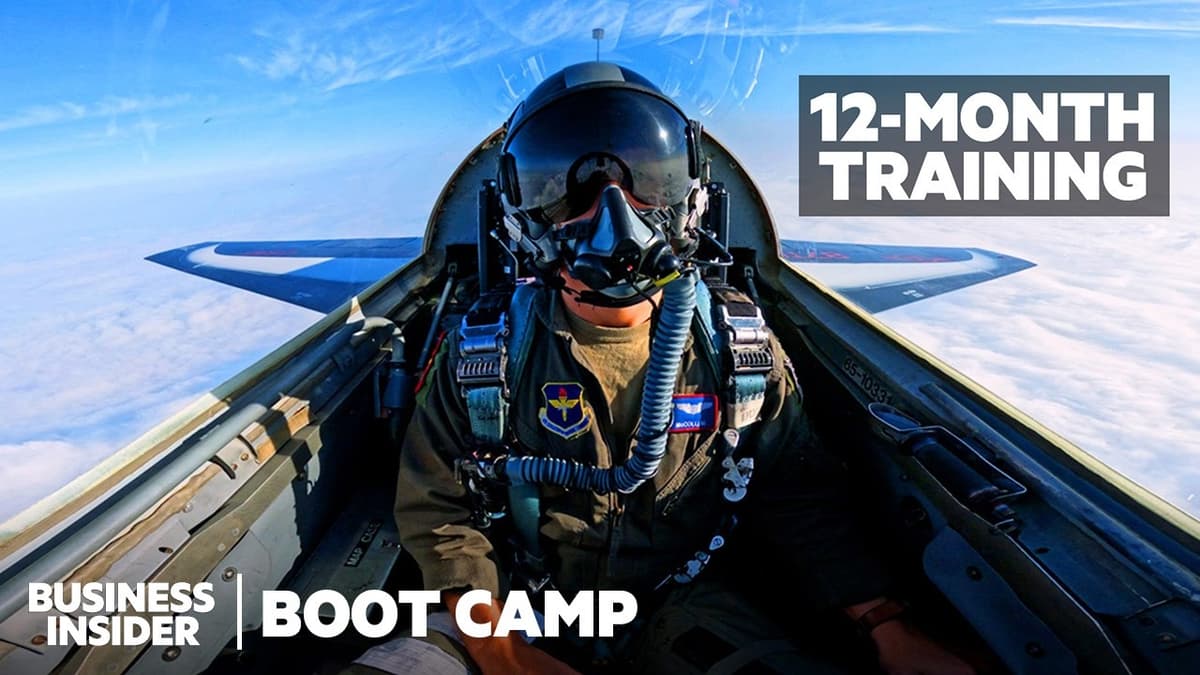
The video explores the training of United States Air Force pilots at Laughlin Air Force Base. Instructors and students describe the rigorous programme.
What the video covers
Written in our own words. It only describes what the video shows and says.Selection and academic foundation
The video begins by outlining the initial stages of becoming a United States Air Force pilot at Laughlin Air Force Base in Texas. According to the narrator, applicants must hold a four-year university degree, be commissioned as officers and pass various aptitude tests to be selected. The narrator explains that the base trains more pilots than any other in the Air Force and aims to address a recent pilot shortage by streamlining the training process. Students start with an academic phase lasting approximately 100 hours. During this time, instructors provide the theoretical foundation necessary for high-performance flying. Students learn about aircraft layout, flight instruments and weather systems. The narrator notes that this knowledge prepares them for the simulator phase, where they spend 50 to 60 hours across three types of devices. An instructor pilot explains that modern immersive training devices have halved the time it takes for students to fly solo compared to previous years.
Practical training and physiological preparation
Before stepping into an actual aircraft, students must be physically prepared for the intense forces they will encounter. The video shows students being custom-fitted for helmets, harnesses and G-suits. An instructor explains that the harness attaches the pilot to the parachute and seat kit, while the mask provides oxygen. Students also undergo spatial disorientation training using a simulator and a spinning device known as a Barany chair. The narrator states that this teaches students to rely on their instruments rather than their senses, which can be misleading in flight. Practical flight training begins in the T-6 Texan II, a single-engine turboprop. Students progress through transition, navigation and formation phases. According to the instructors and students featured in the video, every flight involves a thorough briefing to cover weather and operational risk management, followed by a critical debriefing session to discuss performance and safety objectives.
Advanced training and graduation
Top-performing students are selected to continue their training in the T-38 Talon, a twin-engine supersonic jet. An instructor pilot notes that the T-38 requires a higher level of situational awareness due to its speed and limited fuel capacity. The training in this aircraft includes a heavy emphasis on formation flying, which an instructor describes as a way to simulate the stress and pressure of a deployed environment. The video concludes with drop night, an event where students receive their future aircraft assignments. Students express their hopes of flying fighter jets like the F-16, F-35 or F-15, though the narrator points out that some graduates will remain as instructor pilots. Finally, the students participate in a graduation ceremony where they receive their wings, becoming United States Air Force pilots before moving on to aircraft-specific training at other bases.