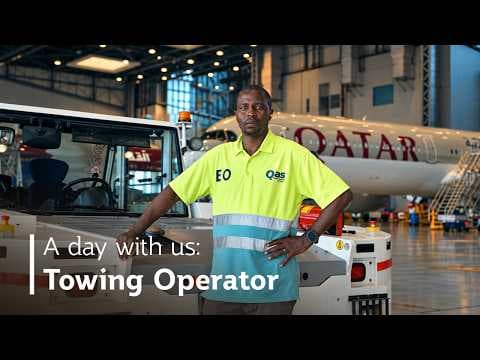
Thomas Chebii, a Qatar Aviation Services towing operator, explains repositioning at Hamad International Airport: checks, communication and speeds.
What the video covers
Written in our own words. It only describes what the video shows and says.Repositioning aircraft between flights
The video opens with questions about what happens to an aircraft between flights, who moves it, where it goes, and how a large aircraft can be towed safely. Thomas Chebii then introduces himself. He works for Qatar Aviation Services as an aircraft towing operator. He says he has done this work for over 10 years and that his main responsibility is to safely reposition aircraft at Hamad International Airport. He describes aircraft towing as repositioning an aircraft from one point to another. He gives examples, including moving an aircraft from a stand to a hangar for maintenance or moving an aircraft from any stand for departure.
Checks before a tow and communication
Chebii says checks are carried out before every tow. The team checks the tug, checks the aircraft connection and makes sure the area around them is clear. Once everything is confirmed, he says they are ready to go. He then turns to communication and says it is one of the most important parts of the job. He names the towing operator, the team around the aircraft, the cockpit crew and the other vehicles operating around them. He says everyone needs to be on the same page. Once movement begins, he says his focus is completely on the aircraft, the route ahead, and everything happening around them. He describes constantly looking around, checking surroundings, watching for other equipment and making sure the aircraft stays exactly where it needs to be.
Speed limits and the role in operations
Chebii says the speed limit for aircraft towing is a maximum of 20 kilometres per hour. For pushback it is five kilometres per hour. He says the aircraft must be respected at all times. He adds that many people work behind the scenes and that towing is one small part of that operation. He says he is proud to be responsible for that part. He then says the most rewarding part is knowing that moving an aircraft helps keep the operation running safely and efficiently. He says every aircraft has somewhere to be and every move has a purpose. He says that after doing the job for more than 10 years, he still gets that feeling every time he sees an aircraft move because he has a role in it.