Airline Outlook reports on Qantas's decision to retire its Airbus A380 fleet from 2028. The video covers the reasons and the replacement aircraft.
What the video covers
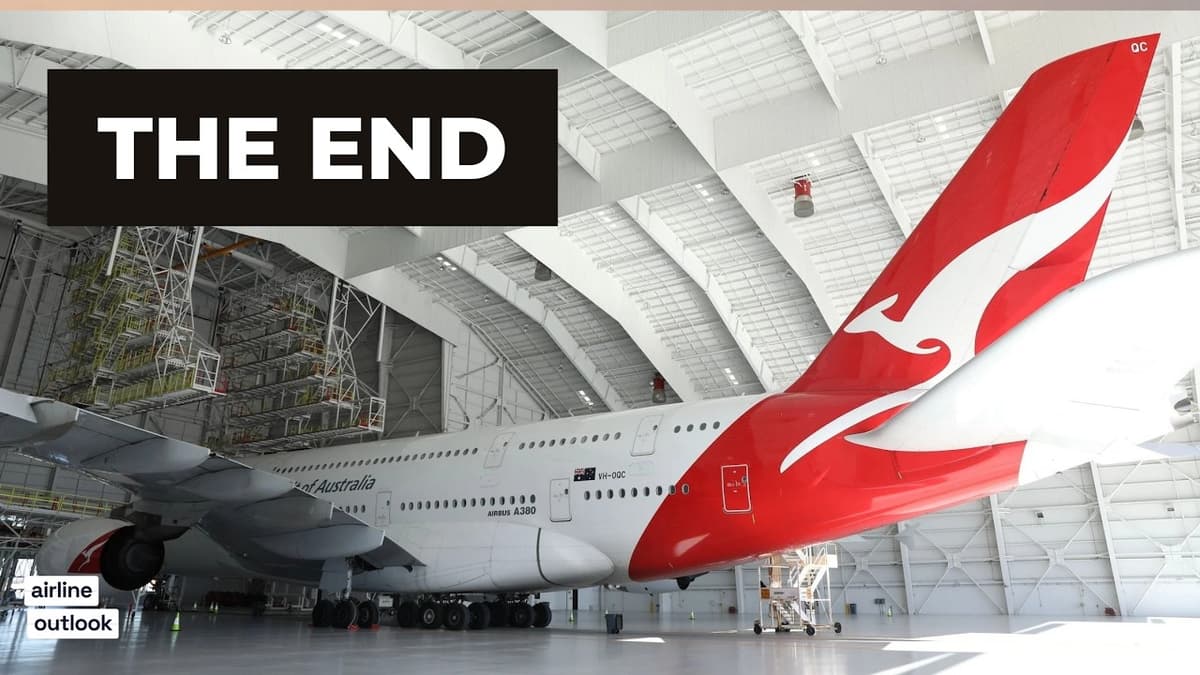
Written in our own words. It only describes what the video shows and says.Qantas announced on 27 August that it will begin retiring its Airbus A380 fleet from 2028, four years earlier than the previously stated date of 2032. Chief Executive Vanessa Hudson confirmed the decision, linking it to the arrival of new aircraft. The phase-out will be gradual, with the first A380 scheduled to leave service in March 2028. The airline has not yet announced a date for the final A380 flight. This accelerated retirement coincides with the delivery of new A350 and 787 aircraft, including the first Project Sunrise A350, which is expected to arrive in April 2027.
A History of the Fleet
This is not the first time Qantas has revised its A380 plans. The airline originally ordered 12 superjumbos in 2000, increasing its commitment to 20 aircraft in 2006. The first A380 was delivered in September 2008, and by 2011, all 12 of the initial order were in service. However, the remaining eight orders were cancelled in 2019. The entire fleet was grounded in 2020 during the pandemic and flown to storage in the California desert. Two of these aircraft never returned to service and were partly scrapped at Victorville. Today, 10 A380s remain, each with a capacity of 485 passengers. They are based in Sydney and operate on key routes to London, Dallas, Los Angeles and Johannesburg.
Reasons and Replacements
The video outlines two primary reasons for the early retirement. The first is the high cost of fuel, which was driven to record highs by conflict in the Middle East. Qantas reported that its fuel bill rose by 610 million Australian dollars, with the four-engined A380 being the most affected. The second reason is the fleet's age, which averages around 17 years. With Airbus having ceased A380 production in 2021, Qantas states that operating and maintenance costs are rising. The earlier exit is projected to save approximately 300 million Australian dollars. The A380s will be replaced by a new fleet of twin-engine jets, including 12 Project Sunrise A350-1000s, with the first non-stop Sydney to London flight planned for October 2027. Qantas also has firm orders for 12 more A350s and 12 Boeing 787s.
Strategy and Passenger Impact
These new aircraft are capable of flying further and can operate on all of Qantas's current international routes. While they carry fewer passengers than the A380, the airline expects its international operating margin to increase. For passengers, the most significant change is the disappearance of the dedicated first class cabin, as the A380 is the only aircraft in the current fleet to offer it. First class service will instead be offered in the six suites on board the new Project Sunrise A350s. The decision reflects a broader change in strategy for Qantas, moving away from the hub-and-spoke model that the A380 was designed for, and towards a focus on direct, long-range flights with smaller aircraft.