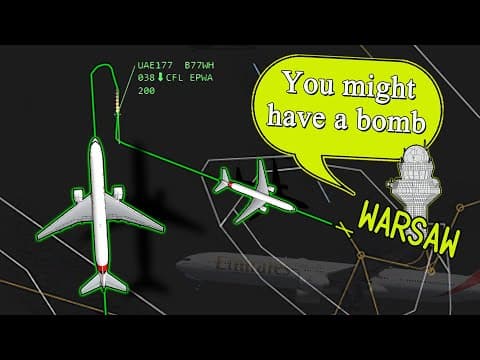
DW News correspondent Teri Schultz on the hoax bomb threats that hit seven flights to Warsaw, Rome, Murcia and Bulgaria.
What the video covers
Written in our own words. It only describes what the video shows and says.In this DW News report, the studio presenter talks to Brussels correspondent Teri Schultz about the bomb threats made against a series of flights across Europe on 3 November 2026. Several of the aircraft involved were operated by Ryanair, one by Scandinavian Airlines and one by the Polish airline LOT. Some flights made unscheduled landings. The authorities determined that all of the threats were false alarms.
Seven flights in one day
Schultz lists the flights affected: two bound for Warsaw, two for Rome, one for Murcia in Spain and two for Bulgaria. Nobody has claimed responsibility. With the investigations at a very early stage nobody can yet say whether the incidents are connected. She says seven in one day seems too many to be a coincidence, whether they turn out to be copycat incidents or part of a single campaign.
Where details have been released, some of the threats arrived as emails to aviation authorities, warning that a bomb, or in one case a dangerous item, might be on board. In that situation the authorities have no choice but to get the aircraft on the ground as quickly as possible, disembark the passengers and search the flight. Nothing was found on any of the aircraft. Schultz points to the cost of each diversion and to the passengers whose journeys were disrupted.
A hoax the day before
The presenter notes that the wave followed a similar case on Monday. Schultz confirms that a flight from London to Bulgaria had to land in Hungary after a bomb scare, which also proved to be a hoax. She links the day to an earlier incident in which fridges and freezers in several European countries were remotely instructed to heat up instead of cool down, while stressing that this cannot be compared with a possible threat to an aircraft. In both cases, she says, it is unusual that nobody has claimed responsibility.
EU meetings and the search for the sender
The EU held emergency meetings with the relevant agencies and with the authorities in the countries affected, to discuss how they can react together and deter similar incidents. Investigators are now trying to trace the emails. Schultz describes the aim of hybrid activity as making people feel unsafe and doubt that their authorities can protect them. She adds that the authorities are not pointing at anyone and need evidence before they do.