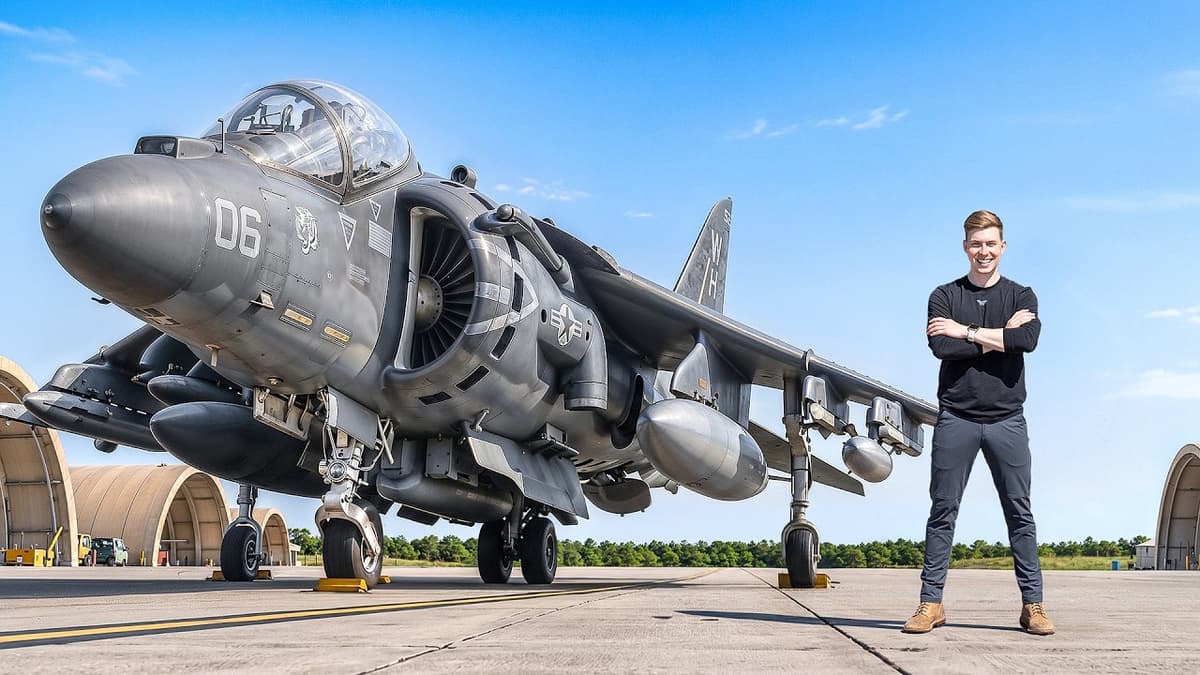
Sam Eckholm joins VMA 231 for the last days of the AV-8B Harrier and shows how the jump jet hovers, launches from ships and lands vertically.
What the video covers
Written in our own words. It only describes what the video shows and says.Sam Eckholm visits Marine Attack Squadron 231, the Ace of Spades, at Cherry Point during the final days of the AV-8B Harrier in United States Marine Corps service. The video presents the Harrier as the primary attack aircraft of the Marine Corps for the last 40 years. A Harrier pilot from the squadron says the jet feels completely wrong on a first flight because it is very unstable in the hover, so a lot of training goes into hovering and landing it.
From Hawker to the AV-8B Harrier II
The story starts in a small British design office during the Cold War. Long runways were an easy target, so Hawker Aircraft set out to build a jet that could take off and land vertically. The P1127 prototype used an engine with four rotating nozzles and made early vertical trials at sea on Ark Royal. The Royal Air Force adopted the Harrier GR1 by the late 1960s. The Marine Corps began flying the AV-8A in 1971, which the video says had short range, limited payload and outdated avionics. McDonnell Douglas then worked with British Aerospace on the AV-8B Harrier II, with a larger composite fuselage, a more powerful Rolls-Royce Pegasus, digital cockpit systems and a redesigned wing. It entered service in 1985.
Pegasus engine, nozzles and manual hovering
The pilot gives a length of about 47 feet, an empty weight of about 16,000 pounds and around 23,000 pounds of thrust at sea level. Intake suction doors open in the hover to bring in more air. Each side has a cold nozzle for air that has not been combusted and a hot nozzle for air that has. A lever next to the throttle moves the nozzles from fully aft to past vertical, which lets the pilot slow down quickly. There is no hover mode: power controls the glide slope while nose position moves the exhaust to control speed.
Ships, weapons and the Ace of Spades
Wasp-class ships are described as almost 250 feet shorter than a conventional carrier, with the landing signal officer calculating the distance needed and the ship speed for wind over the wings. Each wing has three pylons that can carry bombs up to 1,000 pounds and AIM-9 missiles. A 25 millimeter gun can be fitted, but firing it from the hover is not possible. VMA 231 is described as the oldest flying squadron in the Marine Corps, first activated in February 1919, with 52 years on the Harrier. The video closes with a final flight, a short takeoff, a vertical landing on reinforced pavement and reactions from pilots and maintainers.