VideosAIRLINES
A330neo Corsair flight to Reunion: departure and landing
Original title: A330neo MAX TAKEOFF! 11 Hours to Indian Ocean
Just Planes · 34:38 · 24 Oct 2026 · Watch on YouTube

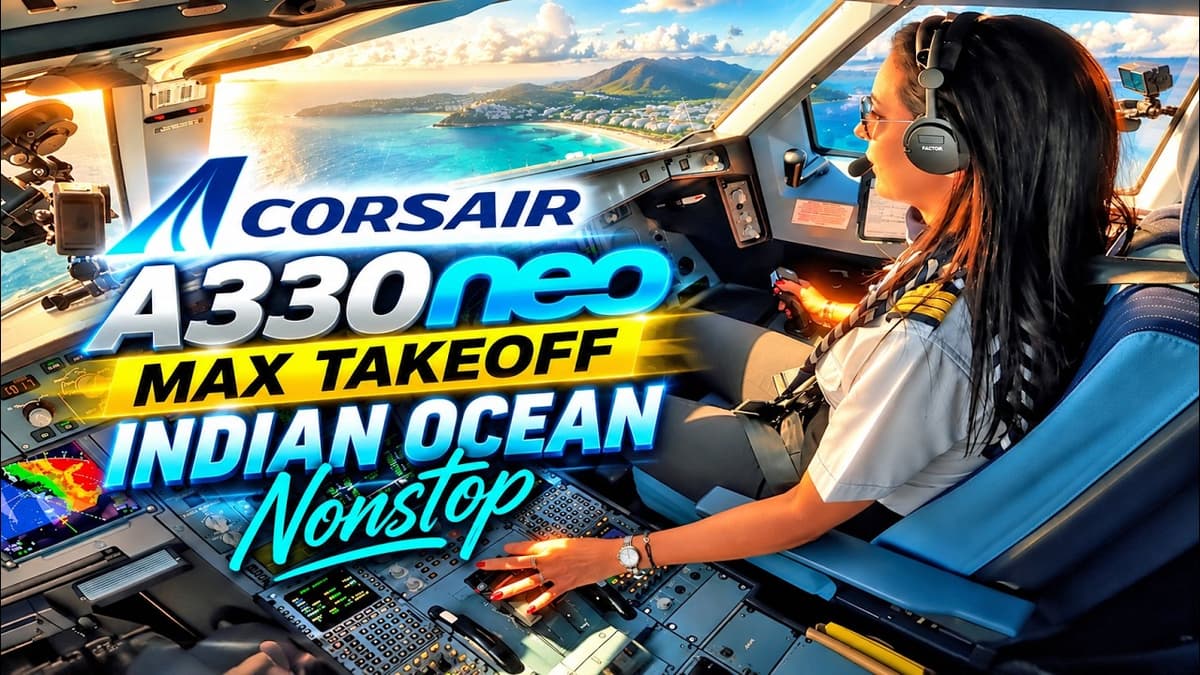
A Corsair A330-900 crew prepares for an 11-hour night flight from Paris to Reunion Island. The presenter narrates the departure, weather and arrival.

What the video covers

Written in our own words. It only describes what the video shows and says.

Departure from Paris

The video opens with a Corsair 910 briefing for a flight to Reunion Island. The crew discuss take-off performance, landing weight and the planned runway. The presenter then describes sitting in an Airbus A330-900 while the preliminary cockpit preparation checklist is started. Christelle is pilot flying and the presenter is pilot monitoring, and because the flight is long there are three pilots in the cockpit. The flight is described as an 11-hour night flight, with arrival around 10.30 local time the next morning. The presenter says departure will use runway 06 rather than the usual runway 07 because the aircraft is too heavy, and gives a take-off weight of about 245 tons against a maximum of 251 tons. The aircraft is pushed back facing west, engine 1 is started first, and the crew taxi to holding point Whiskey 47. The take-off briefing includes actions for failures before and after V1, a climb to 3000 feet after a possible engine failure, and a return for an ILS 06 approach.

Weather and routing

After take-off, the crew accelerate through speeds, retract flaps and climb to flight levels. The presenter shows the navigation display and explains that thunderstorms are visible around the aircraft. He says the red areas must never be entered, yellow areas should be avoided, and green areas relate to humidity. He adjusts the weather radar tilt to estimate cloud tops, saying one degree low corresponds to clouds at least 5000 feet below at about 50 miles. He also mentions the multi-scan radar and says the crew mostly stay in automatic. The route is shown from Paris over Switzerland, the Alps, eastern Italy, Greece, the border with Egypt, Luxor, Cairo, Jeddah, Asmara, Ethiopia, Somalia, the Indian Ocean and Madagascar. The presenter says the crew request 20 miles right of track to avoid bad weather, choosing the right side of the thunderstorm because they get out quicker and the wind comes from the west. The alternate airport is Mauritius.

Arrival at Reunion

Steve, described as the second first officer, says Captain Tim has gone for rest and Steve is the relief pilot. He notes the aircraft has left the Somalian shores near Mogadishu and is heading towards Seychelles airspace, with about three hours to go. The arrival briefing covers the planned arrival, ILS approach, minimum safe altitudes, final course 136, approach configuration, go-around to 3000 feet, extra fuel of 23 minutes and 2.1 tons, autobrake low and full reverse. The threats include terrain, with the minimum safe altitude and terrain shown on the navigation display, and the shorter runway length, with Alpha exit or an end U-turn mentioned. During descent, Corsair 910 heavy receives traffic information, including crossing another aircraft and an A400 1000 feet below. The crew configure for landing, receive a headwind of 22 knots, and land on runway 14. After landing, they are given stand number 4. The crew state the scheduled and actual times, and the next flight to Mayotte is mentioned.


Statements in the video

1:18The flight is an 11-hour night flight to Reunion Island, with arrival around 10.30 local time the next morning.The presenter states this while describing the cockpit preparation for the long flight.
1:26Departure will use runway 06 rather than the usual runway 07 because the aircraft is too heavy, with about 245 tons on take-off and a maximum of 251 tons.The presenter gives the take-off runway and weight during the pre-departure commentary.
14:01Steve says he is the second first officer, Captain Tim went for some rest, and Steve is the relief pilot.Steve states this after the aircraft has left the Somalian shores near Mogadishu.

Moments from the video

0:00“Today Corsair is 910 and we're briefing at the moment. So Christelle will be bringing us down to Reunion Island. Performance for take-off, we talk about normally we will take the runway 25. For me, due to the weather interference during two hours and”6:51“Flaps 0. Zurich, Schönen guten Abend, Corsair 910, heavy with you, climbing FL 330. Corsair 910, hallo, climb to FL 350. Climb now 350, Corsair 910.”10:01“There we go, minus two. You see that we start seeing the cloud a little bit better. And if I come tilt to zero, it'll probably disappear because, of course, it's below us. You see there's not much left. Now, the radar is, of course, very modern radar, so it's…”15:48“at 560 feet barreau and the go-around is by the left we'll come back on that during the threats climbing up to 3000 feet maximum and then we have an extra fuel of 23 minutes 2.1 tons”17:24“OK, I have it on NAV display. I propose to put on terrain on ND also, as mitigation. The second threat is the length of the runway, which is the shorter of the two, so if you need to vacate via Alpha it's perfect,…”27:34“Great, now I'm on predictive wind shear. After landing checklist complete. 300 200”33:44“11 hours and 4 minutes scheduled, 11 hours and 3 minutes, you saved us 1 minute, not bad. 120 kilos. Perfect. Beautiful weather, and so now a little bit of rest, and tomorrow we'll be flying out to Mayotte, which will be another adventure. Great flight, thank…”

More videos

All
Sign in
AIRLINES

A330neo Corsair flight to Reunion: departure and landing

Original title: A330neo MAX TAKEOFF! 11 Hours to Indian Ocean
Just Planes · 34:38 · 24 Oct 2026 · Watch on YouTube

A Corsair A330-900 crew prepares for an 11-hour night flight from Paris to Reunion Island. The presenter narrates the departure, weather and arrival.

IN THIS VIDEO
  1. 0:00Cockpit briefing and pushback
  2. 0:49A330-900 preparation and runway choice
  3. 7:34Weather radar and route deviation
  4. 14:57Arrival briefing and descent
  5. 23:02Landing and stand arrival

What the video covers

Written in our own words. It only describes what the video shows and says.

Departure from Paris

The video opens with a Corsair 910 briefing for a flight to Reunion Island. The crew discuss take-off performance, landing weight and the planned runway. The presenter then describes sitting in an Airbus A330-900 while the preliminary cockpit preparation checklist is started. Christelle is pilot flying and the presenter is pilot monitoring, and because the flight is long there are three pilots in the cockpit. The flight is described as an 11-hour night flight, with arrival around 10.30 local time the next morning. The presenter says departure will use runway 06 rather than the usual runway 07 because the aircraft is too heavy, and gives a take-off weight of about 245 tons against a maximum of 251 tons. The aircraft is pushed back facing west, engine 1 is started first, and the crew taxi to holding point Whiskey 47. The take-off briefing includes actions for failures before and after V1, a climb to 3000 feet after a possible engine failure, and a return for an ILS 06 approach.

Weather and routing

After take-off, the crew accelerate through speeds, retract flaps and climb to flight levels. The presenter shows the navigation display and explains that thunderstorms are visible around the aircraft. He says the red areas must never be entered, yellow areas should be avoided, and green areas relate to humidity. He adjusts the weather radar tilt to estimate cloud tops, saying one degree low corresponds to clouds at least 5000 feet below at about 50 miles. He also mentions the multi-scan radar and says the crew mostly stay in automatic. The route is shown from Paris over Switzerland, the Alps, eastern Italy, Greece, the border with Egypt, Luxor, Cairo, Jeddah, Asmara, Ethiopia, Somalia, the Indian Ocean and Madagascar. The presenter says the crew request 20 miles right of track to avoid bad weather, choosing the right side of the thunderstorm because they get out quicker and the wind comes from the west. The alternate airport is Mauritius.

Arrival at Reunion

Steve, described as the second first officer, says Captain Tim has gone for rest and Steve is the relief pilot. He notes the aircraft has left the Somalian shores near Mogadishu and is heading towards Seychelles airspace, with about three hours to go. The arrival briefing covers the planned arrival, ILS approach, minimum safe altitudes, final course 136, approach configuration, go-around to 3000 feet, extra fuel of 23 minutes and 2.1 tons, autobrake low and full reverse. The threats include terrain, with the minimum safe altitude and terrain shown on the navigation display, and the shorter runway length, with Alpha exit or an end U-turn mentioned. During descent, Corsair 910 heavy receives traffic information, including crossing another aircraft and an A400 1000 feet below. The crew configure for landing, receive a headwind of 22 knots, and land on runway 14. After landing, they are given stand number 4. The crew state the scheduled and actual times, and the next flight to Mayotte is mentioned.

Statements in the video

1:18The flight is an 11-hour night flight to Reunion Island, with arrival around 10.30 local time the next morning.The presenter states this while describing the cockpit preparation for the long flight.
1:26Departure will use runway 06 rather than the usual runway 07 because the aircraft is too heavy, with about 245 tons on take-off and a maximum of 251 tons.The presenter gives the take-off runway and weight during the pre-departure commentary.
14:01Steve says he is the second first officer, Captain Tim went for some rest, and Steve is the relief pilot.Steve states this after the aircraft has left the Somalian shores near Mogadishu.

Moments from the video

0:00“Today Corsair is 910 and we're briefing at the moment. So Christelle will be bringing us down to Reunion Island. Performance for take-off, we talk about normally we will take the runway 25. For me, due to the weather interference during two hours and”6:51“Flaps 0. Zurich, Schönen guten Abend, Corsair 910, heavy with you, climbing FL 330. Corsair 910, hallo, climb to FL 350. Climb now 350, Corsair 910.”10:01“There we go, minus two. You see that we start seeing the cloud a little bit better. And if I come tilt to zero, it'll probably disappear because, of course, it's below us. You see there's not much left. Now, the radar is, of course, very modern radar, so it's…”15:48“at 560 feet barreau and the go-around is by the left we'll come back on that during the threats climbing up to 3000 feet maximum and then we have an extra fuel of 23 minutes 2.1 tons”17:24“OK, I have it on NAV display. I propose to put on terrain on ND also, as mitigation. The second threat is the length of the runway, which is the shorter of the two, so if you need to vacate via Alpha it's perfect,…”27:34“Great, now I'm on predictive wind shear. After landing checklist complete. 300 200”33:44“11 hours and 4 minutes scheduled, 11 hours and 3 minutes, you saved us 1 minute, not bad. 120 kilos. Perfect. Beautiful weather, and so now a little bit of rest, and tomorrow we'll be flying out to Mayotte, which will be another adventure. Great flight, thank…”
READ MORE ON PILOTINQ
What is Getting to Grips with Aircraft Performance?
Practise for your exams and airline selectionStart for free

More videos