Delta CEO Ed Bastian says there will never be fewer than two pilots in his cockpits. Meanwhile EASA has put eMCO, with one pilot at the controls in cruise, on hold. What regulators decided, what manufacturers and pilots want, what AI in the cockpit can really do and what it means if you want to become an airline pilot.


- Delta CEO Ed Bastian told CNN there will never be fewer than two pilots in a Delta cockpit as long as he is there.12
- Research for EASA concluded in June 2025 that eMCO, with one pilot at the controls in cruise, cannot currently be shown to be as safe as two pilots.4
- EASA put its rulemaking task, first for eMCO and then retitled to smart cockpits, on hold in late 2025; the rules once planned for 2027 will not come.914
- Garmin Autoland is on more than 2,500 smaller aircraft; EASA expects AI that assists pilots in eMCO only around 2035.3435
- ECA, IFALPA, ALPA and BALPA campaign for two pilots, and in May 2026 EASA again recommended two persons on the flight deck at all times.2330313215
"There will never be less than two pilots in a Delta cockpit, as long as I'm here." That is what Ed Bastian, chief executive of Delta Air Lines, told CNN's Randi Kaye in an interview CNN published on 7 October1. He expects it to "stand true for a very long time", and said Delta wants to use technology "to make our pilots' jobs as easy as possible and as safe as possible"2. Bastian was answering a question about AI in the cockpit. Artificial intelligence, he said, should make his people smarter and more efficient at a company with 100,000 employees, 1,200 aircraft and 5,000 flights a day, and he admitted that the pace of AI development worries him2. CBS News Minnesota aired a longer version of the interview on 14 October2.
The promise lands in a debate that has been running for years. Aircraft manufacturers wanted a flight deck with only one pilot at the controls during cruise, and perhaps one day a single pilot from take-off to landing. Pilot associations around the world campaign against it. Between the two camps, the European Union Aviation Safety Agency (EASA) set out to establish whether it could be done safely. We looked at what has actually been decided, what AI in the cockpit can really do today, and what it means if you want to become an airline pilot.
What eMCO and single pilot operations mean
Two concepts dominate the debate. The first is eMCO, extended minimum crew operations. EASA defines it as "operations in which there are extended periods of the cruise phase with a minimum flight crew of one pilot at the controls while the other pilot(s) is(are) resting"3. Take-off, climb, descent and landing would still be flown by two pilots. The aim, according to the final report of the research EASA commissioned, is to reduce the number of pilots needed on long-haul flights4.
The second is SiPO or SPO, single pilot operations: one pilot from start to finish, supported by automation and possibly by a colleague on the ground. That is a much bigger step. The researchers found that "several significant issues" must be resolved before SiPO can reach the safety level of today's airline operations with large aircraft, and that in practice the aircraft would have to be capable of autonomous flight5.
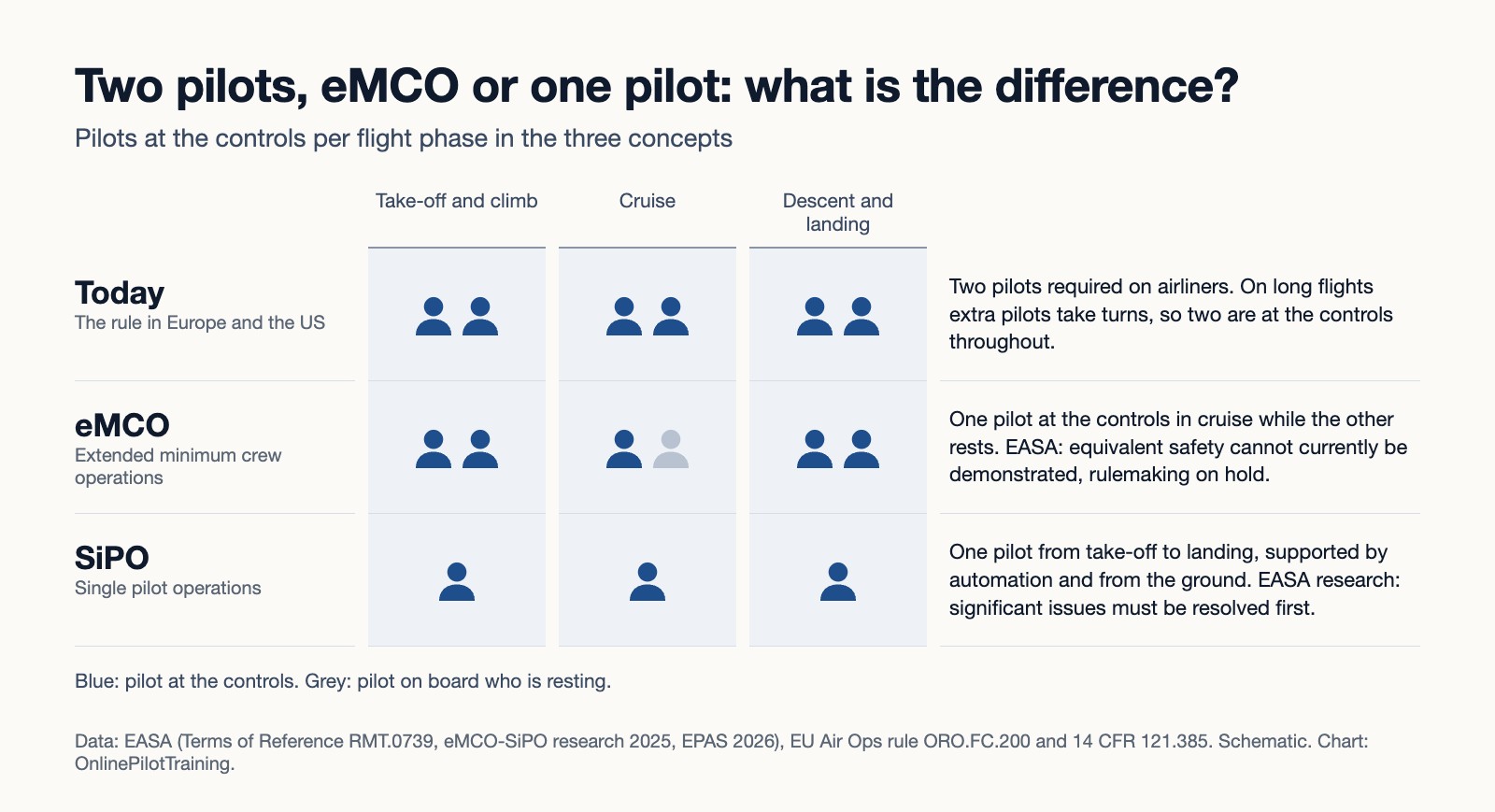
Today's rules are clear. In Europe, commercial flights with any turbojet aeroplane, and with turboprops configured for more than nine passenger seats, need at least two pilots when flown under instrument flight rules or at night6. In the United States the rule for airline flights reads simply: "The minimum pilot crew is two pilots"7. On long flights, extra pilots take turns so that two are always at the controls. Europe even has a specific role for this, the cruise relief co-pilot, who relieves the co-pilot only in cruise above flight level 20086. eMCO cannot exist without changing these rules, and that is what the whole debate is about.
Where the regulators stand
EASA formally started work on eMCO rules in December 2023 with rulemaking task RMT.0739. The goal was a framework that allows eMCO safely while "ensuring at least an equivalent level of safety to that ensured by today's multi-crew operations"3. The plan published in January 2024 foresaw a public consultation in 2025, an opinion in 2026 and the final rules in 20279.
A year later the plan looked different. In January 2025 EASA renamed the task: it became a regulatory framework for advanced flight deck technologies, the so-called smart cockpits. That technology first has to prove itself in normal two-pilot operations. eMCO became a possible later step, and the rules moved to 203010. EASA's executive director Florian Guillermet had already set the tone at EASA's Annual Safety Conference in late October 2024: "we will only approve new functionalities once they have been demonstrated to bring safety benefits"11.
Then came the outcome of the research EASA commissioned from a consortium led by the aerospace research centre NLR, funded under the EU's Horizon Europe programme with a budget of EUR 930,00012. The final report, dated 5 June 2025, is unambiguous: "It is therefore concluded that an equivalent level of safety between eMCO and normal crew operations can currently not be demonstrated." The main problems: detecting pilot incapacitation, cross-checking each other's actions, and sleep inertia, the grogginess after being woken4. EASA adopted the finding in its own safety plan: with the current cockpit design as the reference, equivalent safety "cannot be sufficiently demonstrated". eMCO was removed as a strategic priority13, and the rulemaking task, by then retitled to smart cockpits, has been on hold since late 202514.
That is not a permanent no. EASA writes that advanced flight deck technologies and further research are needed before the feasibility of such concepts is explored again13. But there is no longer a European eMCO rule scheduled for 2027 or 2030. In May 2026 EASA even moved the other way: it once again recommends that operators keep two authorised persons on the flight deck at all times, so also when one of the pilots briefly leaves15.
Globally the plan has stalled too. At the 2022 ICAO Assembly, the EU and other European states asked ICAO to create the enablers for operations with fewer pilots and to review the relevant annexes16, while Costa Rica and IFALPA asked the Assembly to examine whether ICAO should commit any resources to eMCO at all17. The Technical Commission concluded that further work was needed on "a structured plan, based on a clear concept of operations", with at least an equivalent or higher level of safety, and referred the item to the ICAO Council18. At the 2025 Assembly, IFALPA, the International Transport Workers' Federation (ITF) and air traffic controllers' federation IFATCA filed a paper citing the EASA research and stating that the risks of eMCO are "beyond tolerable levels"19. In the US, 45 senators wrote to the Secretary of Transportation in July 2025, urging the FAA to oppose single-pilot operations for airlines at ICAO, including EASA's eMCO concept20.
What manufacturers and airlines want
The push for eMCO came from aircraft manufacturers, who approached EASA with the concept4. In 2021 Reuters reported that Airbus, under the name Project Connect, was working to certify the A350 for single-pilot operations in high-altitude cruise, with Cathay Pacific as a possible first operator from 2025. Cathay said it was engaging with Airbus on the concept but had "not committed in any way to being the launch customer". Lufthansa had also worked on the programme but said it had no plans to use it21. The 2025 launch did not happen. In May 2025 Cathay said it has no plans to introduce single-pilot operations, while it does talk to manufacturers about more automation22.
According to the European Cockpit Association (ECA), both Airbus and Dassault Aviation were actively pursuing the removal of one pilot from the flight deck during cruise23. Dassault's Falcon 10X, the French business jet maker's new flagship, was presented in 2021 with "integrated provisions to anticipate regulatory allowance for duty time credits in two-pilot operations", and pilot seats that could in future recline flat for rest24. The aircraft first flew on 19 June 2026; Dassault chief executive Éric Trappier now expects service entry in 202925.
Airbus keeps developing technology that assists pilots. In January 2023 it announced tests under the name DragonFly on an A350-1000: an automated emergency diversion in cruise, in which the aircraft handled a simulated incapacitated crew member by planning a new route and communicating with air traffic control and the airline's operations centre, plus automatic landing, and taxi assistance tested at Toulouse-Blagnac26. Earlier, its ATTOL project achieved autonomous taxiing, take-off and landing of a commercial aircraft in test flights using on-board image recognition, concluding in June 202027. Boeing's subsidiary Wisk is going furthest of all, but in a different market: its Generation 6 eVTOL, supervised from the ground, first flew in December 2025 and is described by Wisk as the first candidate for an FAA-certified autonomous passenger aircraft in the US28. Airlines themselves have been far more cautious. IATA director general Willie Walsh said in 2022 he doubted single-pilot operations would be seen soon, "if ever"29. Bastian's line fits that picture: technology that makes the job easier and safer, without removing a pilot2.
What pilots say
Pilot associations speak with one voice. ECA launched its One Means None campaign in July 2024. Its president called one pilot in the cockpit for an extensive period of a flight "a gamble with the safety of our 200 to 400 passengers in the back of the plane". "Pilots do not just fly a plane: we monitor each other and all flight aspects", he said23. IFALPA, which represents pilots in more than 70 countries, declared in April 2025 that it is "resolute in opposing Reduced Crew Operations" and that safety hinges on "two properly rested, fully qualified, and well-trained pilots on the flightdeck at all times"30. ALPA in North America runs the Safety Starts with Two campaign and published its white paper "A Gamble with Safety" in 202431. The British pilots' union BALPA warns among other things of sleep inertia that could leave a resting pilot "ineffective in an emergency"32.
Their arguments come down to four points. Fatigue: a pilot monitoring systems alone for hours tires faster. Incapacitation: if the only pilot at the controls collapses, nobody notices at once. Workload: in a failure, one pilot has to do everything at the same time. And waking up: a pilot pulled out of rest needs time to get back to full alertness19. Incapacitation and sleep inertia return in the conclusion of the EASA research, together with the loss of cross-checking between pilots4.
What AI in the cockpit can really do
Much of what already happens automatically in a cockpit is not AI. An autopilot follows fixed rules, and airliners have flown automatic landings for decades. The most talked-about system right now comes from general aviation: Garmin Autoland. At the push of a button, or automatically when the pilot stops interacting with the avionics or the cabin loses pressure, it flies the aircraft to an airport and lands33. It was first certified in May 2020; according to Garmin more than 2,500 aircraft now carry it, across more than 15 models, including the first twin-engine jets since 202634.
On 20 December 2025 it landed a real aircraft outside testing for the first time: a Beechcraft King Air B200 that lost cabin pressure climbing through 23,000 feet after departing Aspen, Colorado, and landed at Rocky Mountain Metropolitan Airport. Only the two pilots were on board, and they chose to let Autoland do its job. Reports that the pilots were incapacitated are incorrect according to the operator; they came from the system's automated radio messages33. It shows both what the technology can do and what it is for: a safety net, not a replacement.
Airbus's DragonFly goes further, with automatic diversion and landing on an A350-100026. But those are tests, not certified airline systems. EASA's view on real AI is set out in its AI Roadmap 2.0 of May 2023. It defines three levels: AI that assists the human (Level 1), human-AI teaming (Level 2) and advanced automation in which the AI takes decisions (Level 3). Systems that assist the pilot in eMCO or single pilot operations fall under Level 2, which EASA expects around 2035, stressing that this is "not a formal target but rather a prediction". Autonomous AI in commercial air transport is placed at 2050 or later35. In November 2025 EASA published its first regulatory proposal on AI, covering Level 1 and Level 2 systems in line with the EU AI Act36.
The safety cases: why the second seat matters
The event closest to eMCO happened on 17 February 2024, on a Lufthansa Airbus A321 flying from Frankfurt to Seville. The captain went to the lavatory and the co-pilot suffered a sudden and severe incapacitation. According to Spain's investigation body CIAIAC, the aircraft then flew for about ten minutes in cruise on autopilot "without additional supervision by either pilot". During his incapacitation the co-pilot inadvertently operated switches and flight controls. The captain regained access, took control and diverted to Madrid37. EASA cites this event in its May 2026 bulletin: periods of single piloting "can result in prolonged unmonitored flight and potential loss of aircraft control, even with modern avionics"15.
How often does it happen? In a survey of 6,300 pilots for the EASA research, respondents reported on average that a crew member has to take over because a colleague is totally incapacitated once every 10,000 flight hours, and because of subtle incapacitation once every 1,667 flight hours38. These are pilots' own reports, and they show these are not theoretical scenarios.
The best-known cases show what two pilots can do together. When US Airways flight 1549 lost almost all thrust in both engines after a bird strike in January 2009, the crew ditched the A320 on the Hudson River, and all 150 passengers and 5 crew survived. The NTSB credited the crew's "excellent crew resource management"39. On Qantas flight QF32 in November 2010, five pilots were on board the A380 when it suffered an uncontained engine failure; the investigators found that the additional pilots on the flight deck provided support to the primary crew40.
The honest picture also shows that two pilots are no guarantee. On Air France 447 in 2009, two co-pilots lost control of their A330 while the captain was resting41. And on Germanwings 9525 in 2015, the co-pilot waited until he was alone in the cockpit42. Moments like Germanwings and the Lufthansa incident, with one person on the flight deck, are exactly what led EASA to recommend two persons at all times again15. For eMCO, the wake-up problem adds to this: sleep inertia is one of the main reasons the researchers could not demonstrate equivalent safety, so in a sudden failure the resting pilot cannot help straight away4.
What passengers think
The clearest poll on one pilot comes from Australia. For the pilots' association AIPA, Redbridge asked 1,022 Australians how they would feel about a flight with one pilot at the controls: 89 percent would feel less safe and 83 percent would be more hesitant to book. Only 2 percent would feel safer43. On fully pilotless aircraft, an Ipsos poll for ALPA in 2018 found that only 15 percent of Americans would be comfortable, while 80 percent saw two pilots working together as the best option for solving problems in flight44. A YouGov poll of 16,632 people in 15 countries for the ITF in 2024 found that 76 percent would not be comfortable on an autonomous plane with no pilot on board45. For airlines, that trust is a business reason to stick with two pilots.
What this means for you as a (future) pilot
The key point first: the profession is here to stay. In Europe no eMCO rule is scheduled any more, the researchers see major obstacles to single pilot operations, and EASA does not expect AI that genuinely assists a pilot in such operations until around 203514535. If you start an ATPL course now, you will finish in roughly two years and fly in a two-pilot flight deck. Demand is strong: Boeing expects the industry to need 674,000 new pilots between 2026 and 204546, and Airbus arrives at 660,000, as we covered in our analysis of the Airbus forecast.
The first place where eMCO would bite is the relief crew on long-haul flights, the extra pilots who take turns so that two are always at the controls8. Pilot associations stress that working alongside an experienced colleague for the whole flight is how experience passes to the next generation of captains19. As long as the rules stay as they are, that route remains open. In business aviation the US is even tightening up: the FAA has stopped issuing, and is rescinding, single-pilot exemptions for older Cessna Citations, as we reported in our story on the CE-500 decision.
What will change is the flight deck itself. More automation, smarter alerting and systems like Autoland are becoming normal. The pilot of the future needs to understand that technology, monitor it and take over when it fails. That is why the core skills tested in airline selections stay the same: processing information quickly, working together under pressure and making sound decisions. You can prepare with practice for airline and academy pilot selections, build your own practice plan, and try the pilot aptitude test. Read how to become an airline pilot, compare airline pilot salaries, and see Delta's pilot profile or the latest pilot jobs.
Timeline: from plan to pause
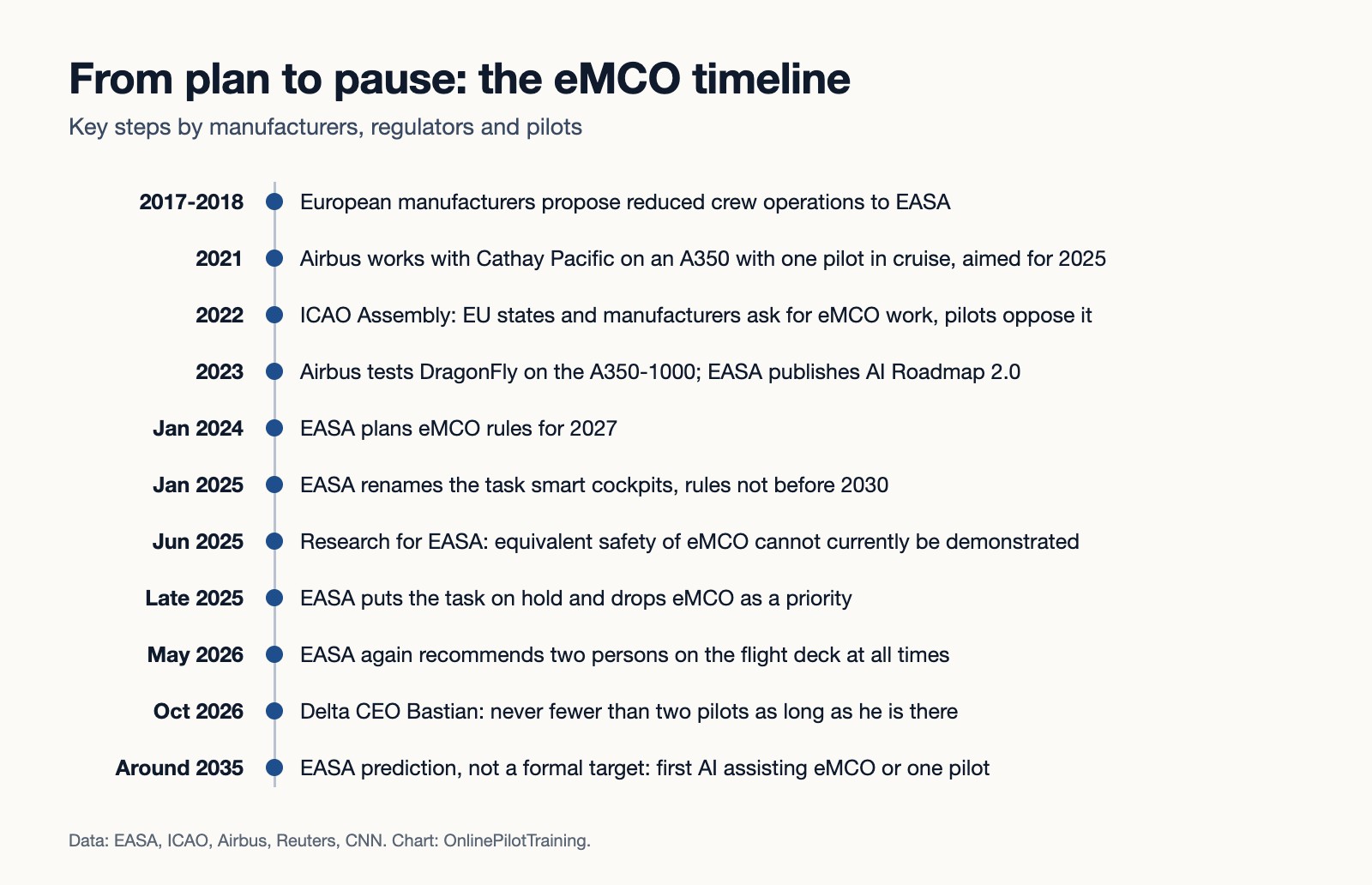
The direction is clear. In 2021 an A350 with one pilot in cruise looked possible within a few years21. In January 2024 EASA still planned rules for 20279. Within two years that moved to 203010, and the task went on hold after the research could not demonstrate equivalent safety414. The next step is up to technology: a smarter flight deck first has to prove itself with two pilots on board13. If you start your training now, that is the flight deck where your career begins. And if Delta's Bastian has his way, it will stay that way for a very long time2.
Sources
- 1CNN · How AI will change the Delta experience (video, Randi Kaye)7 Oct 2026
- 2CBS News Minnesota · "There will never be less than two pilots in a Delta cockpit," CEO Ed Bastian says14 Oct 2026
- 3EASA · Terms of Reference RMT.0739: Introduction of extended minimum-crew operations (eMCO)20 Dec 2023
- 4EASA / NLR · eMCO-SiPO D-9: Final report on risk assessment for eMCOs and SiPOs5 Jun 2025
- 5EASA / NLR · eMCO-SiPO D-8: Report on the preliminary safety risk identification for SiPOs5 Jun 2025
- 6EUR-Lex · Regulation (EU) No 965/2012 (Air Operations), consolidated text, ORO.FC.200 and ORO.FC.A.2011 May 2025
- 7eCFR · 14 CFR 121.385: Composition of flight crew1 Oct 2026
- 8EASA · Easy Access Rules for Aircrew (Regulation (EU) No 1178/2011), FCL.010 cruise relief co-pilot
- 9EASA · European Plan for Aviation Safety 2024, Volume II23 Jan 2024
- 10EASA · European Plan for Aviation Safety 2025, Volume II21 Jan 2025
- 11EASA · EASA Annual Safety Conference 2024: how technological innovation can help humans enhance aviation safety13 Nov 2024
- 12EASA · eMCO-SiPO: Extended Minimum Crew Operations, Single Pilot Operations, Safety Risk Assessment Framework (research project)
- 13EASA · European Plan for Aviation Safety 2026, Addendum to Volume I24 Nov 2025
- 14EASA · European Plan for Aviation Safety 2026, Volume II
- 15EASA · Safety Information Bulletin 2016-09R1: Minimum Cockpit Occupancy18 May 2026
- 16ICAO · A41-WP/101: An approach to new operational concepts involving extended minimum crew operations and single-pilot operations1 Aug 2022
- 17ICAO · A41-WP/323: Extended Minimum Crew Operations (Costa Rica and IFALPA)2 Aug 2022
- 18ICAO · A41-WP/653: Report of the Technical Commission on Agenda Item 314 Oct 2022
- 19ICAO · A42-WP/521: Extended Minimum Crew Operations (IFALPA, ITF and IFATCA)29 Aug 2025
- 20ALPA · US Senators Urge FAA24 Jul 2025
- 21Reuters · Exclusive: Cathay working with Airbus on single-pilot system for long-haul flights16 Jun 2021
- 22South China Morning Post · Hong Kong's Cathay Pacific says no plans to introduce single-pilot flights27 May 2025
- 23SNPL (ECA press release) · Pilots from ECA take a stand against Single Pilot flights: One Means None4 Jul 2024
- 24Dassault Aviation · Falcon 10X backgrounder
- 25AIN · Dassault Falcon 10X Service Entry Slips from 2027 to 202923 Jul 2026
- 26Airbus · Airbus tests new technologies to enhance pilot assistance12 Jan 2023
- 27Airbus · Airbus concludes ATTOL with fully autonomous flight tests29 Jun 2020
- 28Wisk · Wisk Completes First Flight of Generation 6 Autonomous eVTOL16 Dec 2025
- 29FlightGlobal · IATA chief doubts single-pilot operations will be seen soon, if ever9 Dec 2022
- 30IFALPA · Conference Statement 20256 Apr 2025
- 31ALPA · A Gamble with Safety: ALPA's new white paper on reduced-crew operations (Air Line Pilot, September 2024)
- 32BALPA · Reduced Crew Operations: #SafetyStartsWith2
- 33AIN · Garmin Autoland Logs First In-service Activation23 Dec 2025
- 34Garmin · More than 2,500 aircraft are now equipped with Garmin's revolutionary Autoland system14 Oct 2026
- 35EASA · Artificial Intelligence Roadmap 2.010 May 2023
- 36EASA · EASA's first regulatory proposal on artificial intelligence in aviation now open for consultation (NPA 2025-07)10 Nov 2025
- 37CIAIAC · Technical report IN-001/2024, Airbus A321 D-AISO, 17 February 2024 (English translation)27 Nov 2024
- 38EASA / NLR · eMCO-SiPO D-5: Report on pilot incapacitation management13 Nov 2024
- 39NTSB · AAR-10/03: Loss of Thrust in Both Engines After Encountering a Flock of Birds, US Airways Flight 15494 May 2010
- 40ATSB · AO-2010-089: In-flight uncontained engine failure, Airbus A380-842, VH-OQA27 Jun 2013
- 41BEA · Final Report on the accident on 1st June 2009 to the Airbus A330-203, F-GZCP, flight AF 447
- 42BEA · Final Report: Accident on 24 March 2015 to the Airbus A320-211, D-AIPX
- 43AIPA · Passengers reject single-pilot flights: new poll (Redbridge Group)
- 44Ipsos · Few Would be Comfortable with Flying on Pilotless Airliners31 Jul 2018
- 45ITF · Crackdown on rights at odds with public opinion (ITF Global Poll 2024, YouGov)
- 46Boeing · Pilot and Technician Outlook 2026-2045