Airbus forecasts 660,000 new pilots by 2045: where they are needed and what it means for you

Airbus expects the industry to need 660,000 new pilots over the next twenty years, with Europe and the CIS the largest region, and the training market to grow to US$17 billion. The numbers by region, the assumptions, how they compare with Boeing and CAE, and what the demand means for aspiring airline pilots.

By the PilotinQ editorial team · based on 15 sourcesPublished 19 Oct 2026, 07:36 UTC · 7 min read
LinkedInXWhatsAppFacebook
Cockpit of an Airbus A350-900 full flight simulator with two empty pilot seats, screens switched on and taxiway markings in the visual system
The cockpit of an A350-900 simulator in Hong Kong. Airbus expects twice as many simulator hours to be needed over the next twenty years (archive image, 2024). Photo: Ilari Kousa via Wikimedia Commons · CC BY-SA 4.0
IN SHORT
  • Airbus forecasts that the industry needs 660,000 new pilots, 730,000 technicians and 1,050,000 cabin crew from 2026 to 2045, more than 2.44 million people in total.1
  • The training market grows from US$10 billion in 2026 to US$17 billion a year by 2045, according to Airbus.51
  • Europe and the CIS need the most new pilots, 136,000, followed by China with 123,000.2
  • Boeing arrives at 674,000 pilots for the same period; CAE expects 267,000 new commercial pilots by 2034.78
  • Forecasts move with the market: Boeing cut its pilot forecast by 20% in 2021 and expects pressure on recruitment over the next one to two years.117

The airline industry will need 660,000 new pilots over the next twenty years, according to the Airbus Global Services Forecast 2026-2045, presented in Toulouse on 14 October. Airbus also expects demand for 730,000 new maintenance technicians and 1,050,000 new cabin crew, more than 2.44 million people to train in total1. The market for training them grows to US$17 billion a year by 2045, Airbus says1. Europe tops the regional breakdown: together with the CIS countries it needs more new pilots than any other region2. Here are the numbers by region, the assumptions behind them, how they compare with Boeing and CAE, and what they mean if you are heading for an airline cockpit.

What Airbus forecasts

The Global Services Forecast is the annual Airbus outlook for everything it takes to keep aircraft flying: maintenance, parts, modifications, digital services and training. Airbus expects that market to double from US$209 billion in 2026 to US$422 billion in 20453. The forecast rests on a world fleet growing to 45,550 aircraft by 2045 and on passenger numbers doubling to 10 billion a year1. In 2026 the services market supports more than 29,000 aircraft, according to Airbus4.

The demand for people follows from fleet growth and from replacing today's workforce. Over 2026 to 2045 Airbus counts 660,000 pilots, 730,000 technicians and 1,050,000 cabin crew1. It splits that need in two: people to sustain the growth and people to replace the current workforce5. Airbus values the training market at US$10 billion in 2026, growing by an average of 3.1% a year to US$17 billion in 204551. "The industry must intensify efforts to attract and train new talent," Airbus adds1.

Where the pilots are needed

Airbus also breaks the demand down by region. Europe and the CIS need 136,000 new pilots, the highest figure of any region. China follows with 123,000 and the rest of Asia-Pacific with 112,000. North America comes to 109,000, the Middle East and Africa to 92,000, South Asia to 50,000 and Latin America and the Caribbean to 38,0002.
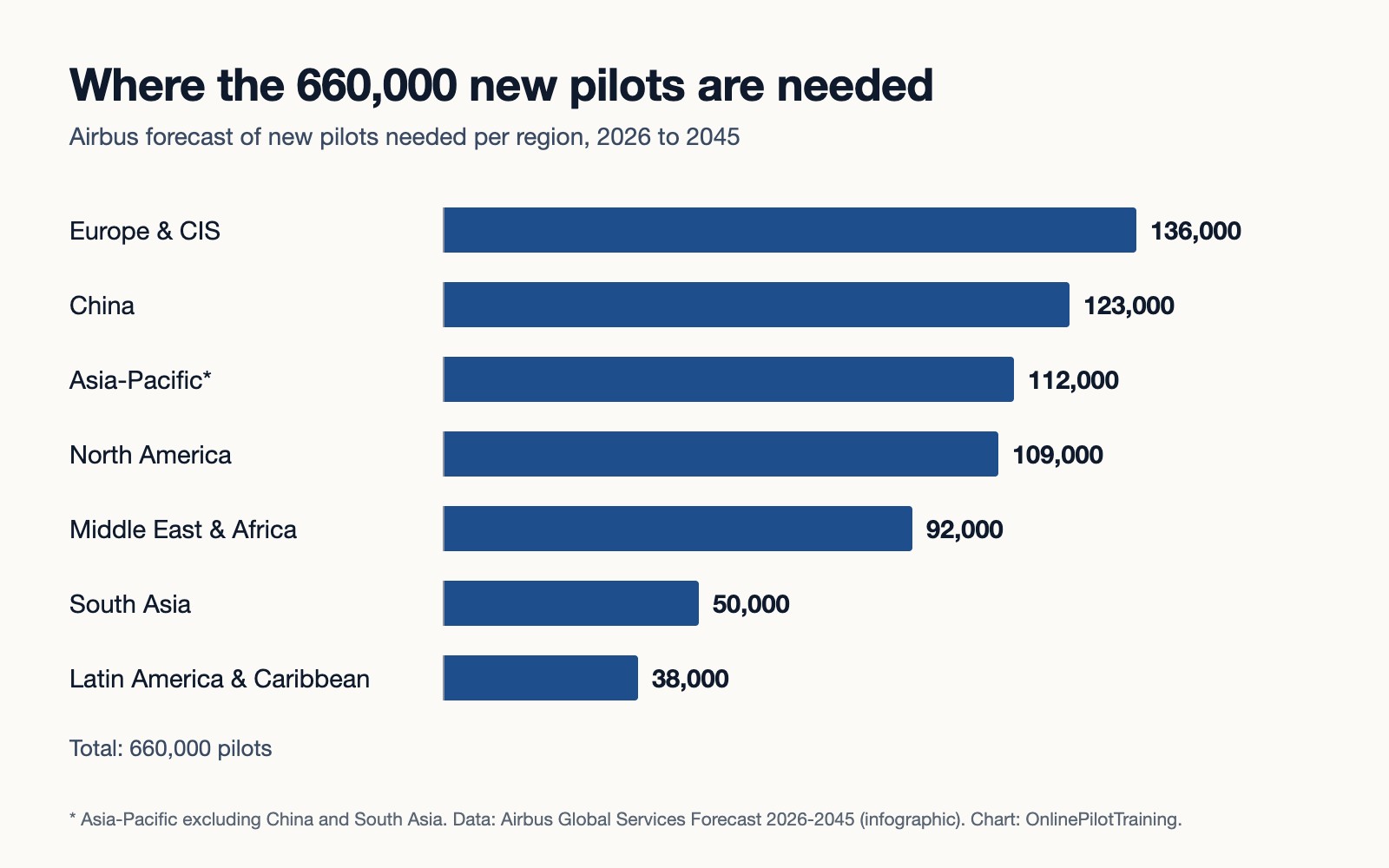
Bar chart of the new pilots Airbus expects each region to need from 2026 to 2045: Europe and CIS 136,000, China 123,000, Asia-Pacific 112,000, North America 109,000, Middle East and Africa 92,000, South Asia 50,000, Latin America and Caribbean 38,000.
New pilots needed per region, 2026 to 2045, according to the Airbus forecast. Chart based on the infographic published with the Airbus Global Services Forecast 2026-2045.

The table adds technicians and cabin crew. Cabin crew demand is the largest everywhere, and in six of the seven regions the number of technicians is above the number of pilots2.

RegionPilotsTechni­ciansCabin crew
Europe and CIS136,000180,000209,000
China123,000126,000193,000
Asia-Pacific (without China, South Asia)112,000120,000203,000
North America109,000112,000135,000
Middle East and Africa92,00090,000172,000
South Asia50,00052,00079,000
Latin America and Caribbean38,00050,00059,000
Total660,000730,0001,050,000

For the services market as a whole, Airbus sees the centre of gravity moving east. Today North America and Europe with the CIS account for nearly half of demand; in twenty years that share falls to around 40%, while Asia generates more than 40% of the global market. South Asia is the fastest growing region3.

The assumptions behind the number

A twenty-year forecast is only as strong as its assumptions, and the biggest one is fleet growth. According to the Airbus presentation, 42,060 new passenger aircraft will be delivered by 2045: 22,240 for growth and 19,820 to replace older aircraft5.

The forecast covers passenger jets with more than 100 seats and freighters with a payload above 10 tonnes, from all manufacturers. Regional jets are not included3, so pilots of smaller regional aircraft are not part of the 660,000.

The second driver is replacement, and in Europe part of it is written into the rules. Under EASA Part-FCL, a pilot aged 60 to 64 may only fly commercial air transport as a member of a multi-pilot crew, and from 65 not at all6. Boeing notes that replacement demand is especially pronounced among pilots in North America and Europe, where a significant share of the workforce will retire over the next decade7.

Airbus, Boeing and CAE side by side

Airbus is not the only one doing the maths. Boeing published its Pilot and Technician Outlook for the same period this year and arrives at 674,000 new pilots, 728,000 technicians and 1,023,000 cabin crew7. Simulator maker and training provider CAE looks ten years ahead and expects commercial aviation to need 267,000 new pilots by 2034, plus 33,000 in business aviation8.

ForecastPeriodNew pilotsEurope
Airbus Global Services Forecast 20262026 to 2045660,000136,000 (Europe and CIS)2
Boeing Pilot and Technician Outlook 20262026 to 2045674,000153,000 (Eurasia)7
CAE Aviation Talent Forecast 2025to 2034267,000 (commercial aviation)not in the press release8
Airbus Global Services Forecast 20252025 to 2044633,000not in the press release9

The differences come partly from scope: Boeing includes regional jets in its fleet forecast and divides the world into different regions7. Both manufacturers raised their number this year. Last year Airbus forecast 633,000 pilots to 20449 and Boeing 660,00010.

Forecasts versus reality

Line the forecasts of recent years up and you see how sensitive they are to the market. In 2019 Boeing still forecast a need for 804,000 pilots. After the pandemic hit, that fell to 763,000 in 2020 and to 612,000 in 2021, a 20% cut in one year11. Boeing is now back at 674,0007.

The near term is not a straight line either. Boeing writes that geopolitical and weather-related disruptions in 2026 led some carriers to adjust their recruitment plans for pilots and cabin crew. It expects the effect to be temporary within the twenty-year horizon, but to put pressure on recruitment and capacity planning over the next one to two years7. In June IATA cut its forecast for passenger traffic growth in 2026 to 2.1%, with 2.8% in Europe, and expects the airline industry's net margin to fall to 2%, the weakest result since the pandemic years12. Airlines are also short of new aircraft, as we covered in our piece on the aircraft shortage to 2030.

None of that changes the long-term picture. All three forecasts point to hundreds of thousands of new pilots, and the retirements are largely fixed by age limits. The pace per year and per airline moves with the economy, fuel prices and aircraft deliveries.

A US$17 billion training market

Training that many people also changes how they are trained. Airbus expects twice as many full flight simulator hours to be needed over the next twenty years. It names competency-based training and assessment (CBTA), where you are assessed on competencies rather than ticked-off exercises, as the way to standardise training worldwide, and expects a bigger role for virtual reality5. Boeing sees the same trend: CBTA is moving earlier in the training pipeline, and airlines increasingly use their own cadet programmes, partner schools and financing arrangements7.

What the demand looks like at European airlines

Airbus does not break the 136,000 for Europe and the CIS down by country2. What airlines and schools publish themselves gives a clearer picture of the routes into the cockpit. KLM says it has "a great need to recruit pilots now and in the future", according to Eimerd Bult, who runs flight operations at the airline. Graduates of the KLM Flight Academy are guaranteed a job as a KLM pilot, and since 1 January 2026 students can pay for their training through a deduction from their gross salary over 120 months13. In Belgium, Brussels Airlines runs its own MPL cadet programme with Skywings Flight Training: after 19 months successful cadets join the Airbus A320 fleet as first officers, and the partly sponsored programme costs EUR 112,500 including VAT14. EPST offers integrated training of about 18 months at schools in Norway, Greece and Switzerland, followed by a six-week MCC course, at EUR 110,500 to EUR 117,500; it also developed the COMPASS test, which it says airlines and training organisations around the world have used for years15.

What this means for you

If you want to fly for an airline, the message from the forecasts is clear: the industry needs new pilots every year for the next two decades, and Europe and the CIS need more of them than any other region. Preparation is what it always was, but the choices are getting sharper. Look at what comes after graduation: a job guarantee, a first officer contract with a cadet programme, or support towards a first job, as EPST offers with its integrated course. Training takes eighteen months to two years, so the market you apply into is not today's market.

Selection remains the biggest hurdle. You can practise for specific airline and academy selections on our selection pages, including KLM Flight Academy, Transavia, EPST and COMPASS, and build your preparation step by step with your own practice plan. What pilots earn is in our airline pilot salary guide, with pages for airlines such as KLM and Brussels Airlines. Already trained? See the latest pilot jobs.

About:Training marketAirbusBoeingKLMBrussels AirlinesEASA
KEEP READINGPRACTICEPractise for airline and academy pilot selectionsPRACTICEBuild your own practice planANSWERAirline pilot salaries by airlineANSWERHow to become an airline pilotPILOT JOBSLatest pilot jobsAsk your own pilot question

Sources

  1. 1Airbus · Airbus forecasts growing services market to double by 204514 Oct 2026
  2. 2Airbus · Global Services Forecast 2026-2045: infographics (New workforce to train by 2045, regional breakdown)14 Oct 2026
  3. 3Airbus · Airbus Global Services Forecast 2026-204514 Oct 2026
  4. 4Airbus · GSF 2026-2045 Highlights14 Oct 2026
  5. 5Airbus · Global Services Forecast 2026-2045: presentation14 Oct 2026
  6. 6EASA · Easy Access Rules for Aircrew (Regulation (EU) No 1178/2011), FCL.065
  7. 7Boeing · Pilot and Technician Outlook 2026-2045
  8. 8CAE · CAE forecasts 1.5 million civil aviation professionals needed over next 10 years16 Jun 2025
  9. 9Airbus · Airbus projects resilient growth of services market in the next 20 years9 Oct 2025
  10. 10Boeing · Boeing Forecasts 20-Year Global Demand for Nearly 2.4 Million New Commercial Pilots, Technicians, Cabin Crew22 Jul 2025
  11. 11AOPA · Boeing 20-year pilot outlook indicates 20 percent decline16 Sep 2021
  12. 12IATA · Global Outlook for Air Transport, June 2026
  13. 13KLM · New funding arrangement KLM Flight Academy students19 Dec 2025
  14. 14Brussels Airlines · Brussels Airlines MPL Cadet Program (accessed 19 October 2026)19 Oct 2026
  15. 15EPST · Pilot training at EPST flight school (accessed 19 October 2026)19 Oct 2026
CHANGES19 Oct 2026, 07:36 UTC · PublishedSpotted an error? Tell us, corrections are noted under the article.Every fact is checked against the sources listed above. How we work

More on training market

Sign in

Airbus forecasts 660,000 new pilots by 2045: where they are needed and what it means for you

Airbus expects the industry to need 660,000 new pilots over the next twenty years, with Europe and the CIS the largest region, and the training market to grow to US$17 billion. The numbers by region, the assumptions, how they compare with Boeing and CAE, and what the demand means for aspiring airline pilots.

By the PilotinQ editorial team · based on 15 sourcesPublished 19 Oct 2026, 07:36 UTC · 7 min read
Cockpit of an Airbus A350-900 full flight simulator with two empty pilot seats, screens switched on and taxiway markings in the visual system
The cockpit of an A350-900 simulator in Hong Kong. Airbus expects twice as many simulator hours to be needed over the next twenty years (archive image, 2024). Photo: Ilari Kousa via Wikimedia Commons · CC BY-SA 4.0
IN SHORT
  • Airbus forecasts that the industry needs 660,000 new pilots, 730,000 technicians and 1,050,000 cabin crew from 2026 to 2045, more than 2.44 million people in total.1
  • The training market grows from US$10 billion in 2026 to US$17 billion a year by 2045, according to Airbus.51
  • Europe and the CIS need the most new pilots, 136,000, followed by China with 123,000.2
  • Boeing arrives at 674,000 pilots for the same period; CAE expects 267,000 new commercial pilots by 2034.78
  • Forecasts move with the market: Boeing cut its pilot forecast by 20% in 2021 and expects pressure on recruitment over the next one to two years.117

The airline industry will need 660,000 new pilots over the next twenty years, according to the Airbus Global Services Forecast 2026-2045, presented in Toulouse on 14 October. Airbus also expects demand for 730,000 new maintenance technicians and 1,050,000 new cabin crew, more than 2.44 million people to train in total1. The market for training them grows to US$17 billion a year by 2045, Airbus says1. Europe tops the regional breakdown: together with the CIS countries it needs more new pilots than any other region2. Here are the numbers by region, the assumptions behind them, how they compare with Boeing and CAE, and what they mean if you are heading for an airline cockpit.

What Airbus forecasts

The Global Services Forecast is the annual Airbus outlook for everything it takes to keep aircraft flying: maintenance, parts, modifications, digital services and training. Airbus expects that market to double from US$209 billion in 2026 to US$422 billion in 20453. The forecast rests on a world fleet growing to 45,550 aircraft by 2045 and on passenger numbers doubling to 10 billion a year1. In 2026 the services market supports more than 29,000 aircraft, according to Airbus4.

The demand for people follows from fleet growth and from replacing today's workforce. Over 2026 to 2045 Airbus counts 660,000 pilots, 730,000 technicians and 1,050,000 cabin crew1. It splits that need in two: people to sustain the growth and people to replace the current workforce5. Airbus values the training market at US$10 billion in 2026, growing by an average of 3.1% a year to US$17 billion in 204551. "The industry must intensify efforts to attract and train new talent," Airbus adds1.

Where the pilots are needed

Airbus also breaks the demand down by region. Europe and the CIS need 136,000 new pilots, the highest figure of any region. China follows with 123,000 and the rest of Asia-Pacific with 112,000. North America comes to 109,000, the Middle East and Africa to 92,000, South Asia to 50,000 and Latin America and the Caribbean to 38,0002.

Bar chart of the new pilots Airbus expects each region to need from 2026 to 2045: Europe and CIS 136,000, China 123,000, Asia-Pacific 112,000, North America 109,000, Middle East and Africa 92,000, South Asia 50,000, Latin America and Caribbean 38,000.
New pilots needed per region, 2026 to 2045, according to the Airbus forecast. Chart based on the infographic published with the Airbus Global Services Forecast 2026-2045.

The table adds technicians and cabin crew. Cabin crew demand is the largest everywhere, and in six of the seven regions the number of technicians is above the number of pilots2.

RegionPilotsTechni­ciansCabin crew
Europe and CIS136,000180,000209,000
China123,000126,000193,000
Asia-Pacific (without China, South Asia)112,000120,000203,000
North America109,000112,000135,000
Middle East and Africa92,00090,000172,000
South Asia50,00052,00079,000
Latin America and Caribbean38,00050,00059,000
Total660,000730,0001,050,000

For the services market as a whole, Airbus sees the centre of gravity moving east. Today North America and Europe with the CIS account for nearly half of demand; in twenty years that share falls to around 40%, while Asia generates more than 40% of the global market. South Asia is the fastest growing region3.

The assumptions behind the number

A twenty-year forecast is only as strong as its assumptions, and the biggest one is fleet growth. According to the Airbus presentation, 42,060 new passenger aircraft will be delivered by 2045: 22,240 for growth and 19,820 to replace older aircraft5.

The forecast covers passenger jets with more than 100 seats and freighters with a payload above 10 tonnes, from all manufacturers. Regional jets are not included3, so pilots of smaller regional aircraft are not part of the 660,000.

The second driver is replacement, and in Europe part of it is written into the rules. Under EASA Part-FCL, a pilot aged 60 to 64 may only fly commercial air transport as a member of a multi-pilot crew, and from 65 not at all6. Boeing notes that replacement demand is especially pronounced among pilots in North America and Europe, where a significant share of the workforce will retire over the next decade7.

Airbus, Boeing and CAE side by side

Airbus is not the only one doing the maths. Boeing published its Pilot and Technician Outlook for the same period this year and arrives at 674,000 new pilots, 728,000 technicians and 1,023,000 cabin crew7. Simulator maker and training provider CAE looks ten years ahead and expects commercial aviation to need 267,000 new pilots by 2034, plus 33,000 in business aviation8.

ForecastPeriodNew pilotsEurope
Airbus Global Services Forecast 20262026 to 2045660,000136,000 (Europe and CIS)2
Boeing Pilot and Technician Outlook 20262026 to 2045674,000153,000 (Eurasia)7
CAE Aviation Talent Forecast 2025to 2034267,000 (commercial aviation)not in the press release8
Airbus Global Services Forecast 20252025 to 2044633,000not in the press release9

The differences come partly from scope: Boeing includes regional jets in its fleet forecast and divides the world into different regions7. Both manufacturers raised their number this year. Last year Airbus forecast 633,000 pilots to 20449 and Boeing 660,00010.

Forecasts versus reality

Line the forecasts of recent years up and you see how sensitive they are to the market. In 2019 Boeing still forecast a need for 804,000 pilots. After the pandemic hit, that fell to 763,000 in 2020 and to 612,000 in 2021, a 20% cut in one year11. Boeing is now back at 674,0007.

The near term is not a straight line either. Boeing writes that geopolitical and weather-related disruptions in 2026 led some carriers to adjust their recruitment plans for pilots and cabin crew. It expects the effect to be temporary within the twenty-year horizon, but to put pressure on recruitment and capacity planning over the next one to two years7. In June IATA cut its forecast for passenger traffic growth in 2026 to 2.1%, with 2.8% in Europe, and expects the airline industry's net margin to fall to 2%, the weakest result since the pandemic years12. Airlines are also short of new aircraft, as we covered in our piece on the aircraft shortage to 2030.

None of that changes the long-term picture. All three forecasts point to hundreds of thousands of new pilots, and the retirements are largely fixed by age limits. The pace per year and per airline moves with the economy, fuel prices and aircraft deliveries.

A US$17 billion training market

Training that many people also changes how they are trained. Airbus expects twice as many full flight simulator hours to be needed over the next twenty years. It names competency-based training and assessment (CBTA), where you are assessed on competencies rather than ticked-off exercises, as the way to standardise training worldwide, and expects a bigger role for virtual reality5. Boeing sees the same trend: CBTA is moving earlier in the training pipeline, and airlines increasingly use their own cadet programmes, partner schools and financing arrangements7.

What the demand looks like at European airlines

Airbus does not break the 136,000 for Europe and the CIS down by country2. What airlines and schools publish themselves gives a clearer picture of the routes into the cockpit. KLM says it has "a great need to recruit pilots now and in the future", according to Eimerd Bult, who runs flight operations at the airline. Graduates of the KLM Flight Academy are guaranteed a job as a KLM pilot, and since 1 January 2026 students can pay for their training through a deduction from their gross salary over 120 months13. In Belgium, Brussels Airlines runs its own MPL cadet programme with Skywings Flight Training: after 19 months successful cadets join the Airbus A320 fleet as first officers, and the partly sponsored programme costs EUR 112,500 including VAT14. EPST offers integrated training of about 18 months at schools in Norway, Greece and Switzerland, followed by a six-week MCC course, at EUR 110,500 to EUR 117,500; it also developed the COMPASS test, which it says airlines and training organisations around the world have used for years15.

What this means for you

If you want to fly for an airline, the message from the forecasts is clear: the industry needs new pilots every year for the next two decades, and Europe and the CIS need more of them than any other region. Preparation is what it always was, but the choices are getting sharper. Look at what comes after graduation: a job guarantee, a first officer contract with a cadet programme, or support towards a first job, as EPST offers with its integrated course. Training takes eighteen months to two years, so the market you apply into is not today's market.

Selection remains the biggest hurdle. You can practise for specific airline and academy selections on our selection pages, including KLM Flight Academy, Transavia, EPST and COMPASS, and build your preparation step by step with your own practice plan. What pilots earn is in our airline pilot salary guide, with pages for airlines such as KLM and Brussels Airlines. Already trained? See the latest pilot jobs.

About:Training marketAirbusBoeingKLMBrussels AirlinesEASA
KEEP READINGPRACTICEPractise for airline and academy pilot selectionsPRACTICEBuild your own practice planANSWERAirline pilot salaries by airlineANSWERHow to become an airline pilotPILOT JOBSLatest pilot jobsAsk your own pilot question
PREPARETry a free aptitude lite testStart free

Sources

  1. 1Airbus · Airbus forecasts growing services market to double by 204514 Oct 2026
  2. 2Airbus · Global Services Forecast 2026-2045: infographics (New workforce to train by 2045, regional breakdown)14 Oct 2026
  3. 3Airbus · Airbus Global Services Forecast 2026-204514 Oct 2026
  4. 4Airbus · GSF 2026-2045 Highlights14 Oct 2026
  5. 5Airbus · Global Services Forecast 2026-2045: presentation14 Oct 2026
  6. 6EASA · Easy Access Rules for Aircrew (Regulation (EU) No 1178/2011), FCL.065
  7. 7Boeing · Pilot and Technician Outlook 2026-2045
  8. 8CAE · CAE forecasts 1.5 million civil aviation professionals needed over next 10 years16 Jun 2025
  9. 9Airbus · Airbus projects resilient growth of services market in the next 20 years9 Oct 2025
  10. 10Boeing · Boeing Forecasts 20-Year Global Demand for Nearly 2.4 Million New Commercial Pilots, Technicians, Cabin Crew22 Jul 2025
  11. 11AOPA · Boeing 20-year pilot outlook indicates 20 percent decline16 Sep 2021
  12. 12IATA · Global Outlook for Air Transport, June 2026
  13. 13KLM · New funding arrangement KLM Flight Academy students19 Dec 2025
  14. 14Brussels Airlines · Brussels Airlines MPL Cadet Program (accessed 19 October 2026)19 Oct 2026

  15. 15EPST · Pilot training at EPST flight school (accessed 19 October 2026)19 Oct 2026
CHANGES19 Oct 2026, 07:36 UTC · PublishedSpotted an error? Tell us, corrections are noted under the article.Every fact is checked against the sources listed above. How we work

More on training market

TRAINING MARKETWill future fighters need pilots? Uncrewed wingmen reach production1 Nov 2026 · 4 min
TRAINING MARKETIndia: a first look at ePlane's e200X electric air taxi prototype21 Oct 2026 · 4 min
TRAINING MARKETColombia: Epic Flight Academy brings pilot training seminars to Bogotá and Medellín19 Oct 2026 · 6 min
