Twelve of those accidents were fatal. Pilots often believed their engine was losing power while they were flying in the second regime. What the power curve is, where it goes wrong at take-off, in a go-around and in the mountains, and what the BEA suggests for pilot training.


- France's BEA links twenty light aeroplane accidents between 2019 and 2025 to flying on the back side of the power curve; twelve were fatal.1
- They are 4 per cent of accidents with aeroplanes below 2.25 tonnes, but 15 per cent of the fatal accidents and 21 per cent of the victims.1
- Pilots often mistook it for an engine that was not delivering enough power, while they were flying at a high angle of attack in the second regime.13
- The way out is full power and, if that is not enough, lowering the nose to gain airspeed.1
- The BEA suggests that training should cover full-power climbs, not only slow flight in level flight.1
France's air accident investigation authority, the BEA, has published a safety study this month on flying on the back side of the power curve, known in French as the second régime. Of the light aeroplane accidents the BEA investigated between 2019 and 2025, the study links twenty, probably or demonstrably, to this phenomenon. Twelve of them were fatal1. Many pilots did not realise they were flying in the second regime, the BEA concludes, and it offers ideas for covering the subject better in pilot training1.
What the BEA found
The twenty accidents make up 4 per cent of all accidents in France involving aeroplanes with a maximum take-off mass below 2.25 tonnes over the period. They account, however, for 15 per cent of the fatal accidents and 21 per cent of the victims in that category1. Eight happened during flights in the mountains, seven during or shortly after take-off and five during a discontinued approach or balked landing. All were general aviation flights1.
The core finding is that the second regime creeps up on you. A stall usually announces itself clearly, but in the second regime the aircraft can feel stable and slide along without buffet while it flies at a high angle of attack1. Pilots who survived often told investigators they believed the engine was not delivering enough power and that this was why the aircraft would not climb. They did not link it to the high angle of attack, so they did not attempt a recovery. The BEA believes the same applied in the fatal accidents1.
What the power curve is
The power needed for level flight depends on drag, which comes in two parts1. Parasite drag, from the fuselage, landing gear and everything else sticking into the airflow, grows as you fly faster. Induced drag is the price of making lift and grows as you fly slower, because you need a higher angle of attack to keep the same lift1. Plot the power required against airspeed and you get a bucket-shaped curve: the power curve12.
To the right of the lowest point everything works as you would expect: slow down and you need less power. To the left it reverses. There, flying slower takes more power2. The difference between what the engine can deliver and what is needed is the excess power, and it sets how fast you can climb1. Textbooks do not all put the start of the second regime in the same place. For piston aircraft the BEA gives, as one possible definition, the point of maximum excess power, which is Vy, the best rate of climb speed1. With a fixed-pitch propeller, Vy lies slightly to the right of the lowest point of the curve. Between the two, flying slower still takes less power, but excess power is already shrinking. Many textbooks, including the FAA's, put the boundary at the lowest point2.
In the first regime the aircraft is speed stable. If you hold altitude without touching the throttle and speed drops a little, excess power grows and the aircraft returns to its trimmed speed. In the second regime it is the other way round. Hold altitude without adding power and excess power shrinks, so speed keeps decaying. The pilot has to correct the speed continuously1. Raising the nose in the second regime to climb faster makes you climb more slowly1. Below the speed at which excess power reaches zero, the aircraft can no longer accelerate in level flight or even hold altitude13.
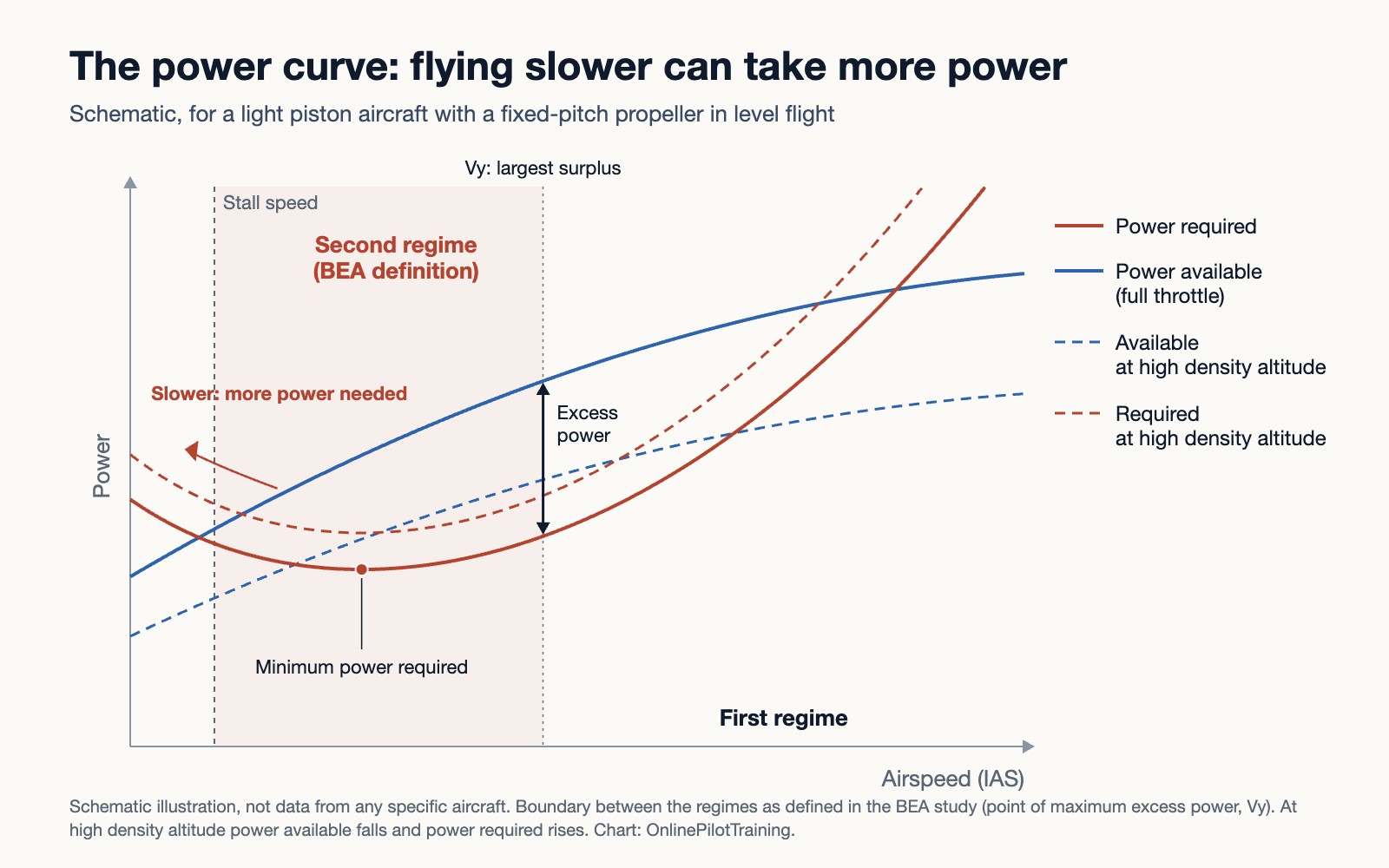
How much excess power you have changes from day to day. It shrinks with higher density altitude and higher mass1. The BEA gives rules of thumb: density altitude rises by about 120 ft for every degree above standard temperature, mountain pilots reckon a normally aspirated piston engine loses about 10 per cent of its power per 3,000 ft, and climb performance falls by 5 to 7 per cent per 1,000 ft1. At 3,000 ft and 34 degrees Celsius you fly with the performance of 6,000 ft, with a climb rate that the BEA puts at about half of what you would get at sea level at 15 degrees1.
Take-off, go-around and a slow final
At take-off you are briefly in the second regime: rotation speed lies there, the BEA notes1. Just after lift-off, ground effect still helps. Above roughly one wingspan of height it fades, and the high angle of attack then produces a lot of drag1. The pilot has to choose a pitch attitude that lets the engine accelerate the aircraft to climb speed1. According to the BEA you stay stuck in the second regime if you pitch up too far or too fast after rotation, if you rotate too early, or if excess power that day is simply too small because of high density altitude, high mass, a short or soft runway or an upslope1. In ten of the twelve take-off and go-around accidents, performance was lower than the pilot expected, and most involved aircraft with little engine power for their weight1.
An aircraft at or beyond its mass and balance limits is particularly exposed. A high mass raises the stall speed and calls for a higher angle of attack at the same airspeed, so the aircraft flies closer to the second regime. A centre of gravity near the aft limit reduces longitudinal stability, especially at low speed4.
The accident to the Robin DR400-160 F-GLKL on 30 July 2024 near Abbeville in northern France shows how this plays out5. A former airline pilot with around 19,000 hours, about 600 of them on light aircraft, took off on a pleasure flight with three passengers from a grass strip with 550 m usable, at 33 degrees Celsius. Density altitude was about 2,400 ft, and according to the flight manual about 650 m of take-off distance to 15 m height on grass was needed at that mass5. The pilot had used a temperature that was too low and arrived at 554 m, already more than the runway length5. He rotated at 100 km/h. The aircraft climbed to about ten metres, did not accelerate and sank5. It came down in a field beyond the road past the runway and burned out, but all four people on board got out5. The BEA concludes that the pilot, who knew the runway was tight, probably pitched up too far without realising it and so stayed in the second regime5.
A go-around works the same way. The change from a descending approach to a climb can take tens of seconds, depending on how quickly the aircraft is reconfigured: carburettor heat, flaps, propeller pitch and, where fitted, landing gear1. Pitch up too quickly or too far and you stay in the second regime1. The FAA Airplane Flying Handbook warns that pilots should resist the impulse to pitch up for a climb when airspeed is insufficient; it may be wise to lower the nose briefly to gain airspeed and get off the back side of the power curve6.
A slow final can also end up in the second regime. If you arrive low and slow and only raise the nose to get back on the glide path, you make it worse. Adding power only helps if there is excess power left, the FAA explains. If you are so slow that even full throttle gives no surplus, you first have to trade height for speed and only then add power, and close to the ground there may not be room for that2. The FAA names slow, unstable approaches and high-drag go-arounds, with flaps or gear still extended, as situations where this happens2.
In the mountains: the Jodel near Mont Blanc
Eight accidents, six of them fatal, happened in the mountains. In every case the aircraft was climbing in a valley towards a pass or ridge1. A light aircraft climbs at a gradient of 5 to 10 per cent. The BEA calculates that 500 ft per minute at 80 kt ground speed is roughly 6 per cent, while a mountain road is usually steeper than 12 per cent1. Without a natural horizon, a pilot then tends to raise the nose further and further without noticing1.
That is what happened on 28 February 2025 to a Jodel D140 from the Megève flying club in the Mont Blanc massif3. The pilot, a PPL holder since 1996 with about 400 hours, flew with a passenger up a glacier valley towards the Col du Midi pass at 3,540 m. The terrain ahead rose at about 20 per cent3. He kept raising the nose, airspeed fell and the climb rate faded. He thought the engine was losing power, but an inspection and bench tests found nothing wrong with it3. He abandoned the climb to make an emergency landing on the glacier, but airspeed kept falling3. At about 90 km/h, which the BEA says was close to the indicated airspeed and near the flaps-up stall speed of 92 km/h, the climb rate collapsed. The aircraft sank about 70 m in roughly ten seconds and hit the glacier3. Both occupants were injured, and fresh snow probably cushioned the impact3. The pilot said afterwards that he had not known enough about the second regime and that the instruction at the various flying clubs he had known did not cover it sufficiently3.
How to get out
The way out is to convert energy1. If you still have power in reserve, apply full power to accelerate to a speed in the first regime. If you have height in reserve, lower the nose and trade some of it for speed1. If the engine is already at full power and there is no excess left, lowering the nose is the only way back1. In a valley or just above the ground that takes you closer to the terrain3. Recognition is therefore what matters most. The BEA lists the symptoms: an unusually high pitch attitude compared with your normal references, being unable to climb or hold altitude despite climb attitude and climb power, soft controls with little effect, stronger secondary effects of the controls and the engine, and reduced stability1.
What this means for training
In training, the second regime is mostly covered during the slow flight lesson, and sometimes during stall exercises, according to the BEA1. Those exercises are mostly flown level, at a safe height and with less than full power. The accidents, however, happened in a climb at full power: after a discontinued approach, in the mountains, or after an early or steep rotation1. The BEA therefore suggests covering the typical scenarios from the study in training, developing teaching material that shows how climb rate changes with indicated airspeed, and, where it can be done safely, practical exercises after an assessment of the aircraft, the instructor and the conditions1. It also points to energy management training for private pilots, modelled on the ICAO guidance written for professional pilots after loss of control accidents1.
For anyone starting a PPL or LAPL, or already flying, the lessons are practical. Work out take-off performance with the actual temperature and mass and add a margin: a French private pilot manual quoted by the BEA calls a 30 per cent increase a reasonable value5. Know your pitch attitude after rotation and in a go-around, and check your airspeed as soon as the aircraft climbs less than you expect. Instructors can let students experience slow flight in a full-power climb too, at a safe height, after an assessment of the aircraft, the instructor and the conditions, so they feel how the climb rate disappears when the nose goes too high1.
Recently we covered a light aircraft crash near an aero club runway in Greece and a Piper Tomahawk crash in Scotland.
Timeline
Sources
- 1BEA · Safety study: Second flight regime15 Oct 2026
- 2FAA · Airplane Flying Handbook, Chapter 4: Energy Management24 Sep 2021
- 3BEA · Safety investigation report: accident to the Jodel D140 F-BMFV on 28 February 2025 on the Vallée Blanche glacier (BEA2025-0067)11 Mar 2026
- 4BEA · Safety topics: Second regime15 Oct 2026
- 5BEA · Safety investigation report: Robin DR400-160 F-GLKL, 30 July 2024, Buigny-Saint-Maclou (BEA2024-0305)13 Feb 2026
- 6FAA · Airplane Flying Handbook, Chapter 9: Approaches and Landings24 Sep 2021