German police say the pilot of a Corendon Boeing 737-800 from Corfu meant to signal a radio failure with 7600 but entered 7500, the hijack code, and with the radio dead nobody could hear it was a slip. How the two codes are handled, what the ADS-B data show and the habits that prevent it.


- Corendon flight XR456 from Corfu to Nuremberg transmitted the hijack code 7500 on 13 October and could not be reached by radio.57
- Police say the pilot meant to select 7600 for a radio failure and entered 7500 by mistake; he is not being investigated.12
- A Croatian fighter and two German Eurofighters escorted the Boeing 737-800; Nuremberg Airport closed until police found no danger.7111
- Open ADS-B data show 7500 for about 14 minutes shortly after departure; no 7600 appears in the data.12
When the radio dies, a crew has one quick way left to tell air traffic control: set 7600 on the transponder. On Tuesday 13 October, German police say, the pilot of a Corendon Boeing 737-800 from Corfu tried to do exactly that and entered 7500 instead, the code for unlawful interference12. Because the radio was not working, nobody on the ground could hear that it was a slip. Fighters were alerted along the route, Nuremberg Airport was closed and a police negotiating team was waiting when the aircraft landed safely with 178 passengers and six crew13. The case shows how differently the system treats two codes that are one digit apart, and why only one of them can be undone on the frequency.
One digit, opposite outcomes
ICAO reserves three codes worldwide: 7700 for an emergency, 7600 for radio communication failure and 7500 for unlawful interference17. Europe's rules of the air copy that list, with the nuance that a crew under unlawful interference "attempts" to select 750013. What happens next depends entirely on which of the two codes the controller sees.
A 7600 opens a conversation without voice. Under ICAO's procedures for pilots, a controller who sees it will test how far the failure goes by asking the crew to squawk ident or change code, and if the receiver on board still works, the flight can be handled with code changes and ident replies as acknowledgements18. In US radar systems the data block shows "RDOF" or "RF" and the controller turns to the communications failure checklist16. A 7500 is designed to do the opposite: the data block shows "HIJK" or "HJ" and hijack procedures start16. On controllers' screens the aircraft symbol changes colour and "HIJACK" appears next to its flight data, and air traffic control informs the police and security services, Der Spiegel explained after the Corendon flight7.
Why silence counts as confirmation
A hijacked crew has to be able to raise the alarm without the hijacker noticing, so the confirmation step is built around silence. When ATC asks a crew to confirm a 7500, ICAO says the pilot shall, according to circumstances, either confirm it or not reply at all, and if there is no reply ATC takes that as confirmation that 7500 is not an inadvertent false code selection18. EASA's guidance on the European rules uses the same words19. UK controllers do not even say "7500" on frequency; they ask the crew to confirm it is squawking the assigned code, "to verify that 7500 has been set intentionally"20. In the US, a crew that is not being hijacked is told to say so in the clear and then check the code in the transponder window; if the pilot replies in the affirmative or does not reply, the controller asks nothing more and notifies the authorities15. SKYbrary's guidance for controllers adds that they should not ask a crew about its intentions22.
Put a dead radio into that design and the outcome is predictable. A crew that cannot transmit cannot say "negative, finger trouble". To the ground it is indistinguishable from a crew confirming a hijack by keeping quiet. "Since we could then no longer reach the cockpit, or rather the tower could no longer reach the cockpit, we had to assume the worst," a police spokesperson told Der Spiegel7.
What happened on XR456
The aircraft was the 737-800 registered 9H-CXD, flying Corendon Airlines Europe flight XR456 from Corfu to Nuremberg10; Corendon confirmed the flight and registration in a written statement3. On Wednesday a police spokesperson told the German news agency dpa that the aircraft's radio was defective, so the crew could not be reached after leaving Corfu, and that according to the inquiry so far the pilot wanted to report the failure with 7600 and accidentally entered 7500124. Police spokesperson Michael Petzold said the pilot was probably not aware of the apparent error at first, but noticed it after military aircraft had escorted the flight for more than half the route1. He also said a code, once sent, cannot be withdrawn, and that the police are not investigating the pilot because they assume he did not act deliberately12. Corendon's statement blames "a brief disruption of the radio communication system", says there was never an actual emergency and does not mention a typing error3.
Military aircraft were already alongside in Croatian airspace, and Austrian Armed Forces interceptors were alerted1. Croatia's defence ministry said one of its fighters escorted the flight to the Slovenian border after a warning from NATO's air command at Torrejón, Spain, according to Der Spiegel7. Over Germany two Eurofighters of Tactical Air Wing 74 from Neuburg an der Donau took over16. A Luftwaffe spokesperson said they escorted the airliner to the landing and stayed overhead until a further take-off could be ruled out5.
Police sealed off Nuremberg Airport and its access roads before the landing8. A negotiating group trained for contact with hijackers and the Bavarian police special support unit were deployed1. Petzold said the services had less than an hour between the alert and the landing1. Contact with the cockpit was only made once the aircraft was parked8. Shortly after 13:00 local time the police gave the all-clear: "Checks at the scene established that there is no danger"115. Passengers waited on board for about an hour before buses took them to the terminal9, flights resumed shortly after 13:306, and several arrivals diverted to Frankfurt, Memmingen, Stuttgart and Munich10.
What the transponder actually broadcast
The open ADS-B network adsb.lol archives what the aircraft itself transmitted12. Flying as CXI2ZD, 9H-CXD switched to 7500 at 08:13 UTC, about six minutes after its first position report following take-off, at roughly 8,000 ft over the Ionian Sea north-west of Corfu and just before it resumed its climb. The ADS-B emergency status for unlawful interference was set at the same moment. At 08:27 UTC, at about 34,500 ft over the southern Adriatic off Apulia, the transponder was back on 3715, the code it had shown before, and from 08:38 UTC until touchdown at 10:16 UTC it showed 600312. No 7600 appears in the data that the open network recorded for this flight.
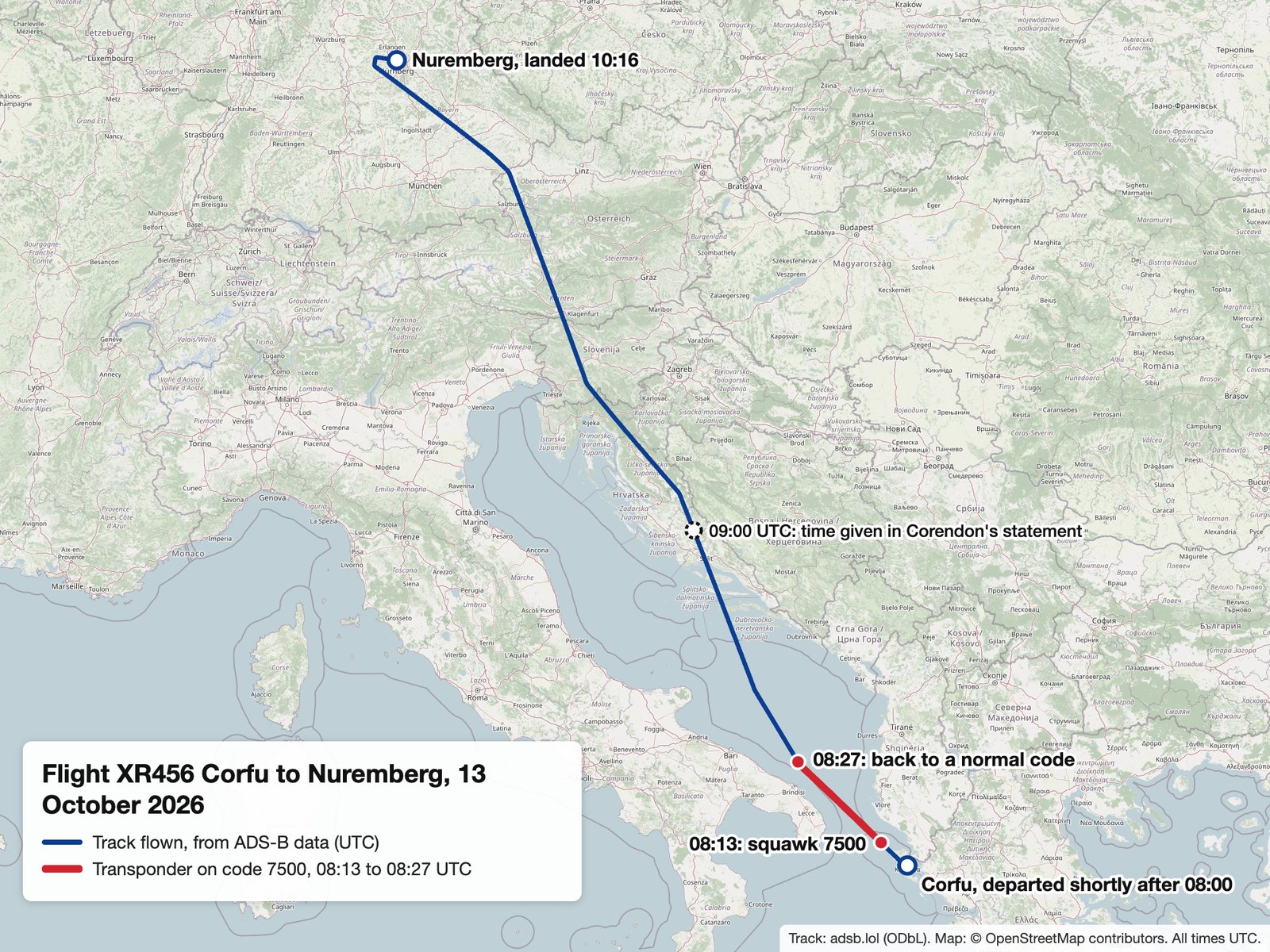
That sits awkwardly with the official timeline. Corendon says the aircraft reported an emergency code "at 9:00 (UTC) in Croatian airspace"3, and police put the code at about halfway, shortly after 11:00 German time, which is the same moment7. By then the transponder had not shown 7500 for more than half an hour. It may be the time the alert reached authorities further along the route, but nobody has said so, and nobody has explained how an early reset fits the police account that the pilot only realised his mistake once fighters were alongside.
Setting codes without slips
Regulators already treat one wrong digit as a known hazard. The FAA asks pilots making routine code changes not to pass through 7500, 7600 or 7700 on the way, because that causes false alarms on the ground; going from 2700 to 7200, switch first to 2200 and then to 720014. The UK AIP calls for caution with conspicuity codes in the 70xx series because they sit close to the special purpose codes, and requires pilots to read back any code they are told to set21. When ATC asks a crew to confirm a code, EASA's acceptable means of compliance say the pilot should check the setting on the transponder, reselect the assigned code if necessary and report what the control panel actually shows19.
Which panel was used on 9H-CXD, and in what sequence the digits went in, has not been published, so no conclusion about the equipment can be drawn. The habits that help are type-independent. Say the code aloud as you set it and let the other pilot check the window before you move on, especially when you are busy with the failure that made you reach for the transponder in the first place. Then fly the lost communication procedure and keep listening: if the receiver works, a controller may ask you to ident or change code to prove it. For anyone preparing for an airline assessment, being able to talk through both the 7600 and the 7500 logic calmly is a useful exercise.
Being intercepted brings its own duties. Under SERA the pilot-in-command must immediately follow the interceptor's instructions and visual signals, try to call the interceptor or intercept control on 121.5 MHz, and select 7700 unless ATC instructs otherwise19.
It has happened before
In January 2011 United flight 940 from Chicago to Frankfurt diverted to Toronto after, according to a Transport Canada report, the pilot spilled coffee on the radio equipment and inadvertently squawked 7500; Canada's defence department was notified23. In September 2016 police surrounded a Saudi Arabian Airlines aircraft at Manila after it squawked 7500; the airport's general manager later said a pilot had activated the code by mistake24. In January 2025 Air India flight AI2957 from Delhi to Mumbai showed 7500 for around three minutes; the captain told ATC it had been pressed inadvertently, but the aircraft was still moved to an isolation bay after landing, PTI reported25. And on 30 June this year a Bulgarian MiG-29 escorted an Airbus A320 squawking 7500 before Turkish F-16s took over; according to reports cited by The Sofia Globe, the pilot said the alert had been triggered in error26.
Frequently asked questions
Was the Corendon flight hijacked?
No. Police checks at Nuremberg found no danger, and the airline said there was never an actual emergency113.
Is the typing error confirmed?
It is the police's preliminary account, given to dpa on 14 October1. There is no technical report yet, and Corendon's statement speaks only of a radio problem3.
Can a crew cancel a 7500 by radio?
A crew can tell ATC in the clear that it is not being hijacked and reset the code15, but the authorities decide when the alert ends. Police said a code, once sent, cannot be withdrawn1.
Timeline
- 13 Oct 202608:06 UTC: first ADS-B position of XR456 after take-off from Corfu.12
- 13 Oct 202608:13 to 08:27 UTC: the transponder shows 7500 over the Ionian and southern Adriatic Seas.12
- 13 Oct 2026About 09:00 UTC: the time Corendon gives for the emergency code, in Croatian airspace.3
- 13 Oct 2026A Croatian fighter escorts the flight to the Slovenian border; Austrian interceptors are alerted; two Luftwaffe Eurofighters take over in German airspace.7
- 13 Oct 202610:16 UTC: landing at Nuremberg, which has been closed.12
- 13 Oct 2026Contact with the cockpit only once the aircraft is parked.8
- 13 Oct 2026Shortly after 11:00 UTC: police give the all-clear; flights resume shortly after 11:30 UTC.6
- 14 Oct 2026Police tell dpa the pilot meant to select 7600 and entered 7500 by mistake; no investigation of the pilot.1
Sources
- 1dpa-AFX via onvista · ROUNDUP: Hijack alert at the airport: Was it a typing error?14 Oct 2026
- 2aero.de (dpa) · Input error triggered major operation14 Oct 2026
- 3inFranken.de · Hostage alert at Nuremberg Airport: Airline now comments on the cause14 Oct 2026
- 420 Minuten · Hijack alert in Nuremberg: Pilot apparently entered the wrong transponder code14 Oct 2026
- 5RTL · Nuremberg Airport closed: Corendon Boeing sends hijack code13 Oct 2026
- 6Der Spiegel · Nuremberg Airport: Flight operations resumed after indication of possible emergency13 Oct 2026
- 7Der Spiegel · Albrecht Dürer Airport Nuremberg: This is why Eurofighters were sent to Nuremberg13 Oct 2026
- 8t-online · Hostage code: What really happened at Nuremberg Airport13 Oct 2026
- 9Euronews · False alarm at Nuremberg Airport: Faulty radio apparently triggered hijack code13 Oct 2026
- 10aeroTELEGRAPH · Eurofighters escort Corendon flight to Nuremberg13 Oct 2026
- 11Deutsche Welle · Nuremberg airport briefly closed after in-flight emergency13 Oct 2026
- 12adsb.lol · ADS-B history for 9H-CXD (hex 4d239a), 13 October 202613 Oct 2026
- 13EUR-Lex · Commission Implementing Regulation (EU) No 923/2012 (Standardised European Rules of the Air), consolidated text
- 14FAA · Aeronautical Information Manual, 4-1-20 Transponder and ADS-B Out Operation9 Jul 2026
- 15FAA · Aeronautical Information Manual, 6-3-4 Special Emergency (Air Piracy)9 Jul 2026
- 16FAA · Order JO 7110.65, Air Traffic Control, chapter 5 section 2 (Beacon/ADS-B systems)9 Jul 2026
- 17ICAO (copy hosted by FOCA Switzerland) · Doc 4444 PANS-ATM, 16th edition with amendments
- 18ICAO (copy hosted by CAA Latvia) · Doc 8168 PANS-OPS Volume III, Aircraft Operating Procedures (2018)
- 19EASA · Easy Access Rules for Standardised European Rules of the Air (SERA), August 20251 Aug 2025
- 20UK Civil Aviation Authority · CAP 413 Radiotelephony Manual, Edition 241 Jul 2026
- 21NATS (UK AIP) · ENR 1.6 ATS surveillance services and procedures1 Oct 2026
- 22SKYbrary · Unlawful Interference: Guidance for Controllers
- 23NBC News (AP) · Pilot's spilled coffee triggers hijacking alert5 Jan 2011
- 24Gulf News · False alarm: Saudi Arabian Airlines jet isolated at Manila airport20 Sep 2016
- 25Deccan Herald (PTI) · Air India flight inadvertently sends out hijack signal; authorities probe incident29 Jan 2025
- 26The Sofia Globe · Bulgarian Air Force fighter scrambles to escort civilian Airbus that reported unlawful interference onboard30 Jun 2026